Computer simulations show nightmare Atlantic current shutdown less likely this century
Advertisement
Read this article for free:
or
Already have an account? Log in here »
To continue reading, please subscribe:

Digital Subscription
One year of digital access for only $205*
- Enjoy unlimited reading on winnipegfreepress.com
- Read the E-Edition, our digital replica newspaper
- Access News Break, our award-winning app
- Play interactive puzzles
*First annual payment billed as $205.00 + GST for one year. This annual subscription will automatically renew at $233.00 + GST every 52 weeks (10% off the regular annual price of $259.35). Offer available to new and qualified returning subscribers only. Cancel any time.
To continue reading, please subscribe:
Add Free Press access to your Brandon Sun subscription for only an additional
$1 for the first 4 weeks*
- Enjoy unlimited reading on winnipegfreepress.com
- Read the E-Edition, our digital replica newspaper
- Access News Break, our award-winning app
- Play interactive puzzles
*Your next Brandon Sun subscription payment will increase by $1.00 and you will be charged $17.95 plus GST for four weeks. After four weeks, your payment will increase to $24.95 plus GST every four weeks.
Read unlimited articles for free today:
or
Already have an account? Log in here »
Hey there, time traveller!
This article was published 26/02/2025 (588 days ago), so information in it may no longer be current.
The nightmare scenario of Atlantic Ocean currents collapsing, with weather running amok and putting Europe in a deep freeze, looks unlikely this century, a new study concludes.
In recent years, studies have raised the alarm about the slowing and potential abrupt shutdown of the Atlantic end of the ocean conveyor belt system. It transports rising warm water north and sinking cool water south and is a key factor in global weather systems. A possible climate change -triggered shutdown of what’s called the Atlantic Meridional Overturning Circulation or AMOC could play havoc with global rain patterns, dramatically cool Europe while warming the rest of the world and goose sea levels on America’s East Coast, scientists predict.
It’s the scenario behind the 2004 fictionalized disaster movie “The Day After Tomorrow,” which portrays a world where climate change sparks massive storms, flooding and an ice age.
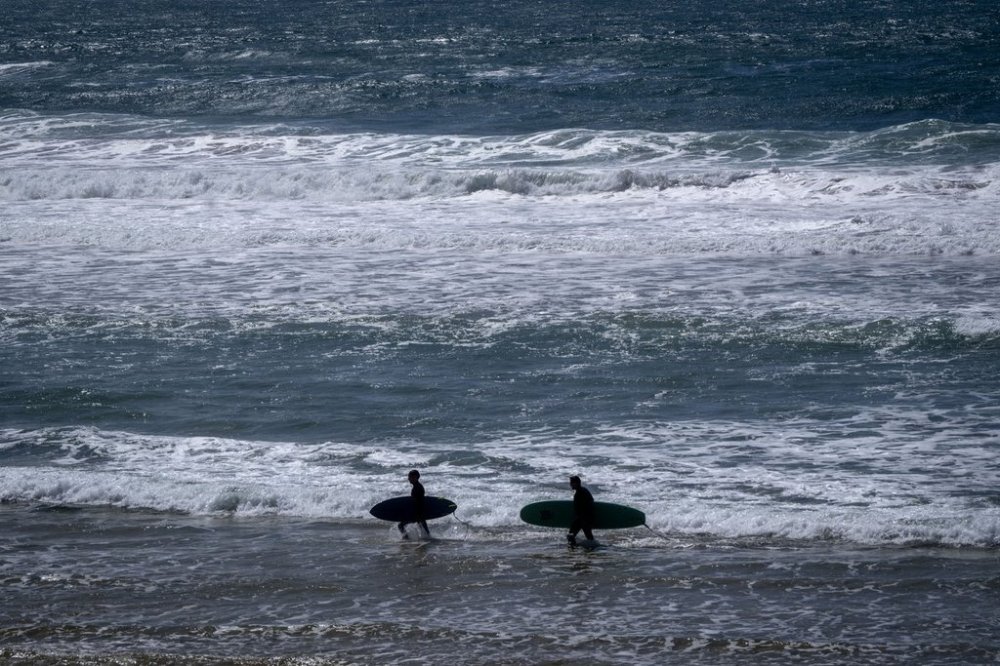
Scientists at the United Kingdom’s Met Office and the University of Exeter used simulations from 34 different computer models of extreme climate change scenarios to see if the AMOC would collapse this century, according to a study in Wednesday’s journal Nature. No simulation showed a total shutdown before 2100, said lead author Jonathan Baker, an oceanographer at the Met Office.
It could happen later, though, he said. The currents have collapsed in the distant past.
Still, the computer simulations should be “reassuring” to people, Baker said.
“But this is no greenlight for complacency,” Baker warned. “The AMOC is very likely to weaken this century and that brings its own major climate impacts.”
The Atlantic current flows because warm water cools as it reaches the Arctic, forming sea ice. That leaves salt behind, causing the remaining water to become more dense, sinking and pulled southward. But as climate change warms the world and more fresh water flows into the Arctic from the melting Greenland ice sheet, the Arctic engine behind the ocean conveyor belt slows down. Previous studies predict it stopping altogether with one of them saying it could happen within a few decades.
But Baker said the computer models and basic physics predict that a second motor kicks in along the Southern Ocean that surrounds Antarctica. The winds there pull the water back up to the surface, called upwelling, where it warms, Baker said. It’s not as strong, but it will likely keep the current system alive, but weakened, through the year 2100, he said.
Baker’s focus on the pulling up of water from the deep instead of just concentrating on the sinking is new and makes sense, providing a counterpoint to the studies saying collapse is imminent, said Oregon State University climate scientist Andreas Schmittner, who wasn’t part of the research.
Those Southern Ocean winds pulling the deep water up act “like a powerful pump keeps the AMOC running even in the extreme climate change scenarios,” Baker said.
As the AMOC weakens, a weak Pacific version of it will likely develop to compensate a bit, the computer models predicted.
If the AMOC weakens but not fully collapses, many of the same impacts — including crop losses and changes in fish stock — likely will still happen, but not the big headline one of Europe going into a deep freeze, Baker said.
Scientists measure the AMOC strength in a unit called Sverdrups. The AMOC is now around 17 Sverdrups, down two from about 2004 with a trend of about 0.8 decline per decade, scientists said.
One of the debates in the scientific world is the definition of an AMOC shutdown. Baker uses zero, but other scientists who have been warning about the shutdown implications, use about 5 Sverdrups. Three of Baker’s 34 computer models went below 5 Sverdrups, but not to zero.
That’s why Levke Caesar and Stefan Rahmstorf, physicists at the Potsdam Institute for Climate Research and authors of an alarming 2018 study about potential shutdown, said this new work doesn’t contradict theirs. It’s more a matter of definitions.
“An AMOC collapse does not have to mean 0 (Sverdrups) overturning and even if you would want to follow that definition one has to say that such a strong AMOC weakening comes with a lot (of) impacts,” Caesar wrote in an email. “The models show a severe AMOC weakening that would come with severe consequences.” ___

Follow Seth Borenstein on X at @borenbears
___
Read more of AP’s climate coverage at http://www.apnews.com/climate-and-environment
___
The Associated Press’ climate and environmental coverage receives financial support from multiple private foundations. AP is solely responsible for all content. Find AP’s standards for working with philanthropies, a list of supporters and funded coverage areas at AP.org.
Related Articles
50-year forecast: Shorter, drier, warmer Prairie winters will result in fewer outdoor recreational opportunities
Advertisement Advertise With Us
Advertisement Advertise With Us