

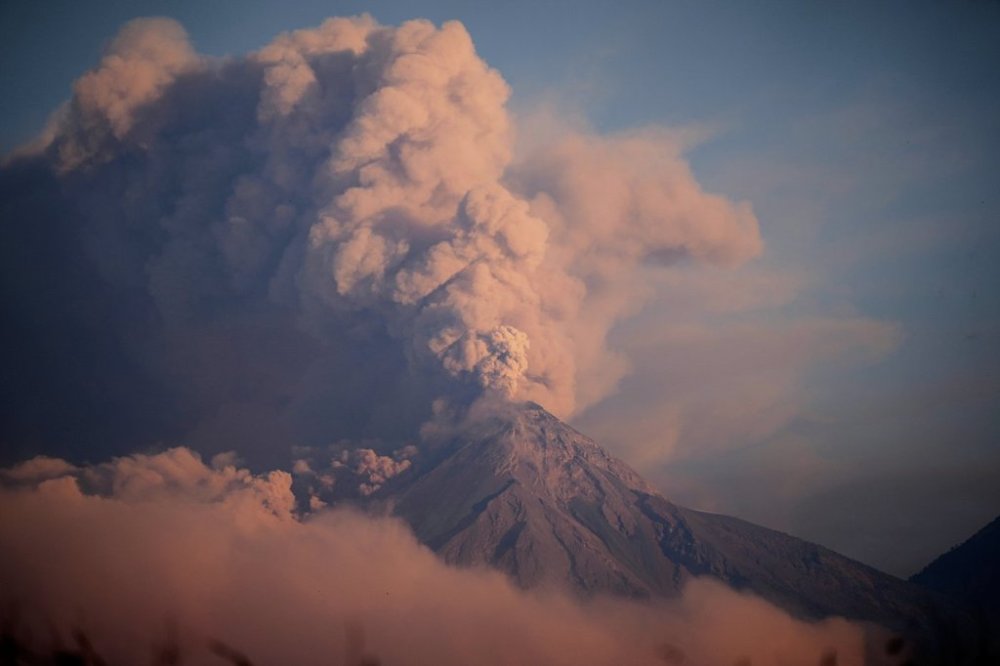
Guatemala’s Volcano of Fire erupts and forces evacuations
Advertisement
Read this article for free:
or
Already have an account? Log in here »
To continue reading, please subscribe:
Monthly Digital Subscription
$1 per week for 24 weeks*
- Enjoy unlimited reading on winnipegfreepress.com
- Read the E-Edition, our digital replica newspaper
- Access News Break, our award-winning app
- Play interactive puzzles
*Billed as $4.00 plus GST every four weeks. After 24 weeks, price increases to the regular rate of $19.95 plus GST every four weeks. Offer available to new and qualified returning subscribers only. Cancel any time.
Monthly Digital Subscription
$4.99/week*
- Enjoy unlimited reading on winnipegfreepress.com
- Read the E-Edition, our digital replica newspaper
- Access News Break, our award-winning app
- Play interactive puzzles
*Billed as $19.95 plus GST every four weeks. Cancel any time.
To continue reading, please subscribe:
Add Free Press access to your Brandon Sun subscription for only an additional
$1 for the first 4 weeks*
*Your next subscription payment will increase by $1.00 and you will be charged $16.99 plus GST for four weeks. After four weeks, your payment will increase to $23.99 plus GST every four weeks.
Read unlimited articles for free today:
or
Already have an account? Log in here »
Hey there, time traveller!
This article was published 10/03/2025 (383 days ago), so information in it may no longer be current.
SAN JUAN ALOTENANGO, Guatemala (AP) — Guatemala’s Volcano of Fire is erupting, and authorities have evacuated nearly 300 families while warning that another 30,000 people in the area could be at risk.
The eruption started overnight. There is no immediate report of casualties. The 12,300-foot (3,763-meter) high volcano is one of the most active in Central America. It last erupted in June 2023.
The volcano spewed gas and ash far into the sky Monday, leading authorities to close schools in the vicinity and a key road connecting communities.
Claudinne Ugalde, secretary of the disaster agency, said “some 30,000 people more or less are at risk in these three (jurisdictions) and we are trying to have them evacuate or self-evacuate,” she said.
The biggest danger from the volcano are lahars, a mixture of ash, rock, mud and debris, that can bury entire towns.
A 2018 eruption killed 194 people and left another 234 missing.
Isaac García, 43, a resident of El Porvenir on the slopes of the volcano, had that tragedy in mind when he and his family decided to heed authorities’ warnings to evacuate early Monday.
“We were a little worried because a few years ago the volcano became active,” García said, referencing the 2018 eruption, as he spoke with a mask to protect against the falling ash. He came to a shelter opened in San Juan Alotenango with his mother, wife and their three children, as well as other relatives.
The volcano is 33 miles (53 km) from Guatemala’s capital.
The flow of volcanic material is weak to moderate but expected to increase, Guatemala’s disaster agency said early Monday.
____
Follow AP’s coverage of Latin America and the Caribbean at https://apnews.com/hub/latin-america