Crocodile attacks in Indonesia are on the rise. It’s left residents on edge
Advertisement
Read this article for free:
or
Already have an account? Log in here »
To continue reading, please subscribe:
Digital Subscription
One year of digital access for only $1.44 a week*
- Enjoy unlimited reading on winnipegfreepress.com
- Read the E-Edition, our digital replica newspaper
- Access News Break, our award-winning app
- Play interactive puzzles
*Billed as $5.77 plus GST every four weeks. After 52 weeks, price increases to the regular rate of $19.95 plus GST every four weeks. Offer available to new and qualified returning subscribers only. Cancel any time.
To continue reading, please subscribe:
Add Free Press access to your Brandon Sun subscription for only an additional
$1 for the first 4 weeks*
- Enjoy unlimited reading on winnipegfreepress.com
- Read the E-Edition, our digital replica newspaper
- Access News Break, our award-winning app
- Play interactive puzzles
*Your next Brandon Sun subscription payment will increase by $1.00 and you will be charged $17.95 plus GST for four weeks. After four weeks, your payment will increase to $24.95 plus GST every four weeks.
Read unlimited articles for free today:
or
Already have an account? Log in here »
Hey there, time traveller!
This article was published 16/03/2025 (584 days ago), so information in it may no longer be current.
BUDONG-BUDONG, Indonesia (AP) — Nearly seven months after a crocodile attack almost took her life, Munirpa walked to the estuary outside her home with her husband and her children, ready to brave a reenactment.
Munirpa, who like many Indonesians only uses one name, recounted how one early morning in August, she threw her household garbage into a creek about 50 meters (164 feet) away from her house, as she normally would.
She didn’t see what was coming next.
By the time she realized a crocodile had attacked her, the four-meter-long (13-foot) beast had already sunk its teeth into most of her body, sparing only her head. She fought hard, trying to jab its eyes. Her husband, hearing her screams, ran over and tried to pull her by the thigh out of the crocodile’s jaws. A tug-of-war ensued; the reptile whipped him with its tail. Fortunately, he saved Munirpa in time, eventually dragging her out of the crocodile’s grip.
People have long feared the ancient predators in the Central Mamuju district of Indonesia’s West Sulawesi, where the Budong-Budong River meets the sea. For Munirpa, 48, that fear turned into a brutal reality when she became one of nearly 180 recorded crocodile attack victims in Indonesia last year. Residents like her are learning to coexist with the crocodiles, a legally protected species in Indonesia, as they balance conservation with looking out for their safety. But as attacks rise, several residents and experts have called for better government interventions to stop the problem from getting even worse.
Communities near the crocodiles are on edge
Following the attack, Munirpa was hospitalized for a month and has had two surgeries. By February this year, her fear was still clearly visible, as were the scars on her legs and thighs.
“I am so scared. I don’t want to go to the beach. Even to the back of the house, I don’t dare to go,” said Munirpa. “I am traumatized. I asked my children not to go to the river, or to the backyard, or go fishing.”
In the villages surrounding the Budong-Budong River, like Munirpa’s, crocodiles have become a daily topic of conversation. Their presence has become so common that warning signs now mark the areas where they lurk, from the river mouth to the waterways which were once a popular swimming spot for children.
In 2024, there were 179 crocodile attacks in Indonesia, the highest number of crocodile attacks in the world, with 92 fatalities, according to CrocAttack, an independent database. Social media videos showing crocodile appearances and attacks in Sulawesi and other regions in Indonesia are also on the rise.
The increase in attacks began about 12 years ago with the rise of palm oil plantations around the river mouth, said 39-year-old crocodile handler Rusli Paraili. Some companies carved artificial waterways, linking them to the larger part of the Budong-Budong River. That was when the crocodiles started straying, leaving the river and creeping to nearby residential areas, such as fish and shrimp ponds, he explained.
Palm oil plantations now dominate the landscape in West Sulawesi, from the mountains to the coast, and patrolling for crocodiles has become part of people’s daily routine. When residents check the water pumps in their ponds, they have no choice but to keep out an eye for the beasts — flashlights in hand, scouring up, down and across canals and waterways — resigned to the uneasy reality of sharing their home with a predator.
Balancing conservation and safety
The saltwater crocodile has been a legally protected species in Indonesia since 1999, making it an animal that cannot be hunted freely. As a top predator, there is also no population control in nature.
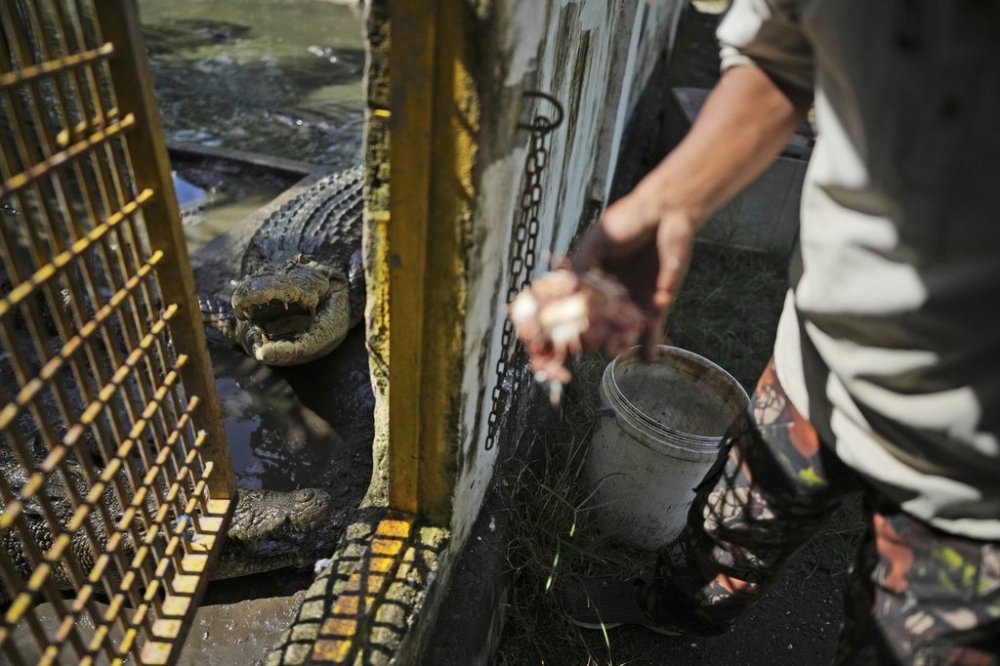
Paraili, the crocodile handler, said that while the law protects crocodiles from being killed, the rise in attacks is a major concern. In response, he’s taken care of some of the crocs in a specially-designed farm away from human populations. He’s received some financial support from the government and community donations, as well as support from palm oil companies for the last five years.
The farm has four ponds and around 50 reptiles. Some have names: Tanker, the largest, shaped like a ship, or Karossa, named after the sub-district the animal was caught after fatally attacking someone.
When funds run low, he uses his own money to ensure they’re fed, at least once every four days.
Amir Hamidy, who studies reptiles at the National Research and Innovation Agency, worries the rise in attacks indicates that crocodile numbers are becoming far too dangerous. Hamidy supports better population control.
Being a protected species “does not necessarily mean that the population cannot be reduced when it is at a level that is indeed unsafe,” he said.
Improving protection for residents
Around a year ago in Tumbu village, Suardi, who goes by one name, was harvesting coconuts when they fell into the river. When he went to retrieve them, he was attacked by a crocodile he initially didn’t notice. He’s since made a full recovery.
Still, the experience has made him more cautious. “Yes, I am worried. But what else can we do,” Suardi said. “The important thing is that we are careful enough.”
Along with Munirpa, Suardi is one of 10 people in the region who was attacked by a crocodile last year. Three of those attacked were killed.
Suyuti Marzuki, who’s head of West Sulawesi Marine and Fisheries Agency, said the crocodile habitat shift is making people’s everyday activities — like harvesting coconuts, fishing or even disposing of garbage like Munirpa — very risky.
Marzuki said the government is looking at possible options that can provide both safety and economic alternatives for residents.
While he acknowledged that crocodile population numbers and ecosystems need to be protected, Marzuki also raised the possibility of bolstering the local economy through the crocodile skin trade. That industry is controversial because of conservation and animal welfare issues.
Paraili, the crocodile handler, also urged serious government interventions.
“This is a matter of human lives. So when the government is not serious, then our brothers and sisters in the future — in 5 or 15 years — there will be even more who will die from being attacked by crocodiles,” he said.
Residents like Munirpa and Suardi are waiting for more immediate and realistic steps from the authorities to ensure their community’s and families’ safety.
“It is enough that I’ve been bitten by a crocodile,” Munirpa said. “I won’t let it happen to my children.”
___
The Associated Press’ climate and environmental coverage receives financial support from multiple private foundations. AP is solely responsible for all content. Find AP’s standards for working with philanthropies, a list of supporters and funded coverage areas at AP.org