Drought, wind, and debris from recent hurricanes are stoking fires across the US
Advertisement
Read this article for free:
or
Already have an account? Log in here »
To continue reading, please subscribe:

Digital Subscription
One year of digital access for only $205*
- Enjoy unlimited reading on winnipegfreepress.com
- Read the E-Edition, our digital replica newspaper
- Access News Break, our award-winning app
- Play interactive puzzles
*First annual payment billed as $205.00 + GST for one year. This annual subscription will automatically renew at $233.00 + GST every 52 weeks (10% off the regular annual price of $259.35). Offer available to new and qualified returning subscribers only. Cancel any time.
To continue reading, please subscribe:
Add Free Press access to your Brandon Sun subscription for only an additional
$1 for the first 4 weeks*
- Enjoy unlimited reading on winnipegfreepress.com
- Read the E-Edition, our digital replica newspaper
- Access News Break, our award-winning app
- Play interactive puzzles
*Your next Brandon Sun subscription payment will increase by $1.00 and you will be charged $17.95 plus GST for four weeks. After four weeks, your payment will increase to $24.95 plus GST every four weeks.
Read unlimited articles for free today:
or
Already have an account? Log in here »
Hey there, time traveller!
This article was published 28/03/2025 (566 days ago), so information in it may no longer be current.
In North Carolina, wildfires stoked by unusually dry air and debris from last year’s Hurricane Helene are burning out of control. In Florida, there are dozens of blazes, including one that scorched about 42 square miles in Miami-Dade County. And they continue to burn in Oklahoma, where four people have died this month due to wind-driven fires. Those states were just three of eight where large fires were being reported on Friday.
Some 14,800 wildfires have burned 1,105 square miles so far this year — well above the 10-year average, according to data released Friday by the National Interagency Fire Center. Most devastating were the Los Angeles wildfires in January, fueled by dry vegetation and howling winds, that destroyed entire neighborhoods.
Wildfires have happened with such frequency in recent years that many U.S. fire officials say there is no longer a “fire season,” which traditionally ran from late spring through the fall. That is because climate change, caused by the burning of fuels like gasoline and coal, has raised average global temperatures, creating drier conditions that allow wildfires, which are mostly mostly caused by humans, to burn longer and more intensely.
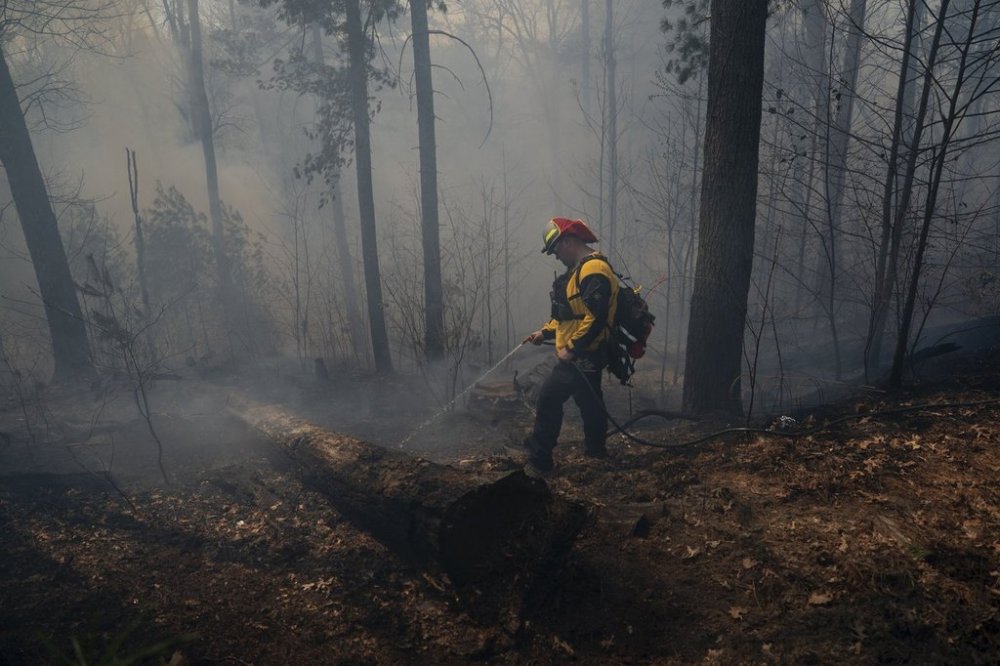
While major fires often happen early in the year — in February 2024, Texas experienced the largest wildfire in state history — this year is a bit unusual “because we’re seeing it happen in so many places,” said Brad Rippey, a U.S. Department of Agriculture meteorologist who monitors drought.
This week, 45% of the country is in drought, when historically it’s around 20% at any given time, Rippey said. That dried out lots of fuel just waiting for a spark — from freeze-dried grasses in the southern Plains to downed trees and brush from hurricanes that ravaged parts of the southeast and southern Appalachians in recent years.
The National Interagency Fire Center’s significant wildfire outlook notes that several states still have debris from hurricanes Laura, Ida, Debby and Idalia in the past five years, as well as from ice storms and other severe weather.
Add in gusty winds and low humidity, “and you’ve got a pretty ripe situation for wildfires,” Rippey said.
In Hurricane Helene-devastated North Carolina, power lines downed by strong winds have been blamed for two of three large fires that have burned for more than a week in an area where the mean relative humidity this month has been the lowest on record, officials said. Impassable areas and lots of toppled trees are making it difficult to reach intense and erratic fires that are spreading rapidly because of high winds and dry weather.
Many roads have either been covered with storm debris or “they have just been completely washed away,” said North Carolina Forest Service spokesman Philip Jackson, who said the fire danger could plague the state for years as more debris dries out.
Much of Florida also is in drought, contributing to an earlier-than-normal fire season that included a massive brush fire in Miami-Dade County that at one point hindered travel to and from the Florida Keys.
That fire is 95% contained while dozens of smaller fires continue to burn, according to the Florida Forest Service. Many counties are under red flag warnings, meaning conditions are favorable for fires to occur.
West Virginia, Tennessee, Georgia, Missouri and South Carolina also report large wildfires.
The greatest wildfire potential is in the southeast and the southern Plains, and will be significant into April in most of Texas and parts of New Mexico and Arizona, as well as several southeastern states, according to the National Interagency Fire Center.

La Nina — a periodic cooling of the Pacific Ocean that can shift the jet stream and lead to cooler, drier air — might have affected conditions in the southern U.S., said Tim Brown, director of the Western Regional Climate Center.
But there also has been long-term drying in the southwest as temperatures overall increase with global warming, said Rippey, who has monitored drought for more than 25 years. Warmer temperatures have led to more erratic precipitation that tends to fall more heavily in short periods, leading much of it to run off rather than soak into the ground.
“I do think that contributes to more wildfires,” he said.
___
The Associated Press’ climate and environmental coverage receives financial support from multiple private foundations. AP is solely responsible for all content. Find AP’s standards for working with philanthropies, a list of supporters and funded coverage areas at AP.org.