Trump’s transportation officials buck a long-held practice of using ‘road diets’ to slow speeders
Advertisement
Read this article for free:
or
Already have an account? Log in here »
To continue reading, please subscribe:

Digital Subscription
One year of digital access for only $205*
- Enjoy unlimited reading on winnipegfreepress.com
- Read the E-Edition, our digital replica newspaper
- Access News Break, our award-winning app
- Play interactive puzzles
*First annual payment billed as $205.00 + GST for one year. This annual subscription will automatically renew at $233.00 + GST every 52 weeks (10% off the regular annual price of $259.35). Offer available to new and qualified returning subscribers only. Cancel any time.
To continue reading, please subscribe:
Add Free Press access to your Brandon Sun subscription for only an additional
$1 for the first 4 weeks*
- Enjoy unlimited reading on winnipegfreepress.com
- Read the E-Edition, our digital replica newspaper
- Access News Break, our award-winning app
- Play interactive puzzles
*Your next Brandon Sun subscription payment will increase by $1.00 and you will be charged $17.95 plus GST for four weeks. After four weeks, your payment will increase to $24.95 plus GST every four weeks.
Read unlimited articles for free today:
or
Already have an account? Log in here »
Hey there, time traveller!
This article was published 20/04/2025 (543 days ago), so information in it may no longer be current.
A stylist was just starting her shift at a salon in Kansas City, Missouri, when a car smashed through the storefront window and landed in the waiting area a few feet away.
Such crashes were so common along 31st Street that business owners regularly texted one another photos showing the damage caused by vehicles speeding along the four-lane road lined with shops, bars and restaurants, which drivers used as a shortcut between major highways.
“A wide road makes people think, ‘We’ll just drive as fast as we want on it,'” said Ryan Ferrell, who owns the property housing the salon, a bookstore and apartments above.
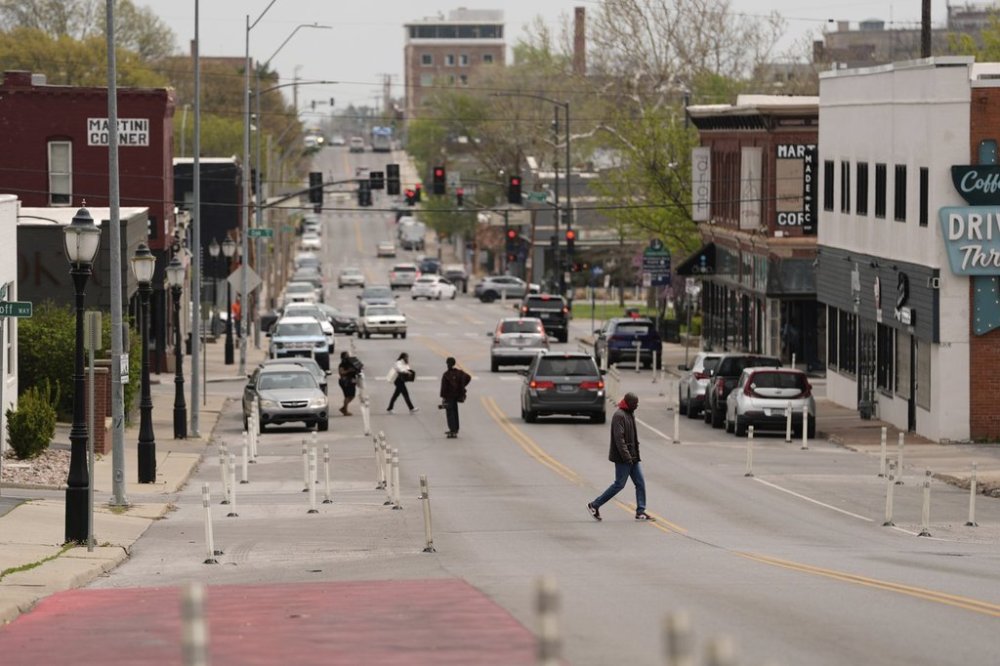
When concrete sidewalk barriers didn’t work, Ferrell and other business leaders campaigned to put the street on a “road diet.”
Removing lanes has been a tool numerous cities have used for years to calm traffic, despite resistance from some Republican governors. President Donald Trump’s administration doesn’t like it either.
Federal transportation officials once heralded road diets for cutting crashes by 19% to 47%, but criteria for an upcoming round of road safety grants say projects aimed at “reducing lane capacity” should be considered “less favorably,” the administration said.
Forcing travelers into more constrained spaces “can lead to crashes, erratic maneuvers, and a false sense of security that puts everyone at risk,” the U.S. Department of Transportation said in an email statement to The Associated Press. “The update reflects the Department’s concerns about the safety hazards associated with congestion.”
Add a gas line, subtract some traffic lanes
Kansas City saved some money when it converted 31st Street in 2022 because a gas line was going in anyway. It reopened with one lane in each direction instead of two, a shared turn lane near the signalized intersections, better pedestrian crossings and protected on-street parking spaces.
Road diets are now an almost automatic part of the process in Kansas City whenever a street is up for repaving. For years, federal guidelines said lane reductions were usually appropriate on roads carrying fewer than 25,000 vehicles a day. Most of the city’s four-lane roads don’t meet that threshold.
Bobby Evans, an urban planner at the Mid-America Regional Council who has worked on Kansas City’s road diets, calls the strategy “a smashing success” and one of the most effective tools at reducing speed, crashes and injuries.
“In the architectural world you’d call it environmental determinism,” Evans said. “You want to make it so they don’t feel comfortable going too fast. You’re really not slowing them down. You’re bringing them back to the speed limit.”
Rethinking the need for speed
Numerous other cities have credited road diets with improving safety.
Philadelphia cited a 19% drop in injury crashes. Portland, Oregon, saw a more than 70% decline in vehicles traveling at least 10 mph (16 kph) over the speed limit. The average speed in Fort Lauderdale, Florida, fell by 5 mph (8 kph) on some roads within months.
But Jay Beeber, executive director for policy at the National Motorists Association, an advocacy organization for drivers, said most road diets represent an ill-advised effort to force vehicles off the road. The number of vehicles may decline on dieted roads, but then surrounding roads have to absorb the traffic, he said.
“Those cars have to go somewhere,” he said. “Cars are like water. They seek their own level.”
Leah Shahum, who directs the Vision Zero Network, a nonprofit advocating for street safety, said road diets are inexpensive and supported by years of research. Cities in Republican-led states are among the converts and Shahum isn’t sure if the Trump administration’s new guidance will make them reconsider.
“I certainly hope that does not bleed over into indirectly discouraging communities from using this proven safety countermeasure,” Shahum said. “That would be a real loss.”
No negative impact on emergency vehicles
Trump’s transportation department cited delivery and emergency vehicles among its concerns.
When University of Iowa researchers surveyed first-responders in Cedar Rapids, their study published last year found no noticeable difference in response time when a road diet was in place. There was, however, a perceived need to educate drivers about what to do when an ambulance uses a center turn lane to pass.
Cara Hamann, an associate professor of epidemiology who co-authored the study, said she recalled no major examples of EMS or fire trucks being unable to get through.
“The road diet didn’t cause a level of congestion that slowed them down,” she said.
Road diet resistance before Trump
Even before Trump, skepticism was growing in some red states.
San Antonio spent years planning to repurpose a formerly state-owned portion of its Broadway Street by removing vehicle lanes and improving a stretch for bikes and pedestrians. But Texas abruptly reclaimed the road in 2022 and nixed the project as GOP Gov. Greg Abbott ran for reelection and called for an end to anti-car policies.
“They basically used Broadway as a political football,” said Bryan Martin, owner of Bronko Bikes, an electric bike repair shop.
Florida’s Republican Gov. Ron DeSantis signed a bill last year calling for a 180-day review period and several other steps before a local government can eliminate a lane. He said it would prevent activists from intentionally clogging roads to slow vehicles.

Not all the pushback has come from Republican-led states. During the pandemic, Culver City, California, implemented a road diet to prioritize walking, biking and transit. But when cars returned and traffic backed up for miles, the city reversed the plan.
Some residents sued in Vancouver, Washington, saying the city should have put its road diets up for a public vote.
“I’ve seen people passing in the shoulder or the bike lane,” said Justin Wood, one of the opponents. “It creates more opportunity for conflict.”
Evans, the planner in Kansas City, said road diets can’t stop all reckless drivers.
“If you are bound and determined to go 12 miles over the speed limit on a three-lane road, you’re going to have to engage in some stupid, dangerous driving,” Evans said.