Cuban families devise ingenious solutions to endure frequent power shortages
Advertisement
Read this article for free:
or
Already have an account? Log in here »
To continue reading, please subscribe:

Digital Subscription
One year of digital access for only $205*
- Enjoy unlimited reading on winnipegfreepress.com
- Read the E-Edition, our digital replica newspaper
- Access News Break, our award-winning app
- Play interactive puzzles
*First annual payment billed as $205.00 + GST for one year. This annual subscription will automatically renew at $233.00 + GST every 52 weeks (10% off the regular annual price of $259.35). Offer available to new and qualified returning subscribers only. Cancel any time.
To continue reading, please subscribe:
Add Free Press access to your Brandon Sun subscription for only an additional
$1 for the first 4 weeks*
- Enjoy unlimited reading on winnipegfreepress.com
- Read the E-Edition, our digital replica newspaper
- Access News Break, our award-winning app
- Play interactive puzzles
*Your next Brandon Sun subscription payment will increase by $1.00 and you will be charged $17.95 plus GST for four weeks. After four weeks, your payment will increase to $24.95 plus GST every four weeks.
Read unlimited articles for free today:
or
Already have an account? Log in here »
Hey there, time traveller!
This article was published 04/06/2025 (478 days ago), so information in it may no longer be current.
HAVANA (AP) — For Marylín Álvarez and her family, like countless other Cubans, the question is no longer if the power will go out, but when — forcing them to implement ingenious alternatives to sustain daily life as the island undergoes its most severe energy crisis in decades.
Since December, when the government stopped supplying their cooking gas, the family had relied on an electric burner — until persistent blackouts made that solution impractical.
“The blackouts are quite severe and, with gas in short supply, I have to be running around to get food on time,” said Álvarez, a 50-year-old cosmetologist living with her husband and two teenage daughters in the populous Bahía neighborhood in Havana.
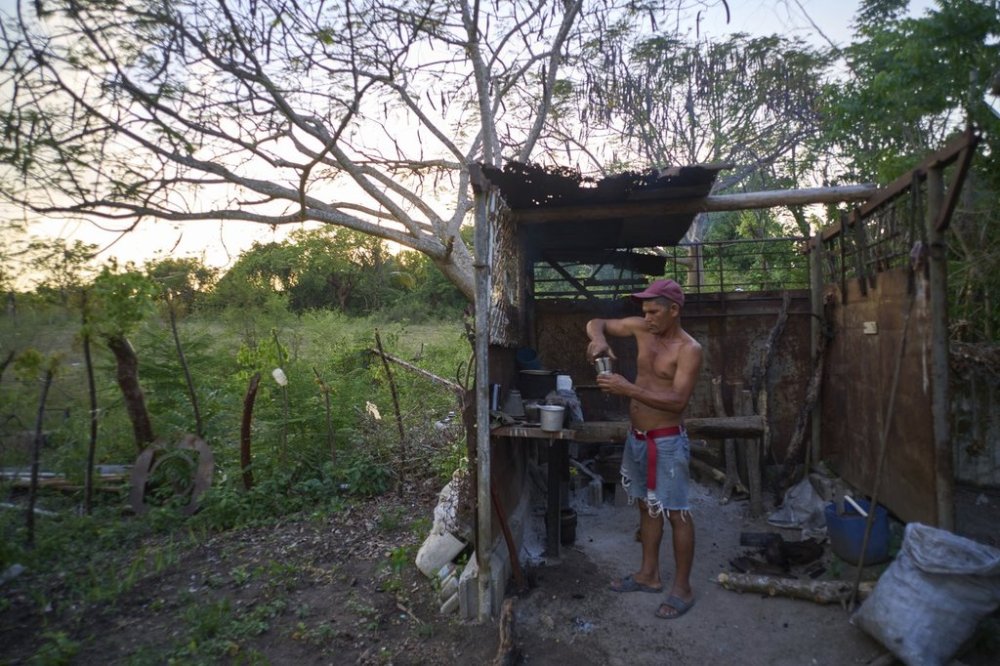
But what happens when even the electricity is gone — a reality for several days a month and often for hours each day? That’s when the family’s ingenuity truly kicks in: with no gas and no power, they turn to their charcoal stove.
Leisure time also requires creative solutions. Álvarez’s husband, Ángel Rodríguez, an auto mechanic, found a way for the family to catch up on their beloved telenovelas even during blackouts. He ingeniously assembled a television using an old laptop screen and an electric motorcycle battery.
“It doesn’t last very long,” Rodríguez said, “but it’s good enough for my family to watch TV or have some entertainment.”
Electricity cuts, a problem for months, have intensified in recent weeks due to persistent fuel shortages at power plants and aging infrastructure. With summer’s rising demand approaching and no apparent solution in sight, families face a grim outlook.
“We do our best,” Álvarez said.
Cuban President Miguel Díaz-Canel recently acknowledged that power outages are among one of his government’s biggest challenges.
In the last eight months alone, Cuba has experienced four total blackouts, plunging the entire island into darkness.
Highlighting the nation’s severe energy deficit, Díaz-Canel said last week that while electricity demand soared from 2,580 megawatts in March to 3,050 in May, availability barely increased, rising only from 1,790 megawatts in March to around 1,900 these days.
The government has said that a plan to address the problem includes the installation of solar parks and repair its generators with the support from China and Russia. But little progress has been made so far.
In the meantime, Cubans must continue to find ways to navigate the crisis.
In the outskirts of Havana, 45-year-old blacksmith Edinector Vázquez is busier than ever, serving a growing clientele of less affluent families.
Vázquez makes charcoal stoves from metal scraps that he sells for around $18 — the equivalent of a Cuban state worker’s monthly salary — but he says he offers discounts to low-income families.
Natividad Hernández, with slightly more resources than the Bahía neighborhood family, invested in solar panels, but her budget didn’t allow for installing batteries and other components, limiting their use to daytime hours and when there’s some grid electricity.
As blackouts increase, Cuba’s online shopping pages are inundated with ads for rechargeable fans, lamps with chargers and charging stations — mostly imports from the United States and Panama — making them unaffordable for many.
“Lack of oil, gas, and increased electricity consumption for cooking, combined with high summer temperatures and possible hurricanes — not even a good Mexican soap opera can paint a more dramatic picture,” said Jorge Piñón, a researcher at the University of Texas at Austin’s Energy Institute.
According to Piñón, solving Cuba’s energy crisis would require “three to five years” and up to $8 billion.

Faced with this grim prospect, Cubans are not optimistic.
“This is difficult,” said Rodríguez as he set up his rustic television and a soap opera’s first images flickered to life before his family’s eyes.
“The time will come when we will run out of ideas.”
____
Follow AP’s coverage of Latin America and the Caribbean at https://apnews.com/hub/latin-america
Advertisement Advertise With Us
Advertisement Advertise With Us