Shifting global picture disrupted Canada’s national security strategy update: memo

Advertisement

Advertise with us

OTTAWA - The Liberal government's efforts to revise Canada's national security strategy hit a snag when it became clear earlier this year that many of the assumptions underlying the work were "no longer valid," a newly released memo reveals.

Read this article for free:


or

Already have an account? Log in here »

To continue reading, please subscribe:

Subscribe and receive a limited-edition Free Press branded hat or tote.

Digital Subscription

One year of digital access for only $205*

  • Enjoy unlimited reading on winnipegfreepress.com
  • Read the E-Edition, our digital replica newspaper
  • Access News Break, our award-winning app
  • Play interactive puzzles

*First annual payment billed as $205.00 + GST for one year. This annual subscription will automatically renew at $233.00 + GST every 52 weeks (10% off the regular annual price of $259.35). Offer available to new and qualified returning subscribers only. Cancel any time.

To continue reading, please subscribe:

Add Free Press access to your Brandon Sun subscription for only an additional

$1 for the first 4 weeks*

  • Enjoy unlimited reading on winnipegfreepress.com
  • Read the E-Edition, our digital replica newspaper
  • Access News Break, our award-winning app
  • Play interactive puzzles
Start now

*Your next Brandon Sun subscription payment will increase by $1.00 and you will be charged $17.95 plus GST for four weeks. After four weeks, your payment will increase to $24.95 plus GST every four weeks.

Hey there, time traveller!
This article was published 12/10/2025 (352 days ago), so information in it may no longer be current.

OTTAWA – The Liberal government’s efforts to revise Canada’s national security strategy hit a snag when it became clear earlier this year that many of the assumptions underlying the work were “no longer valid,” a newly released memo reveals.

John Hannaford, the Privy Council clerk at the time, told Prime Minister Mark Carney in the memo that “changes to Canada’s strategic environment” meant work on a draft of the document was based on outdated premises.

The Canadian Press obtained a copy of the heavily redacted March 20 note through the Access to Information Act.
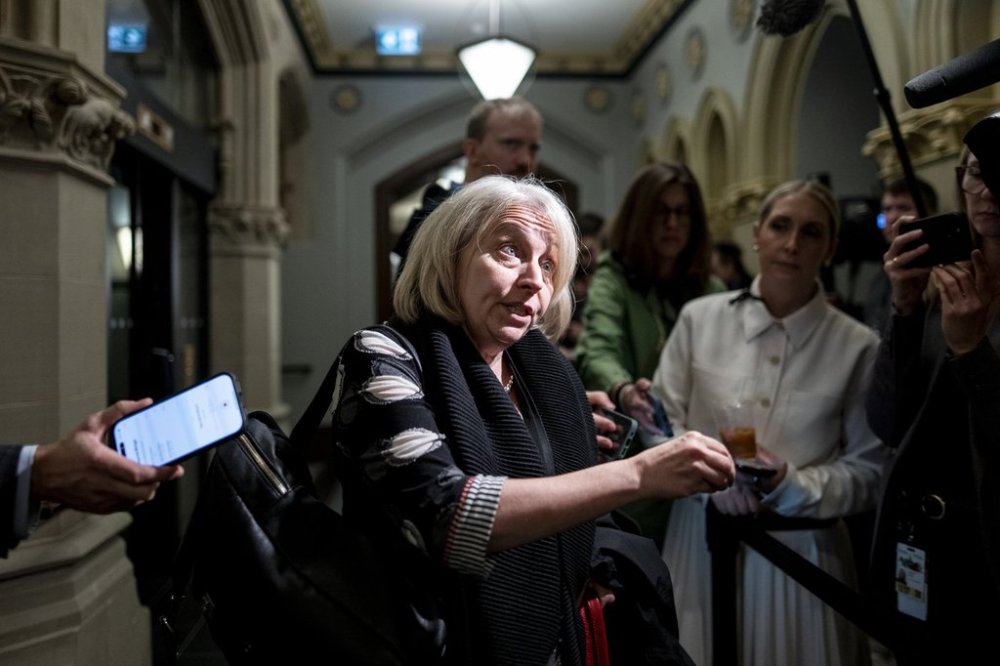
National Security and Intelligence Adviser to the Prime Minister and Deputy Clerk of the Privy Council Nathalie Drouin speaks to reporters ahead of a cabinet meeting on Parliament Hill in Ottawa, on Thursday, Sept. 25, 2025. THE CANADIAN PRESS/Spencer Colby

The memo, which was also sent to national security and intelligence adviser Nathalie Drouin, came less than a week after Carney was sworn in as prime minister.

Just days earlier, on March 9, Carney won the Liberal leadership against the backdrop of a barrage of tariffs on Canadian goods from U.S. President Donald Trump, along with his repeated threats to make Canada a U.S. state.

Canada’s last full-fledged national security policy emerged from the government led by Paul Martin in 2004.

In April of last year, Justin Trudeau’s government said it would publish a national security strategy every four years.

The government said this approach reflected a new reality of uncertainty and change. It said a more systematic approach would allow Ottawa to regularly assess the security environment and its implications for Canada.

Trudeau asked Drouin in a November 2024 mandate letter to lead efforts to deliver a renewed national security strategy in 2025. He said it should set out an integrated framework for Canada’s national security, defence and diplomatic posture, “leveraging engagement with Canadians from coast-to-coast-to-coast.”

Privy Council Office spokesman Pierre-Alain Bujold said while the specific changes and assumptions mentioned in Hannaford’s memo cannot be disclosed, “it is clear that the geopolitical and security environment is becoming increasingly complex and marked by significant developments.” 

“The rules-based international order is shifting, driven by growing competition among major powers,” Bujold said in response to questions. “This rapid transformation requires Canada to continually reassess the threat landscape to address emerging challenges.” 

At a cabinet planning forum early last month, Carney said a new national security policy would be released “in due course.”

Speaking to media at the forum, Carney said the world is a more dangerous place than in the 1990s and the early part of this century.

“There were challenges then, but there are bigger challenges now,” he said. “The power balances are shifting, alliances are shifting.”

Intelligence expert Wesley Wark, a senior fellow at the Centre for International Governance Innovation, said he suspects work on the national security strategy has proven to be challenging because of “conflicting desires.”

On the one hand, officials want the strategy to be a meaningful expression of a new Canadian policy rooted in the national interest. On the other, they fear inciting tensions with the Trump administration during extended trade negotiations.

“I suspect it will stay on the shelf for now,” Wark said. “There is zero political gain to release it.”

The tensions with the United States should not delay a fresh national security strategy, said Vincent Rigby, a former security and intelligence adviser to the prime minister who now teaches at the Max Bell School of Public Policy at McGill University.

Canadians have lived in a very unpredictable, unsettled world for the last five or six years, said Rigby, pointing to conflicts in Europe and the Middle East, an assertive China and threats from states like Iran and North Korea.

The dangers to Canada include foreign interference, espionage and cyberthreats, he said.

“I think, more than ever, we need a national security strategy, and especially because of what’s been happening with the U.S. and the fact that President Trump has called into question some of the fundamentals of the relationship in terms of defence and security,” Rigby said.

He suggested there has been an aversion within government for many years to craft a national security strategy because officials felt it was a lot of work for a document with only a six-month shelf life.

The trick is coming up with a flexible security strategy that stays relevant even when unexpected events arise, Rigby said.

“You need a road map,” he said. “You get in a car to drive somewhere, you need to know where you’re going, you need to know what highways you’re going to take. You need to make sure that you’ve got the right car.”

Carney has already said publicly that Canada’s old relationship with the United States is over and a new partnership must take its place, Rigby noted.

“I suspect that any national security strategy that comes out, while it’s going to acknowledge that these are difficult times with the U.S., is also going to say at the end of the day that they remain a committed ally,” he said.

“Are there political risks? Yes. But can you overcome those risks in developing the strategy? Absolutely.”

This report by The Canadian Press was first published Oct. 12, 2025.

Report Error Submit a Tip

More Stories

Uncaring hubby fell flat at first hurdle

Maureen Scurfield 4 minute read Yesterday at 2:00 AM CDT

DEAR MISS LONELYHEARTS: I re-rented my favourite summer cabin this fall because I’m trying to finish my thesis. My husband of just over a year was very annoyed with me for going on my own, but didn’t say much about it because I paid.

I thought we were both OK with this arrangement, until I got the flu up at the lake very badly and couldn’t keep anything down. I felt faint. I phoned him and he said he was at a party with the guys. I could hear music and girls laughing.

He wouldn’t come for me, so at 4 a.m. when I was getting even more sick and scared, I drove back to the city unannounced.

I went straight to my parents’ house and pretty much fell through the door. Mom said to me when she grabbed me: “This is not right. You could have died in the ditch. Where is your husband?”

Perfumer battling city hall to keep his shop open

Gabrielle Piché 5 minute read Preview

Perfumer battling city hall to keep his shop open

Gabrielle Piché 5 minute read Yesterday at 5:45 PM CDT

Michael O’Malley has been here before — fighting the City of Winnipeg to keep his business open.

He usually spends his days concocting scents. He’s owned La Parfumerie, a Wolseley shop, since 1993.

Twenty-seven natural perfumes line shelves on 145 Evanson St.’s bottom floor. O’Malley lives above the space.

Now, he’s required to change the home’s zoning or shut out walk-in customers. Either would kill the company, O’Malley said.

Read
Yesterday at 5:45 PM CDT

Wab Kinew as ‘communicator in chief’

Paul G. Thomas 6 minute read Preview

Wab Kinew as ‘communicator in chief’

Paul G. Thomas 6 minute read Yesterday at 2:00 AM CDT

Premier Wab Kinew and his party have been riding high in the polls longer than normal for a government one year or less away from its first re-election contest. One reason is his ubiquitous, dominating communications presence as NDP leader and premier.

The argument here is that Kinew has supplemented his prerogatives as premier and party leader (such as appointing cabinet ministers and approving party nominations) with the skilful use of communications to advance his policy agenda, boost his personal popularity and maintain the competitive advantage of his party over the opposition Progressive Conservatives.

Communications has always been a significant part of politics and policy making. However, in the contemporary political and media environments, communications considerations have moved from the background to the foreground of decision-making by political parties, including when they are performing in the role of government. Campaigning and governing now overlap in what has been described as a permanent election campaign.

Political parties use communications strategies for several purposes: to establish an image of the leader which makes a positive emotional connection with voters; to promote a coherent message and to keep party members on message; and to gain favourable media coverage for its policies and other actions on almost a daily basis.

Read
Yesterday at 2:00 AM CDT

Bathhouse owner upset after judge grants bail to man accused in foiled bombing

Dean Pritchard and Morgan Modjeski 5 minute read Preview

Bathhouse owner upset after judge grants bail to man accused in foiled bombing

Dean Pritchard and Morgan Modjeski 5 minute read Updated: Yesterday at 5:00 PM CDT

The owner of a Notre Dame Avenue bathhouse is troubled after a man accused of planting a pipe bomb outside his club was granted bail.

Erik Lymen Olson, 59, was granted release following a contested bail hearing last Monday.

“I don’t think he should have got out with something like this — at all,” said Christopher Gregoire, owner of AQ Sauna.

Olson was arrested Sept. 12, one day after allegedly planting a pipe bomb outside the sex and lifestyle club.

Read
Updated: Yesterday at 5:00 PM CDT

Billions of dollars spent on health, but scattershot financial reporting leaves decision-makers, Manitobans in the dark, auditor general says

Nicole Buffie 3 minute read Preview

Billions of dollars spent on health, but scattershot financial reporting leaves decision-makers, Manitobans in the dark, auditor general says

Nicole Buffie 3 minute read 5:20 PM CDT

Manitoba’s auditor general says significant gaps in health-sector financial reporting make it difficult to understand how billions of dollars in public funds are spent.

Auditor General Tyson Shtykalo is calling for clearer, more transparent reporting in his latest report, titled Observations on Health Sector Financial Reporting and Accountability in Manitoba.

“Manitoba spends nearly $10 billion annually on health care, but current financial reporting does not provide a clear picture of how that money is spent, what services cost, or the financial pressures facing the system,” Shtykalo said in a news release.

While some financial information is available, the reports do not provide a “complete, consistent, or easily understood” picture of how health-care funds are spent, the report said.

Read
5:20 PM CDT

Manitoba PCs choose Narth as interim leader; Khan blasts former caucus colleagues

Carol Sanders 4 minute read Preview

Manitoba PCs choose Narth as interim leader; Khan blasts former caucus colleagues

Carol Sanders 4 minute read Updated: 1:59 PM CDT

Manitoba’s Progressive Conservatives have chosen Konrad Narth as their interim party leader after the sudden resignation of Obby Khan.

Narth, who represents La Vérendrye in the province’s southeast, was chosen in a closed-door caucus meeting Tuesday morning.

Khan announced late Monday afternoon that he was quitting caucus and will sit in the legislature as an independent MLA.

“We’re not fractured,” Narth said shortly after being selected and just hours before the legislature resumed sitting after a summer break of nearly four months.

Read
Updated: 1:59 PM CDT