This river sends 500 billion microplastics into Lake Ontario each year: study

Advertisement

Advertise with us

TORONTO - A new study of one of Canada's most urbanized rivers suggests it dumps the equivalent of about 18 cars worth of microplastics into Lake Ontario every year, a finding that shocked the lead author and underscored efforts to cut down on pollution. 

Read this article for free:


or

Already have an account? Log in here »

To continue reading, please subscribe:

Subscribe and receive a limited-edition Free Press branded hat or tote.

Digital Subscription

One year of digital access for only $205*

  • Enjoy unlimited reading on winnipegfreepress.com
  • Read the E-Edition, our digital replica newspaper
  • Access News Break, our award-winning app
  • Play interactive puzzles

*First annual payment billed as $205.00 + GST for one year. This annual subscription will automatically renew at $233.00 + GST every 52 weeks (10% off the regular annual price of $259.35). Offer available to new and qualified returning subscribers only. Cancel any time.

To continue reading, please subscribe:

Add Free Press access to your Brandon Sun subscription for only an additional

$1 for the first 4 weeks*

  • Enjoy unlimited reading on winnipegfreepress.com
  • Read the E-Edition, our digital replica newspaper
  • Access News Break, our award-winning app
  • Play interactive puzzles
Start now

*Your next Brandon Sun subscription payment will increase by $1.00 and you will be charged $17.95 plus GST for four weeks. After four weeks, your payment will increase to $24.95 plus GST every four weeks.

Hey there, time traveller!
This article was published 23/10/2025 (304 days ago), so information in it may no longer be current.

TORONTO – A new study of one of Canada’s most urbanized rivers suggests it dumps the equivalent of about 18 cars worth of microplastics into Lake Ontario every year, a finding that shocked the lead author and underscored efforts to cut down on pollution. 

The peer-reviewed study published Thursday estimates the Don River basin flushes about 500 billion particles of microplastics, with a mass of about 36,000 kilograms, into the lake each year. That’s far more than the estimated 160 kilograms of larger plastic items. 

“I was pretty shocked to see that levels that we see here are more on par with places that don’t have as good of waste management,” said co-author Chelsea Rochman, an expert on plastics pollution and associate professor at the University of Toronto. 
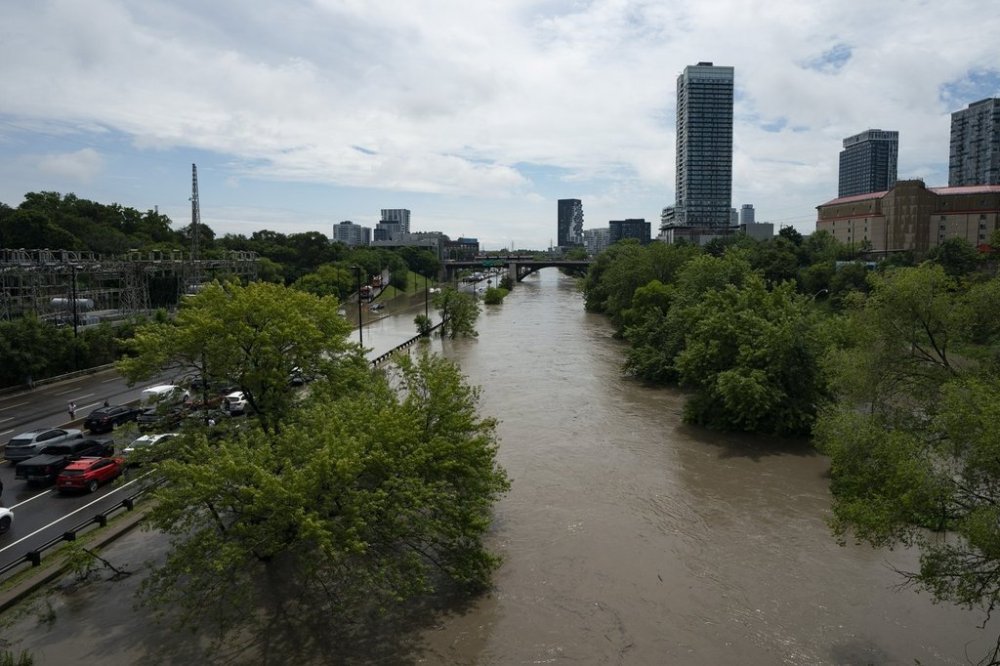
The Don River overflows causing flooding on surrounding roads following heavy rain in Toronto, on Tuesday, July 16 2024. THE CANADIAN PRESS/Arlyn McAdorey

Microplastics, no bigger than a pencil eraser and down to particles smaller than what’s visible with the human eye, have become ubiquitous and shown up everywhere from human blood to Arctic Sea ice. The broken-down bits of larger plastics have been linked to a suite of issues in wildlife, including lower levels of fish growth and reproduction, while also raising concerns about possible human health impacts. 

Some common sources of microplastics in the Don River are construction foam, car tires, plastic pellets and tiny pieces shed from larger single-use plastics, Rochman said. 

The most common large plastics found in the river were bags and wet wipes, accounting for about 20 per cent each, the study suggested. Rochman estimates there are tens of thousands of those wipes sitting in the river system at any given time, particularly in Taylor-Massey Creek.

For comparison, another study co-authored by Rochman and published in June found the Don River discharged far more large plastics than the river running through Chicago. 

“By understanding these sources, we can work with the relevant stakeholders to turn off the tap on each of those sources,” said Rochman.

That includes working with companies to stop foam from blowing off construction sites, continued support for sewer infrastructure upgrades and banning some single-use plastics, said Rochman.

“There’s a lot we can do, but it’s really important that we monitor.” 

Part of the issue is Toronto’s aging combined sewer system, she said. 

When heavy rains stretch the system, untreated sewage is dumped into the river and Lake Ontario. When people flush plastic wet wipes down the toilet – “which we should never do,” Rochman says – they can get released into the river during a storm. 

The city is in the midst of a $3-billion program to upgrade the system and get sewer overflow out of the river.

The researchers behind the study measured plastics before, during and after a storm at four spots along the river basin. The study suggests the amount of plastic in the river was about the same before and after the storm.

That finding suggests if all plastic pollution was cut off the river may naturally “clean itself” over time, Rochman said. 

“We could truly protect this watershed that a lot of us here in Toronto know well and love,” she said. 

The study was published in the academic journal Philosophical Transactions A of the Royal Society. 

This report by The Canadian Press was first published Oct. 23, 2025. 

Report Error Submit a Tip

More Stories

Frustration mounts as drug raids sweep problems out of downtown, into West End

Scott Billeck 7 minute read Preview

Frustration mounts as drug raids sweep problems out of downtown, into West End

Scott Billeck 7 minute read Friday, Aug. 21, 2026

West End business owners say their neighbourhood has been under siege for months, and some believe downtown police drug sweeps have made things worse by pushing more street disorder in their direction — and pushing customers away.

Read
Friday, Aug. 21, 2026

This river sends 500 billion microplastics into Lake Ontario each year: study

Jordan Omstead, The Canadian Press 3 minute read Preview

This river sends 500 billion microplastics into Lake Ontario each year: study

Jordan Omstead, The Canadian Press 3 minute read Thursday, Oct. 23, 2025

TORONTO - A new study of one of Canada's most urbanized rivers suggests it dumps the equivalent of about 18 cars worth of microplastics into Lake Ontario every year, a finding that shocked the lead author and underscored efforts to cut down on pollution. 

The peer-reviewed study published Thursday estimates the Don River basin flushes about 500 billion particles of microplastics, with a mass of about 36,000 kilograms, into the lake each year. That's far more than the estimated 160 kilograms of larger plastic items. 

"I was pretty shocked to see that levels that we see here are more on par with places that don't have as good of waste management," said co-author Chelsea Rochman, an expert on plastics pollution and associate professor at the University of Toronto. 

Microplastics, no bigger than a pencil eraser and down to particles smaller than what's visible with the human eye, have become ubiquitous and shown up everywhere from human blood to Arctic Sea ice. The broken-down bits of larger plastics have been linked to a suite of issues in wildlife, including lower levels of fish growth and reproduction, while also raising concerns about possible human health impacts. 

Read
Thursday, Oct. 23, 2025

Residents fear mailbox crime sprees

Morgan Modjeski 4 minute read Preview

Residents fear mailbox crime sprees

Morgan Modjeski 4 minute read Yesterday at 2:01 AM CDT

Some North End residents are concerned new community mailboxes will become a target for vandalism and crime after the base of one was recently lit ablaze — before it was even installed.

The community mailboxes started to show up on Andrews Street within the last two weeks. Some have been installed, while at other locations, only the concrete foundation is in place.

“They just dumped them on the boulevard,” said Stephen Giesbrecht, who lives beside one of the boxes in the St. John’s neighbourhood. “They dumped them on the corner and then they were gone.”

One of the concrete slabs has already played host to a fire and some of the hardware needed to install the mailbox melted.

Read
Yesterday at 2:01 AM CDT

City inundated with thousands of complaints after launch of new transit system

Morgan Modjeski 11 minute read Preview

City inundated with thousands of complaints after launch of new transit system

Morgan Modjeski 11 minute read Friday, Aug. 21, 2026

Despite complaints from thousands of dissatisfied users, Winnipeg hasn't hit the brakes on the rollout of its new primary transit network. And it appears that ignoring the public response cost Winnipeg Transit millions of dollars in lost revenue and ridership.

Read
Friday, Aug. 21, 2026

Wait times for MRIs getting worse in Brandon, Dauphin

Rylee Gerrard 4 minute read Yesterday at 2:01 AM CDT

BRANDON — Wait times for MRI scans have surged in the Prairie Mountain Health region during the last two years.

Despite a campaign promise by the NDP in September 2023 to increase the number of allied health professionals capable of administering diagnostic imaging in northern and rural areas, wait times for MRIs have increased dramatically in Brandon and Dauphin.

Median imaging wait times tripled at Dauphin Regional Health Centre between 2024 and 2026, increasing from eight to 24 weeks, according to the province’s wait time dashboard.

The Brandon Regional Health Centre median wait times for MRI scans more than doubled during the same period, from nine to 23 weeks.

Puzzles Palace

1 minute read Monday, Jul. 27, 2026

To solve our puzzles, please subscribe with this special offer: |