Railway project in the Amazon raises questions over Brazil’s efforts to stop deforestation

Advertisement

Advertise with us

SAO PAULO (AP) — As Brazil seeks to boost its environmental credentials by hosting the United Nations’ climate summit, a proposal to build a railway through the Amazon has threatened to tarnish that image amid protests by Indigenous groups and environmentalists.

Read this article for free:


or

Already have an account? Log in here »

To continue reading, please subscribe:

Subscribe and receive a limited-edition Free Press branded hat or tote.

Digital Subscription

One year of digital access for only $205*

  • Enjoy unlimited reading on winnipegfreepress.com
  • Read the E-Edition, our digital replica newspaper
  • Access News Break, our award-winning app
  • Play interactive puzzles

*First annual payment billed as $205.00 + GST for one year. This annual subscription will automatically renew at $233.00 + GST every 52 weeks (10% off the regular annual price of $259.35). Offer available to new and qualified returning subscribers only. Cancel any time.

To continue reading, please subscribe:

Add Free Press access to your Brandon Sun subscription for only an additional

$1 for the first 4 weeks*

  • Enjoy unlimited reading on winnipegfreepress.com
  • Read the E-Edition, our digital replica newspaper
  • Access News Break, our award-winning app
  • Play interactive puzzles
Start now

*Your next Brandon Sun subscription payment will increase by $1.00 and you will be charged $17.95 plus GST for four weeks. After four weeks, your payment will increase to $24.95 plus GST every four weeks.

Hey there, time traveller!
This article was published 19/11/2025 (319 days ago), so information in it may no longer be current.

SAO PAULO (AP) — As Brazil seeks to boost its environmental credentials by hosting the United Nations’ climate summit, a proposal to build a railway through the Amazon has threatened to tarnish that image amid protests by Indigenous groups and environmentalists.

The Ferrograo railway project would transport commodities including corn and soybeans nearly 1,000 kilometers (621 miles) from a city on the southern edge of the rainforest to a port along a major tributary of the Amazon River. From there, commodities would be ferried to a larger port near Belem, the host city of the COP30 conference, for export to China and other trading partners.

The Brazilian government hopes to move forward with the railway once the country’s Supreme Court rules on the legality of changing a national park’s borders to allow construction and a congressional watchdog approves the plans. Protesters, including potentially affected Indigenous populations, took to streets and rivers in the Amazon this month to oppose it.
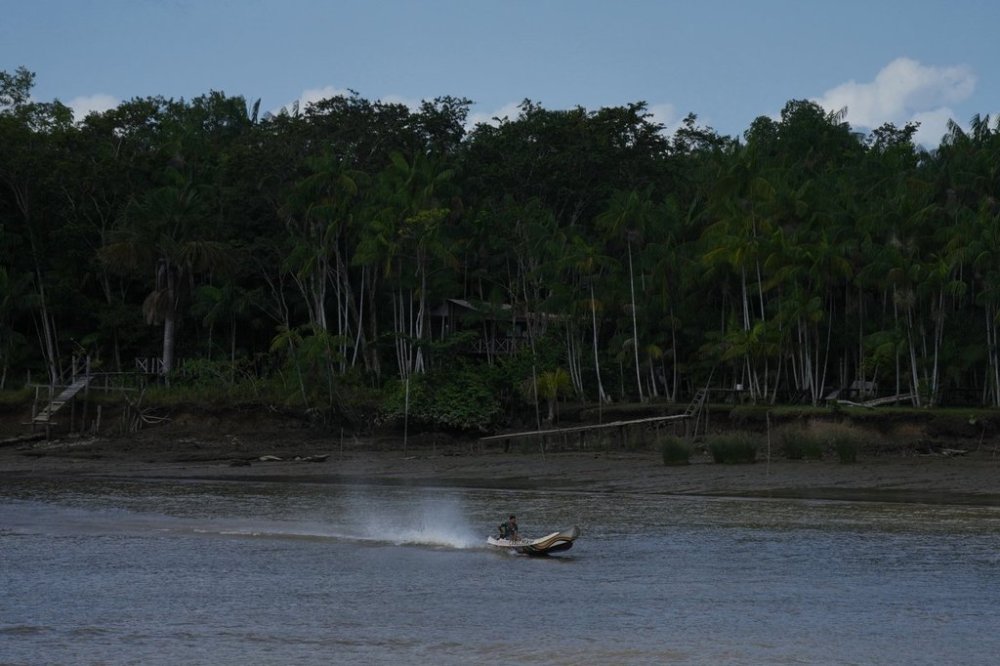
A boat maneuvers near the shore of Barcarena, Brazil, on Sunday, Nov. 9, 2025. (AP Photo/Fernando Llano)

Currently, trucks carrying soybeans and corn through the rainforest must drive on roads that are unpaved in places, spilling grain that’s pushed to the side of the road each day. The proposed railway would follow a similar route from the city of Sinop to the port of Miritituba on the Tapajos River, a major tributary of the Amazon River.

As of July 2023 — months after President Luiz Inácio Lula da Silva returned to office — local officials estimated the rail project would cost about 20 billion Brazilian reais ($3.8 billion). Independent analysts estimate the price tag will be one-third higher than that.

Asked about Ferrograo and other projects in Northern Brazil, where most of the country’s Amazon lies, Transport Minister Renan Filho said: “You cannot become one of the world’s biggest exporters without an infrastructure.”

Speaking on TV Band, Filho added: “Today, differently from the past, central Brazil has a lot of heavy cargo and that needs to be transported.”

New projections are expected next year when Brazil’s Transportation Ministry hands in studies to the congressional watchdog. The government estimates that a single 170-car train could replace 422 trucks, reducing carbon emissions in the region, according to local media reports. On the other hand, any cutting of forests, no matter what for, often leads to more development. That happened across the Amazon as Brazil undertook major highway projects in the 1970s.

Since returning to office, Lula has made curbing deforestation in the Amazon a central part of his agenda — and has made significant progress. That effort seems to be at odds with a major train project.

Indigenous groups speak out

Experts say about 15 Indigenous groups are scattered through the Ferrograo pathway and the waterways leading to Barcarena, the port near Belem where the grain is loaded on ships for export.

“The cumulative impacts (from Ferrograo), that’s deforestation, monoculture and toxics, show that comparing emissions is not enough,” Alessandra Munduruku, leader of an Indigenous population that could be affected by the railway, said in a statement. She and other activists claim anyone living in the basins of the Xingo and the Tapajos rivers could lose their homes to farms if the railway increases shipping and makes agriculture more lucrative.

Mariel Nakane, an analyst on Ferrograo at the non-profit Socio-Environmental Institute, told The Associated Press that Lula’s administration has done little to consult with Indigenous groups.

“This administration said they would reach out to the Indigenous, but they just didn’t,” Nakane said, adding that there was also “zero dialogue” with Lula’s predecessor, former President Jair Bolsonaro.

Government estimates show that the railway could carry up to 40 million metric tons (44 million tons) of soybeans and corn every year, doubling the current capacity through the road — with a potential of reaching 70 million metric tons (77 million tons). But the damage to rivers and their shores could push Indigenous peoples away, further increasing the potential for farming and deforestation, according to the Socio-Environmental Institute.

Chief Raoni Metuktire, 93, whose Kayapo people would be among those most affected by the construction of the railway, joined more than 300 Indigenous people and activists who took part in a flotilla of boats that traveled to Belem to protest the railway as the COP30 summit was getting underway. The conference is scheduled to end on Friday.

“I spoke to Lula and (French President, Emmanuel) Macron so they don’t drill oil around her and do not allow Ferrograo,” Metuktire told journalists in Belem last week.

Local populations near Miritruba say that soybean shipments are already contaminating the water and causing restrictions on fishing — effects that could worsen if a new railway increases shipping.

Ongoing court battles

Melillo Dinis, a lawyer at the non-profit Kabu Institute who represents Indigenous groups, said opponents of Ferrograo are committed to fighting it in court and through administrative actions for as long as it takes. His organization is behind a class action suit against the Brazilian government seeking 1.7 billion Brazilian reais ($320 million).

“We will litigate this, we will have civil actions, we will take this to the government watchdogs, and we will also fight if we have to if there’s an environmental licensing phase,” Dinis told the AP.

Dinis says Indigenous protection groups wisely chose to walk out of government discussions on Ferrograo last year, as they understood their recommendations were not taken seriously by authorities.

“Dialogue with the Indigenous takes place in the villages, within the cultural model of each of those peoples. They thought a meeting in the capital, Brasilia, should sort this out,” Dinis said. “We were there for almost eight months. We offered them 100 pages with suggestions. They totally ignored them.”

___ The Associated Press’ climate and environmental coverage receives financial support from multiple private foundations. AP is solely responsible for all content. Find AP’s standards for working with philanthropies, a list of supporters and funded coverage areas at AP.org.
Report Error Submit a Tip

More Stories

Moving drama at MTYP gives voice to boy who changed law

Holly Harris 4 minute read Preview

Moving drama at MTYP gives voice to boy who changed law

Holly Harris 4 minute read Yesterday at 2:37 PM CDT

The heroic true tale of Norway House Cree Nation-born Jordan River Anderson came home Friday night, as Manitoba Theatre for Young People presented Yvette Nolan’s Jordan.

The touring production, a collaboration with Geordie Theatre, runs weekends through Oct. 11, with additional stops in Toronto, Vancouver and Ottawa’s National Arts Centre.

Having several of Anderson’s family members witness the local première underscored the evening with poignancy. Elder and Pine Creek First Nation member Barbara Nepinak added her own dignified presence and prayers following MTYP artistic director Pablo Felices-Luna’s welcoming remarks.

The season-opener also marks the Winnipeg-raised playwright’s homecoming; the Algonquin playwright, director, dramaturg, actor and educator was a fixture in our local theatre community for many years before going on to serve as artistic director for Native Earth Performing Arts from 2003 to ‘11, among other contributions.

Read
Yesterday at 2:37 PM CDT

’Disgusting’ posters being investigated by police

Morgan Modjeski 4 minute read Yesterday at 2:22 PM CDT

The Winnipeg Police Service major crimes unit is investigating what some have labelled offensive and hateful posters on full-display at a Winnipeg home.

One of the people irked by the display is Gracie Garrett. She’s has lived on Ashburn Street in Winnipeg’s Minto neighbourhood for almost ten years. She’s never felt unsafe in the neighbourhood before, but now, a set of posters plastered on a nearby house are making her feel uneasy.

The five signs, posted facing the street prominently on a front window, contain a slur, refer to Nazis as “heroes” and call Muslims, Christians and other groups “evil.”

Learning of the signs Friday, Garrett said she’ll be reporting the posters to police, as she worries they incite and promote violence.

Railway project in the Amazon raises questions over Brazil’s efforts to stop deforestation

Mauricio Savarese, The Associated Press 5 minute read Preview

Railway project in the Amazon raises questions over Brazil’s efforts to stop deforestation

Mauricio Savarese, The Associated Press 5 minute read Wednesday, Nov. 19, 2025

SAO PAULO (AP) — As Brazil seeks to boost its environmental credentials by hosting the United Nations’ climate summit, a proposal to build a railway through the Amazon has threatened to tarnish that image amid protests by Indigenous groups and environmentalists.

The Ferrograo railway project would transport commodities including corn and soybeans nearly 1,000 kilometers (621 miles) from a city on the southern edge of the rainforest to a port along a major tributary of the Amazon River. From there, commodities would be ferried to a larger port near Belem, the host city of the COP30 conference, for export to China and other trading partners.

The Brazilian government hopes to move forward with the railway once the country's Supreme Court rules on the legality of changing a national park's borders to allow construction and a congressional watchdog approves the plans. Protesters, including potentially affected Indigenous populations, took to streets and rivers in the Amazon this month to oppose it.

Currently, trucks carrying soybeans and corn through the rainforest must drive on roads that are unpaved in places, spilling grain that's pushed to the side of the road each day. The proposed railway would follow a similar route from the city of Sinop to the port of Miritituba on the Tapajos River, a major tributary of the Amazon River.

Read
Wednesday, Nov. 19, 2025

Letters, Oct. 3

7 minute read Yesterday at 2:01 AM CDT

A morning in the life …

My very first lesson does not start when I walk into that lecture hall, oh no — it starts long before. It begins when I walk to my car, check the estimated arrival time to the University of Manitoba and hope that Winnipeg traffic agrees with it.

A drive that appears completely manageable changes almost immediately when I’m greeted by a tsunami of orange pylons and a line of cars that appears to go on forever. Traffic moves by the inch, lanes magically disappear and the detour I took yesterday now has a detour of its own. These factors make me do a calculation that I have become all too familiar with. How late can I arrive and still find parking, run to my class across campus and get to class with enough time left to make it worth it?

I have grown used to people saying, “Why not just leave earlier?” I do. But when I’m already leaving for my 8:30 a.m. class at 7 a.m., there’s only so much I can do. This drive that some would think is relaxing is one that feels like an assignment that I didn’t know I had to complete and is due at 8:30 a.m.

Morning-show veteran swaps microphone for macchiatos at new Corydon café

David Sanderson 9 minute read Preview

Morning-show veteran swaps microphone for macchiatos at new Corydon café

David Sanderson 9 minute read Yesterday at 2:00 AM CDT

Good news if you were used to having your morning coffee with Terri Gale, who earlier this summer signed off from CTV Your Morning, after 15 years on the job.

Gale, the three-hour program’s longtime weather expert, and her husband Rob Gale, the ex-head soccer coach of Valour FC and co-founder of the Northern Super League’s new Winnipeg franchise, are the owners of Golden Hour Café and Bar at 775 Corydon Ave.

Gale (formerly Apostle) nods when she is asked who would know more about caffeinated beverages than a person who, for the last decade and a half, set her alarm to go off in the wee small hours.

“I do love coffee and take mine black. Except because I hate burning my tongue — not a good thing when you speak for a living — I got into the habit of throwing a couple of ice cubes in my cup, to be on the safe side,” Gale says, seated on the second level of their attractive, 2,100-square-foot premises, which officially opened in mid-September.

Read
Yesterday at 2:00 AM CDT

Volunteer pop-up library axed from Manitoba Youth Centre

Matthew Frank 4 minute read Preview

Volunteer pop-up library axed from Manitoba Youth Centre

Matthew Frank 4 minute read Updated: Yesterday at 11:25 AM CDT

Manitoba Corrections has cancelled a pop-up library program at the Manitoba Youth Centre, leaving inmates without librarian services and fewer options to borrow certain books.

The Prison Libraries Committee, part of the non-profit Manitoba Library Association, operated and funded the volunteer program since 2024 before it was shut down by the province last month. The group previously partnered with the province to offer the service because the facility has no dedicated library of its own.

“It is concerning that community members who are incarcerated, especially youth, are losing out on meaningful programming, access to information and rehabilitation efforts, which are offered at no cost to (Manitoba) Corrections. We urge Manitoba Justice to promote more library services and programming, not less,” said a Sept. 24 letter from the non-profit addressed to the justice minister.

Ashley Huot, chair of the Prison Libraries Committee, said she was puzzled when she received an email last month from Manitoba Corrections stating that the pop-up library was no longer needed.

Read
Updated: Yesterday at 11:25 AM CDT