Indigenous people reflect on the meaning of their participation in COP30 climate talks
Advertisement
Read this article for free:
or
Already have an account? Log in here »
To continue reading, please subscribe:

Digital Subscription
One year of digital access for only $205*
- Enjoy unlimited reading on winnipegfreepress.com
- Read the E-Edition, our digital replica newspaper
- Access News Break, our award-winning app
- Play interactive puzzles
*First annual payment billed as $205.00 + GST for one year. This annual subscription will automatically renew at $233.00 + GST every 52 weeks (10% off the regular annual price of $259.35). Offer available to new and qualified returning subscribers only. Cancel any time.
To continue reading, please subscribe:
Add Free Press access to your Brandon Sun subscription for only an additional
$1 for the first 4 weeks*
- Enjoy unlimited reading on winnipegfreepress.com
- Read the E-Edition, our digital replica newspaper
- Access News Break, our award-winning app
- Play interactive puzzles
*Your next Brandon Sun subscription payment will increase by $1.00 and you will be charged $17.95 plus GST for four weeks. After four weeks, your payment will increase to $24.95 plus GST every four weeks.
Read unlimited articles for free today:
or
Already have an account? Log in here »
Hey there, time traveller!
This article was published 22/11/2025 (327 days ago), so information in it may no longer be current.
BELEM, Brazil (AP) — Indigenous people filled the streets, paddled the waterways and protested at the heart of the venue to make their voices heard during the United Nations climate talks that were supposed to give them a voice like never before at the annual conference.
As the talks, called COP30, concluded Saturday in Belem, Brazil, Indigenous people reflected on what the conference meant to them and whether they were heard.
Brazilian leaders had high hopes that the summit, taking place in the Amazon, would empower the people who inhabit the land and protect the biodiversity of the world’s largest rainforest, which helps stave off climate change as its trees absorb carbon pollution that heats the planet.
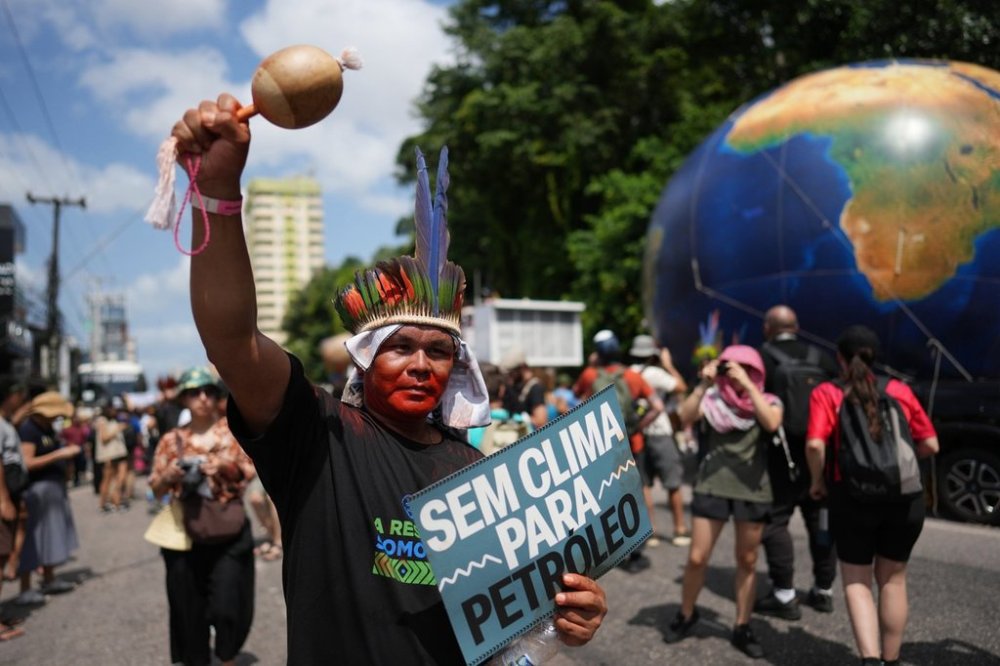
Many Indigenous people who attended the talks felt strengthened by the solidarity with tribes from other countries and some appreciated small wins in the final outcome. But for many, the talks fell short on representation, ambition and true action on climate issues affecting Indigenous people.
“This was a COP where we were visible but not empowered,” said Thalia Yarina Cachimuel, a Kichwa-Otavalo member of A Wisdom Keepers Delegation, a group of Indigenous people from around the world.
Some language wins but nothing on fossil fuels
The first paragraph of the main political text acknowledges “the rights of Indigenous Peoples, as well as their land rights and traditional knowledge.”
Taily Terena, an Indigenous woman from the Terena nation in Brazil, said she was happy because the text for the first time mentioned those rights explicitly.
But Mindahi Bastida, an Otomí-Toltec member of A Wisdom Keepers Delegation, said countries should have pushed harder for agreements on how to phase out fuels like oil, gas and coal “and not to see nature as merchandise, but to see it as sacred.”
Several nations pushed for a road map to curtail use of fossil fuels, which when burned release greenhouse gases that warm the planet. Saturday’s final decision left out any mention of fossil fuels, leaving many countries disappointed.
Brazil also launched a financial mechanism that countries could donate to, which was supposed to help incentivize nations with lots of forest to keep those ecosystems intact.
Although the initiative received monetary pledges from a few countries, the project and the idea of creating a market for carbon are false solutions that “don’t stop pollution, they just move it around,” said Jacob Johns, a Wisdom Keeper of the Akimel O’Otham and Hopi nations.
“They hand corporations a license to keep drilling, keep burning, keep destroying, so long as they can point to an offset written on paper. It’s the same colonial logic dressed up as climate policy,” Johns said.
Concerns over tokenism
From the beginning of the conference, some Indigenous attendees were concerned visibility isn’t the same as true power. At the end, that sentiment lingered.
“What we have seen at this COP is a focus on symbolic presence rather than enabling the full and effective participation of Indigenous Peoples,” Sara Olsvig, chair of the Inuit Circumpolar Council, wrote in a message after the conference concluded.
Edson Krenak, Brazil manager for Indigenous rights group Cultural Survival and member of the Krenak people, didn’t think negotiators did enough to visit forests or understand the communities living there. He also didn’t believe the 900 Indigenous people given access to the main venue was enough.
Sônia Guajajara, Brazil’s minister of Indigenous peoples, who is Indigenous herself, framed the convention differently.
“It is undeniable that this is the largest and best COP in terms of Indigenous participation and protagonism,” she said.
Protests showed power of Indigenous solidarity
While the decisions by delegates left some Indigenous attendees feeling dismissed, many said they felt empowered by participating in demonstrations outside the venue.
When the summit began on Nov. 10, Paulo André Paz de Lima, an Amazonian Indigenous leader, thought his tribe and others didn’t have access to COP30. During the first week, he and a group of demonstrators broke through the barrier to get inside the venue. Authorities quickly intervened and stopped their advancement.
De Lima said that act helped Indigenous people amplify their voices.
“After breaking the barrier, we were able to enter COP, get into the Blue Zone and express our needs,” he said, referring to the official negotiation area. “We got closer (to the negotiations), got more visibility.”
The meaning of protest at this COP wasn’t just to get the attention of non-Indigenous people, it also was intended as a way for Indigenous people to commune with each other.
On the final night before an agreement was reached, a small group with banners walked inside the venue, protesting instances of violence and environmental destruction from the recent killing of a Guarani youth on his own territory to the proposed Prince Rupert Gas Transmission Project in Canada.
“We have to come together to show up, you know? Because they need to hear us,” Leandro Karaí of the Guarani people of South America said of the solidarity among Indigenous groups. “When we’re together with others, we’re stronger.“
They sang to the steady beat of a drum, locked arms in a line and marched down the long hall of the COP venue to the exit, breaking the silence in the corridors as negotiators remained deadlocked inside.
Then they emerged, voices raised, under a yellow sky.
___
The Associated Press’ climate and environmental coverage receives financial support from multiple private foundations. The AP is solely responsible for all content. Find the AP’s standards for working with philanthropies, a list of supporters and funded coverage areas at AP.org.