CIBC analysts cast doubt on private sector taking on new B.C. pipeline any time soon
Advertisement
Read this article for free:
or
Already have an account? Log in here »
To continue reading, please subscribe:

Digital Subscription
One year of digital access for only $205*
- Enjoy unlimited reading on winnipegfreepress.com
- Read the E-Edition, our digital replica newspaper
- Access News Break, our award-winning app
- Play interactive puzzles
*First annual payment billed as $205.00 + GST for one year. This annual subscription will automatically renew at $233.00 + GST every 52 weeks (10% off the regular annual price of $259.35). Offer available to new and qualified returning subscribers only. Cancel any time.
To continue reading, please subscribe:
Add Free Press access to your Brandon Sun subscription for only an additional
$1 for the first 4 weeks*
- Enjoy unlimited reading on winnipegfreepress.com
- Read the E-Edition, our digital replica newspaper
- Access News Break, our award-winning app
- Play interactive puzzles
*Your next Brandon Sun subscription payment will increase by $1.00 and you will be charged $17.95 plus GST for four weeks. After four weeks, your payment will increase to $24.95 plus GST every four weeks.
Read unlimited articles for free today:
or
Already have an account? Log in here »
Hey there, time traveller!
This article was published 28/11/2025 (309 days ago), so information in it may no longer be current.
CALGARY – Analysts at CIBC Capital Markets say they don’t expect the private sector to take the lead on a new West Coast oilsands pipeline so long as the British Columbia government and First Nations are opposed.
“The requirement to consult with B.C. and Indigenous groups is necessary and logical,” they wrote in a report Friday, a day after the Alberta and federal governments signed a memorandum of understanding on a wide range of energy policy issues.
“The MOU does not contain anything resembling judicial reform and therefore seems to rely on the Building Canada Act and the pre-existing duty to consult Indigenous Peoples to avoid endless legal challenges.”
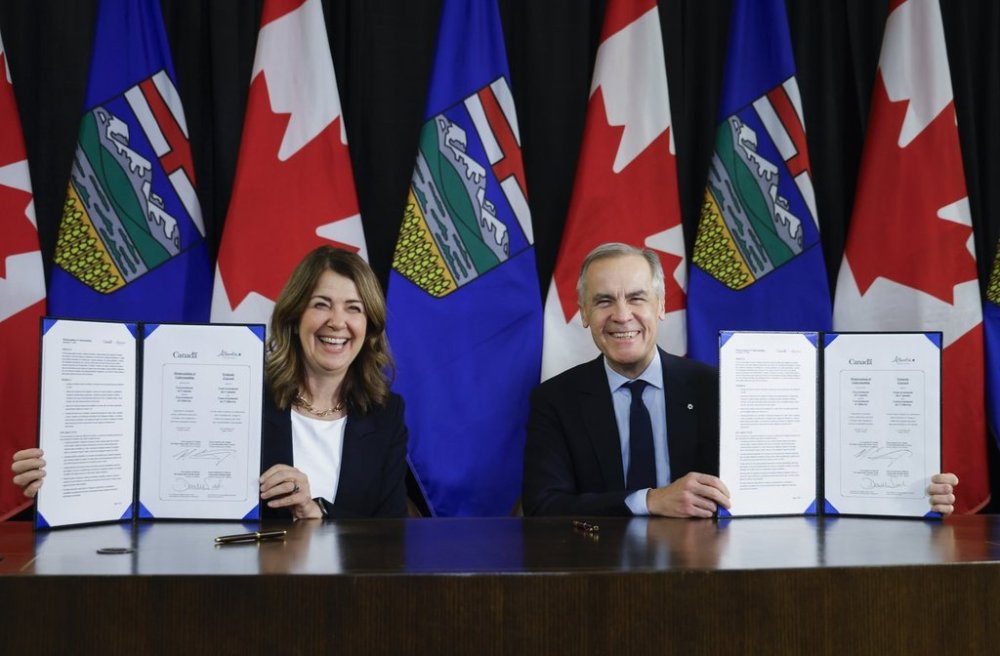
The federal Building Canada Act, under which the new Major Projects Office was created this summer to speed along “nation-building” infrastructure, remains “untested,” the analysts wrote.
The constitutional duty to consult First Nations, meanwhile, is “controversial and ill-defined,” they added. Court challenges caused delays for the defunct Northern Gateway project to B.C.’s north coast more than a decade ago, and for the Trans Mountain pipeline now shipping oilsands crude to the Vancouver area.
“Before any company on our coverage list gets financially involved in a pipeline project as politically charged as this one, we would at least like to see some alignment among Alberta, B.C. and Indigenous groups,” the CIBC report said.
“Recognizing this is unlikely, we would expect some financial incentives to shield any project proponent from legal costs and cost overruns from potentially endless legal challenges.”
The analysts also aren’t banking on oilsands producers ramping up their output immediately, even though the memorandum of understanding spells out that they will not be subject to a federal emissions cap.
“We view a West Coast pipeline as important for economic sovereignty, but believe it will take some time to materialize.”
BMO Capital Markets managing director Randy Ollenberger told a panel earlier this week that costs remain a big unknown, and he’d like to see forensic audits to find out why Trans Mountain and the Coastal Gas Link natural gas pipeline to B.C. ended up costing so much more than initially planned.
“It’s great to approve a pipeline, but if you’re going to build a $100-billion pipeline to the West Coast, you’re not going to ship any oil in it and producers aren’t going to support it and fill it up,” he said.
“We can’t build these expensive gold-plated projects that cost billions and billions of dollars more than they should have cost because we’re moving anthills and birds’ nests and digging up bones along the way. We have to have a much more efficient, streamlined process to build these things so that we can be competitive.”
Former Alberta premier Jason Kenney said he has questions about the costs to industry from some items in the MOU beyond the pipeline.
He told reporters that he worries oilsands economics could be undermined by the industrial carbon price eventually rising to $130 a tonne in addition to the massive capital that would be needed for the Pathways carbon capture and storage project — a condition for the pipeline.
“Texas doesn’t do that. Russia doesn’t do it. Saudi Arabia doesn’t do it. If the Venezuelan heavy crude industry ever comes back in the future under a new government, they won’t be encumbering themselves with those kinds of costs,” Kenney said Thursday after Prime Minister Mark Carney’s address to a Calgary business audience.
“Does this agreement embed costs that make the future Canadian growth of the industry uncompetitive? That remains to be determined.”
Carney’s remarks appeared to hit the right notes for many of those in the room, as standing ovations bookended his speech.
“He’s begun to weave together an answer to a very complex problem,” Trans Mountain chief executive Mark Maki said in an interview Friday.
“We wanted Canada to be an energy superpower and this is a big step in that direction.”
Trans Mountain currently provides Canadian oil producers the only meaningful export access to Asian markets via a marine terminal in Burnaby, B.C. Since an expansion came into service in May 2024, 60 per cent of cargoes have gone to Asia — mainly China — with tankers also heading to Washington state, California and Alaska.
Ottawa bought the pipeline for $4.5 billion in 2018 after Kinder Morgan Canada walked away from it amid fierce environmental opposition and court challenges. It ended up costing more than $34 billion by the time it started up in May of 2024.
Trans Mountain and two peers — South Bow Corp. and Enbridge Inc. — are advising the Alberta government in its efforts to see a whole new pipeline of up to one million barrels a day built to B.C.’s north coast.
The province has committed $14 million to fund early work on preparing an application to the Major Projects Office in the spring, with the goal of derisking it enough to hand it off to the private sector.
Maki said Trans Mountain brings insight into the construction challenges, as well as how to engage with First Nations.
“One of the really important things that the world can learn from the Trans Mountain experience is the importance of early, open, honest, transparent engagement with Indigenous (communities) about the project, what it does, its importance, what it means to them economically.”
This report by The Canadian Press was first published Nov. 28, 2025.
Companies in this story: (TSX:ENB) (TSX:SOBO)