

Restorers swap brushes for lasers in the first restoration of an iconic Roman monument in 40 years
Advertisement
Read this article for free:
or
Already have an account? Log in here »
To continue reading, please subscribe:
Monthly Digital Subscription
$1 per week for 24 weeks*
- Enjoy unlimited reading on winnipegfreepress.com
- Read the E-Edition, our digital replica newspaper
- Access News Break, our award-winning app
- Play interactive puzzles
*Billed as $4.00 plus GST every four weeks. After 24 weeks, price increases to the regular rate of $19.95 plus GST every four weeks. Offer available to new and qualified returning subscribers only. Cancel any time.
Monthly Digital Subscription
$4.99/week*
- Enjoy unlimited reading on winnipegfreepress.com
- Read the E-Edition, our digital replica newspaper
- Access News Break, our award-winning app
- Play interactive puzzles
*Billed as $19.95 plus GST every four weeks. Cancel any time.
To continue reading, please subscribe:
Add Free Press access to your Brandon Sun subscription for only an additional
$1 for the first 4 weeks*
*Your next subscription payment will increase by $1.00 and you will be charged $16.99 plus GST for four weeks. After four weeks, your payment will increase to $23.99 plus GST every four weeks.
Read unlimited articles for free today:
or
Already have an account? Log in here »
Rome (AP) — High above the rooftops in the heart of Rome, restorers on Thursday used laser beams to clean a marble column in the piazza outside the prime minister’s office, removing layers of dust and grime that had covered the Roman monument for decades.
The 47-meter (154-foot) tall column, built between A.D. 180 and 193, features a relief that spirals upward and recounts the battles of one of Rome’s best-known emperors, Marcus Aurelius. During the column’s last restoration, in the 1980s, restorers used tiny brushes to remove the dirt.
For a rare, up-close peek at the restoration, a group of journalists tramped up 16 levels of scaffolding — though their numbers progressively diminished as those with fear of heights turned back.
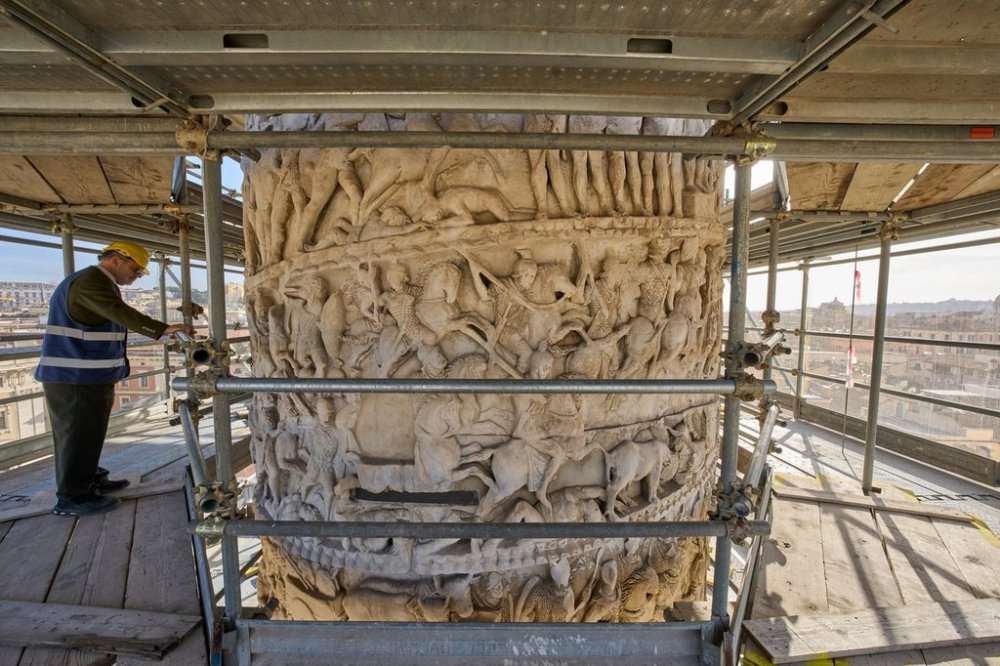
“The laser gives us an excellent result,” said Marta Baumgartner, the director of restoration works. “It works faster and above all allows a great respect for the material — for the marble and for the surface layers.”
Ancient artists did not hold back on the gory details of war. As the relief twists upward, it depicts soldiers dragging women with children off by their hair. Decapitated enemies lie on the ground, horses rear in the heat of battle and war prisoners look terrified with their necks bound together.
In addition to debuting the short-pulse lasers, the group of 18 restorers use chemical wraps, sponges and resin to erase dirt from the smog in the Italian capital and fill holes created by water freezing in cold weather and expanding within. The monument has also suffered from erosion that has erased some of the faces of the engraved figures.
Creating a vertical construction site around a delicate column sculpted two millennia ago was a challenge.
Wide, square scaffolding around it affords the restorers the space needed to work comfortably. They can step back and look at the figures, which get steadily larger up the column — a technique to make them more visible from the ground.

“It was a way of making the person who looked at it read the story,” said Valentin Nitu, a restorer working on the project. “It really drags the viewer in, seeing it phase by phase, scene by scene with the truly wonderful details.”
The 2-million-euro ($2.3-million) restoration is funded by the post-pandemic European recovery fund, and includes a new system to illuminate the column at night. Work began in April and the restoration is expected to finish in June.