EPA proposes limiting power of states and tribes to block major projects over water concerns

Advertisement

Advertise with us

WASHINGTON (AP) — The Environmental Protection Agency on Tuesday proposed limiting states’ and Native American tribes’ power to wield the Clean Water Act to block major projects like natural gas pipelines, advancing the Trump administration's goal of accelerating the construction of new fossil fuel infrastructure and data centers.

Read this article for free:


or

Already have an account? Log in here »

To continue reading, please subscribe:

Subscribe and receive a limited-edition Free Press branded hat or tote.

Digital Subscription

One year of digital access for only $205*

  • Enjoy unlimited reading on winnipegfreepress.com
  • Read the E-Edition, our digital replica newspaper
  • Access News Break, our award-winning app
  • Play interactive puzzles

*First annual payment billed as $205.00 + GST for one year. This annual subscription will automatically renew at $233.00 + GST every 52 weeks (10% off the regular annual price of $259.35). Offer available to new and qualified returning subscribers only. Cancel any time.

To continue reading, please subscribe:

Add Free Press access to your Brandon Sun subscription for only an additional

$1 for the first 4 weeks*

  • Enjoy unlimited reading on winnipegfreepress.com
  • Read the E-Edition, our digital replica newspaper
  • Access News Break, our award-winning app
  • Play interactive puzzles
Start now

*Your next Brandon Sun subscription payment will increase by $1.00 and you will be charged $17.95 plus GST for four weeks. After four weeks, your payment will increase to $24.95 plus GST every four weeks.

Hey there, time traveller!
This article was published 13/01/2026 (264 days ago), so information in it may no longer be current.

WASHINGTON (AP) — The Environmental Protection Agency on Tuesday proposed limiting states’ and Native American tribes’ power to wield the Clean Water Act to block major projects like natural gas pipelines, advancing the Trump administration’s goal of accelerating the construction of new fossil fuel infrastructure and data centers.

The agency said new constraints on local water quality reviews for federally regulated projects will still allow states to protect their environment while preventing unnecessary delays. Successive administrations have seesawed on the scope of states’ power. President Donald Trump’s first administration reduced it, the Biden administration restored it and now the Trump administration is once again adding constraints to what’s called Section 401 of the Clean Water Act.

“When finalized, the proposed rule will increase transparency, efficiency and predictability for certifying authorities and the regulated community,” said Jess Kramer, EPA’s assistant administrator for water. “It will also ensure states and authorized tribes adhere to their Section 401 role.”
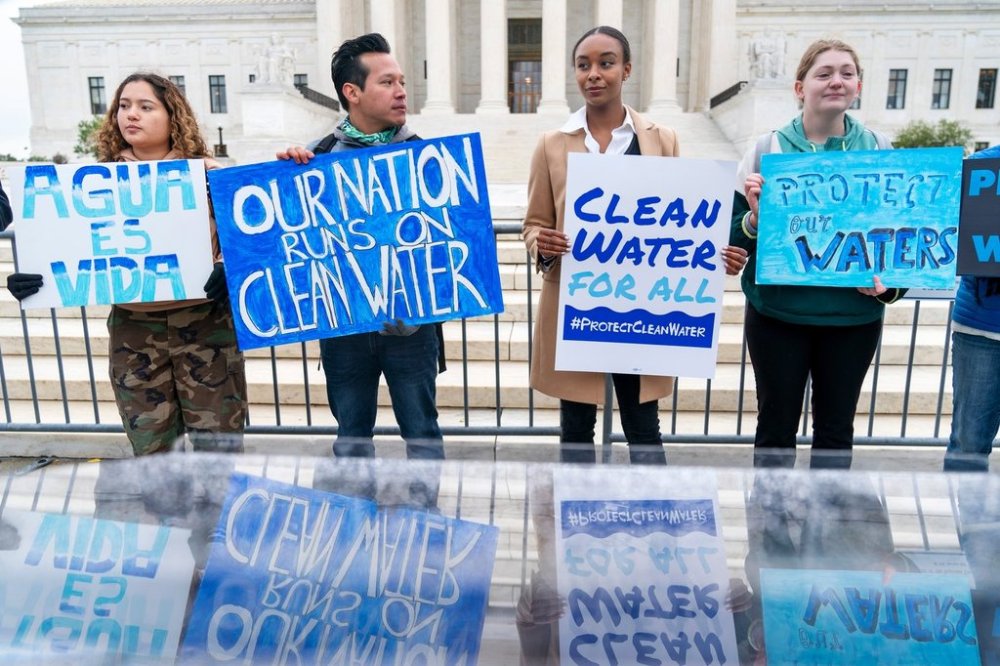
FILE - Bethsaida Sigaran, left, of Baltimore, her brother Jaime Sigaran, with American Rivers, and Thea Louis, with Clean Water Action, join other supporters of the Clean Water Act as they demonstrate outside the Supreme Court, Oct. 3, 2022, in Washington, as the court begins arguments in Sackett v. Environmental Protection Agency (EPA). (AP Photo/Jacquelyn Martin, File)

The Clean Water Act allows states and some authorized tribes to review what effect pipelines, dams and other federally regulated projects have on water quality within their borders. Pipelines, for example, might cross rivers, streams and wetlands — disruptions that states can scrutinize and that have caused holdups before. In 2017, for example, New York regulators rejected a permit for a pipeline, saying there weren’t sufficient protections for hundreds of streams and wetlands.

The proposed change is similar to EPA’s rule in Trump’s first term. They proposed a clear description of what applicants need to submit to states, strict deadlines for reviews and a requirement that states fully explain why any conditions were placed on a developer or why their permit was rejected.

In 2023, the Biden administration strengthened states’ and tribes’ authority to conduct water quality reviews. Activists at the time praised the change, saying it would help protect the local environment. The agency said then that states should be able to look beyond pollution that’s released directly into waters and instead “holistically evaluate” the impact of a project on local water quality.

The Trump administration wants to do away with that broader authority to focus reviews on direct releases to federally regulated waters. They are doing so at a time when fewer waters are federally regulated by the Clean Water Act. In 2023, the Supreme Court in Sackett v. EPA limited the federal government’s power to regulate millions of acres of wetlands.

Congress has said that when federally backed projects like oil pipelines or nickel mines affect water quality, fishing and drinking water, states and tribes get to review them and reject proposals that will do too much damage, according to Moneen Nasmith, director of national climate, fossil fuel infrastructure at the nonprofit Earthjustice.

“EPA’s claims that states and tribes are overreaching are baseless,” she said. “This proposed rule is trying to solve for a problem that does not exist.”

Under Administrator Lee Zeldin, the EPA expanded its traditional focus on the environment and public health to include several economic “pillars” like restoring America’s energy dominance — Trump’s shorthand for fossil fuels — and making the U.S. “the artificial intelligence capital of the world.” As demand for new data centers increases, some of these projects will need state water quality permits. Kramer said the update will make the rules for these reviews clear.

“This makes what we are doing in the 401 space crucial, right? Those projects, they need to be able to move forward with certainty,” said Kramer.

A final rule is expected in the spring after a public comment period.

___

Associated Press writer Matthew Daly contributed.

___

The Associated Press receives support from the Walton Family Foundation for coverage of water and environmental policy. The AP is solely responsible for all content. For all of AP’s environmental coverage, visit https://apnews.com/hub/climate-and-environment


Report Error Submit a Tip

More Stories

Puzzles Palace

1 minute read Monday, Jul. 27, 2026

To solve our puzzles, please subscribe with this special offer: |

Today’s horoscope

Georgia Nicols 4 minute read Preview

Today’s horoscope

Georgia Nicols 4 minute read 2:00 AM CDT

MOON ALERT: Caution! Avoid shopping (except food and gas) and important decisions until after 6:30 p.m. today. After that, the moon moves from Cancer into Leo.

ARIES (March 21-April 19)

Don’t expect much co-operation from partners, spouses and close friends. This is why you might feel cut off from others or a bit lonely. There’s the sense a gulf exists between you and everyone else. But this is temporary. Courage!

TAURUS (April 20-May 20)

Read
2:00 AM CDT

The election of our discontent: City at a crumbling crossroads, grumbling residents say in poll

Matthew Frank 7 minute read Preview

The election of our discontent: City at a crumbling crossroads, grumbling residents say in poll

Matthew Frank 7 minute read 2:37 PM CDT

There’s an undercurrent of unhappiness running through the Winnipeg electorate as the municipal election day approaches.

One-half of Winnipeggers believe the city is heading in the wrong direction, according to a new Abacus Data poll, with nearly one-third unsure if Winnipeg is regressing or progressing.

Only 21 per cent of residents believe the city is on the right track, the Free Press-commissioned poll found.

That discontentment extends to how the city spends its tax dollars, with four in 10 Winnipeggers believing they receive poor value for what they pay in property taxes.

Read
2:37 PM CDT

EPA proposes limiting power of states and tribes to block major projects over water concerns

Michael Phillis, The Associated Press 4 minute read Preview

EPA proposes limiting power of states and tribes to block major projects over water concerns

Michael Phillis, The Associated Press 4 minute read Tuesday, Jan. 13, 2026

WASHINGTON (AP) — The Environmental Protection Agency on Tuesday proposed limiting states’ and Native American tribes’ power to wield the Clean Water Act to block major projects like natural gas pipelines, advancing the Trump administration's goal of accelerating the construction of new fossil fuel infrastructure and data centers.

The agency said new constraints on local water quality reviews for federally regulated projects will still allow states to protect their environment while preventing unnecessary delays. Successive administrations have seesawed on the scope of states' power. President Donald Trump's first administration reduced it, the Biden administration restored it and now the Trump administration is once again adding constraints to what's called Section 401 of the Clean Water Act.

“When finalized, the proposed rule will increase transparency, efficiency and predictability for certifying authorities and the regulated community," said Jess Kramer, EPA's assistant administrator for water. “It will also ensure states and authorized tribes adhere to their Section 401 role.”

The Clean Water Act allows states and some authorized tribes to review what effect pipelines, dams and other federally regulated projects have on water quality within their borders. Pipelines, for example, might cross rivers, streams and wetlands — disruptions that states can scrutinize and that have caused holdups before. In 2017, for example, New York regulators rejected a permit for a pipeline, saying there weren't sufficient protections for hundreds of streams and wetlands.

Read
Tuesday, Jan. 13, 2026

Mayoral candidate Vogiatzakis criticized for living outside Winnipeg

Malak Abas 4 minute read Preview

Mayoral candidate Vogiatzakis criticized for living outside Winnipeg

Malak Abas 4 minute read Friday, Oct. 2, 2026

A mayoral hopeful took heat from other candidates Friday for living outside Winnipeg while running in the civic election.

Mike Vogiatzakis’s primary residence is in the Rural Municipality of St. Andrews, about 25 kilometres north of Winnipeg — a community with its own mayor and councillors.

But the funeral director said he owns a home in Winnipeg where he divides his time, and he would move to the city full-time if elected mayor.

“It doesn’t matter where a person lives. Why are we dividing St. Andrews and Manitoba and Winnipeg? I’ve met the criteria to run for mayor,” Vogiatzakis said Friday morning.

Read
Friday, Oct. 2, 2026

Board game company charts winning path

Aaron Epp 5 minute read Preview

Board game company charts winning path

Aaron Epp 5 minute read Friday, Oct. 2, 2026

Dennis Northcott has launched a game without frontiers.

The Winnipeg entrepreneur is the co-designer of Galactic Cruise, a board game published last year by Kinson Key Games LLC, the business he co-founded. Since its release, Galactic Cruise has been translated into 11 languages and sold around 50,000 copies worldwide.

It’s also one of three finalists for this year’s Deutsche Spiele Preis, a prestigious community-voted board game award. Northcott will travel to Essen, Germany, later this month, where the winner will be announced at Spiel Essen, an annual board game trade fair.

“It’s been amazing,” Northcott said of the response to Galactic Cruise during an interview in his Island Lakes neighbourhood home earlier this week. “The sales have been great, but it’s also been amazing in terms of people giving their reviews.”

Read
Friday, Oct. 2, 2026