EV charging build-out has stayed hot, but the Trump administration is throwing up new roadblocks
Advertisement
Read this article for free:
or
Already have an account? Log in here »
To continue reading, please subscribe:

Digital Subscription
One year of digital access for only $205*
- Enjoy unlimited reading on winnipegfreepress.com
- Read the E-Edition, our digital replica newspaper
- Access News Break, our award-winning app
- Play interactive puzzles
*First annual payment billed as $205.00 + GST for one year. This annual subscription will automatically renew at $233.00 + GST every 52 weeks (10% off the regular annual price of $259.35). Offer available to new and qualified returning subscribers only. Cancel any time.
To continue reading, please subscribe:
Add Free Press access to your Brandon Sun subscription for only an additional
$1 for the first 4 weeks*
- Enjoy unlimited reading on winnipegfreepress.com
- Read the E-Edition, our digital replica newspaper
- Access News Break, our award-winning app
- Play interactive puzzles
*Your next Brandon Sun subscription payment will increase by $1.00 and you will be charged $17.95 plus GST for four weeks. After four weeks, your payment will increase to $24.95 plus GST every four weeks.
Read unlimited articles for free today:
or
Already have an account? Log in here »
Hey there, time traveller!
This article was published 11/02/2026 (247 days ago), so information in it may no longer be current.
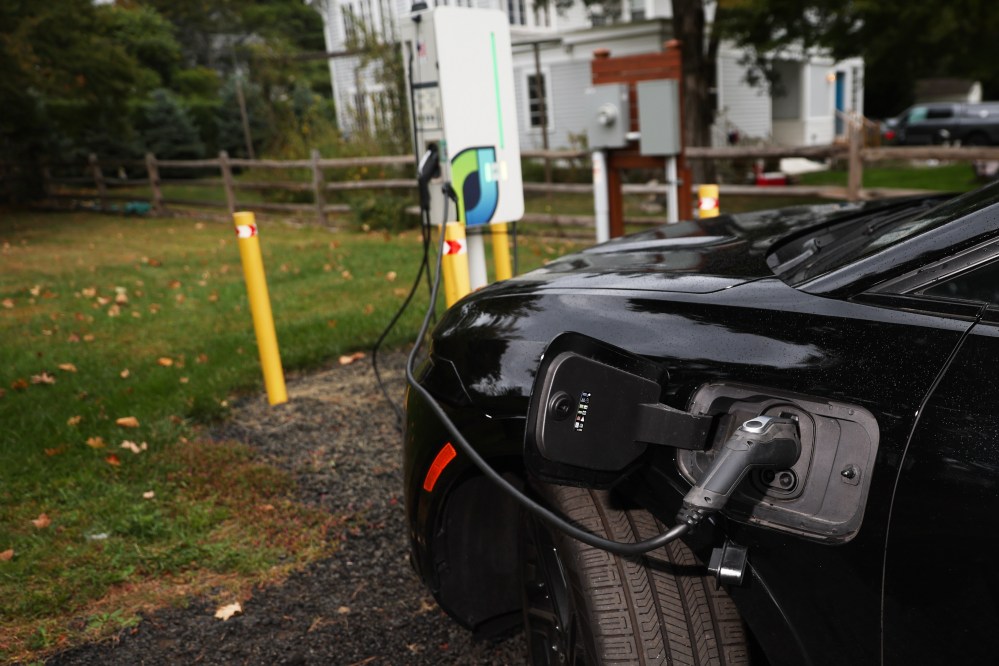
DETROIT (AP) — The build-out of electric vehicle charging in the U.S. has not stopped since President Donald Trump returned to office. But the administration and Congress are continuing to throw up new roadblocks.
Those include the administration withholding charger money to Democratic-controlled states and Congress slicing away at separate infrastructure funding across other states.
And this week, Transportation Secretary Sean Duffy decreed that chargers must now be fully American-made — a difficult requirement that is certain to delay them.
Here’s where things stand.
EVs cool off, but fast-charging build-out has stayed hot
Even as EV adoption in the U.S. stayed just about the same last year as it did in 2024, fast-charging installations saw record-breaking growth, according to a year-end report from data firm Paren.
The industry added more than 18,000 new fast-charging ports, amounting to a 30% increase year-over-year.
The expansion of fast charging is especially important for EV drivers taking longer trips or those without alternatives such as home charging, which can be done overnight or over a longer period of time. But charging availability overall remains a concern for U.S. drivers considering an EV purchase.
Slower charging options, known as Level 1 and Level 2 charging, have also grown.
Trump attacks charging
Most recently, the Trump administration is attempting to withhold money for charging infrastructure from Democratic-controlled states, directing the Department of Transportation to cancel funds for California, Colorado, Illinois and Minnesota.
Representatives for the four governors’ offices told The Associated Press this week they had not yet received official notice of the cancellations.
Congress, meanwhile, has rescinded more than $800 million in separate, previously appropriated charger money for several other states in its recent budget bill decisions, including Texas and Florida.
And another wrench
This week, Transportation Secretary Sean Duffy announced that states receiving federal money for EV chargers will have to install ones made entirely with U.S. parts. While yet to be finalized, the requirement was previously for 55% of the parts to be American.
“Now we’re ensuring that if Congress wants to see these chargers built, we put America First,” Duffy said in a statement. ”Doing so will unleash American manufacturing, protect our national security, and prevent taxpayer dollars from subsidizing our foreign adversaries.”
But experts say chargers of 100% U.S. parts could be nearly impossible with the current supply chain.
“By creating unreasonable standards and regulatory uncertainty for domestic manufacturers, such actions may cause supply chain disruptions, drive up costs, or cede market share to international competitors,” said Albert Gore, executive director of the Zero Emission Transportation Association.
Democratic Sen. Sheldon Whitehouse of Rhode Island, ranking member of the Senate’s environment committee, said: “This administration’s message is clear: don’t build.”
It all goes back to NEVI
The congressional cuts and Duffy’s rule hamper the National Electric Vehicle Infrastructure program, born out of the Biden administration’s Bipartisan Infrastructure Law that was passed by Congress in 2021.
It gave $5 billion to states over five years in an attempt to fill gaps in the nation’s public EV charging, focusing on highway corridors and in other areas in need of infrastructure. (Another $2.5 billion was allocated through what is called the Charging and Fueling Infrastructure Discretionary Grant Program, or CFI.)
Last February, the Trump administration directed states to stop spending the funds for EV charging.
In May, 17 of the states that received program funds sued the administration and challenged the Federal Highway Administration over the money, and a federal judge ruled they must release billions of dollars to 14 of the state recipients.
At the end of last year, 16 Democratic-led states and the District of Columbia launched a second lawsuit over the withholding of $2 billion of the funding. In January, the same judge ruled that the administration must also release these funds.
Only a fraction of what was obligated has been spent so far given not all of the funds have been available, according to Loren McDonald, chief analyst at EV data firm Chargeonomics, which tracks the state awards.
Despite the administration’s loss in both lawsuits, Congress’ spending reallocation and Duffy’s proposed rule means further bumps in the road for NEVI, McDonald said. At the worst, some experts say both could effectively kill the program.
Broader EV stance
Since his first day back in the White House, Trump has targeted several policies friendly to cleaner cars and trucks in favor of those promoting gasoline-powered vehicles.
Trump revoked the Biden administration’s target for half of all new vehicle sales in the U.S. to be electric by 2030.
In its tax and spending bill signed into law by Trump last summer, Congress eliminated federal tax credits that saved buyers up to $7,500 off new and used electric vehicle purchases.
The administration has plans to weaken the rules set for how far automakers’ new vehicles must travel on average on a gallon of gasoline, and is undermining the climate regulation at the core of auto tailpipe emissions.
“We need to do more to make sure that the broader benefits and value proposition for transportation electrification is not just stuck in a climate debate, and really, needs to be re-centered on the future of the auto industry in the U.S. and how we’re going to compete,” said Ben Prochazka, executive director of the nonprofit Electrification Coalition.
___

Alexa St. John is an Associated Press climate reporter. Follow her on X: @alexa_stjohn. Reach her at ast.john@ap.org.
___
Read more of AP’s climate coverage.
___
The Associated Press’ climate and environmental coverage receives financial support from multiple private foundations. AP is solely responsible for all content. Find AP’s standards for working with philanthropies, a list of supporters and funded coverage areas at AP.org.