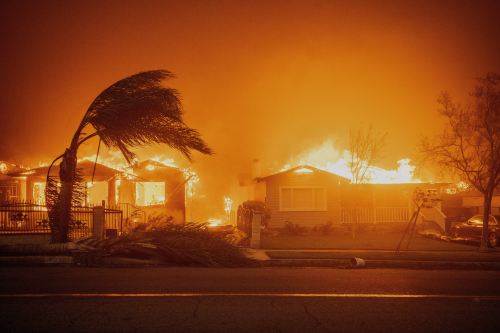
California announces investigation into delayed evacuation orders during LA-area wildfire
Advertisement
Read this article for free:
or
Already have an account? Log in here »
To continue reading, please subscribe:
Digital Subscription
One year of digital access for only $1.44 a week*
- Enjoy unlimited reading on winnipegfreepress.com
- Read the E-Edition, our digital replica newspaper
- Access News Break, our award-winning app
- Play interactive puzzles
*Billed as $5.77 plus GST every four weeks. After 52 weeks, price increases to the regular rate of $19.95 plus GST every four weeks. Offer available to new and qualified returning subscribers only. Cancel any time.
To continue reading, please subscribe:
Add Free Press access to your Brandon Sun subscription for only an additional
$1 for the first 4 weeks*
- Enjoy unlimited reading on winnipegfreepress.com
- Read the E-Edition, our digital replica newspaper
- Access News Break, our award-winning app
- Play interactive puzzles
*Your next Brandon Sun subscription payment will increase by $1.00 and you will be charged $17.95 plus GST for four weeks. After four weeks, your payment will increase to $24.95 plus GST every four weeks.
Read unlimited articles for free today:
or
Already have an account? Log in here »
Hey there, time traveller!
This article was published 12/02/2026 (250 days ago), so information in it may no longer be current.
LOS ANGELES (AP) — California’s top prosecutor announced a civil rights investigation Thursday into how delayed evacuations impacted a historically Black community ravaged by one of last year’s deadly wildfires near Los Angeles.
Attorney General Rob Bonta said the investigation was spurred by months of conversation with community members and fire survivors concerned about the disparate impact of the fire on the west side of Altadena, an unincorporated town in LA County. The Eaton Fire was one of two blazes that broke out on Jan. 7, 2025. It killed 19 people and destroyed more than 9,400 structures.
The overarching question is whether “unlawful race, disability, or age-based discrimination in the emergency response result in a delayed evacuation notification that disproportionately impacted west Altadena,” Bonta said.

All but one of the deaths occurred in west Altadena, which received evacuation orders hours after the east side of town and well after homes were already burning, the Los Angeles Times first reported.
By midnight, roughly six hours after the fire sparked, none of the neighborhoods west of Altadena’s North Lake Avenue had been issued an evacuation warning, The Associated Press found. Orders expanded significantly after 3 a.m. One West Altadena resident told AP she didn’t receive alerts to leave until hours after she’d already packed up and fled.
Bonta said most of the investigation’s attention will be focused on the LA County Fire Department, looking at whether the existing systems contributed to the delayed evacuation notices and possible disparities in emergency response. He expects officials to voluntarily comply in sharing information with investigators.
“The families forever changed because of the Eaton Fire deserve nothing less than our full commitment,” he said.
LA County said in a statement that it will fully cooperate with the investigation. The county said it has fully cooperated in all independent reviews, and “none have found any discriminatory or structural bias in the County’s response.”
“We believe the Attorney General will find that emergency responders did the best they could under unprecedented and extreme conditions as they fought to save lives, homes, and businesses,” the statement read.
Altadena for Accountability, a group of fire survivors that campaigned for an investigation into the county’s fire response over the past year, called Bonta’s announcement a “trailblazing move” in a press release.
“Losing my home and seeing my parents lose theirs was devastating. I’m heartened today knowing that we have a real pathway to answers and accountability for what went wrong,” fire survivor Gina Clayton-Johnson said in a statement. “This is a big day for all fire survivors today and victims of climate change disasters in the future.”
A 2025 after-action report on evacuations by an independent group found that the county had “conflicting and outdated policies, protocols” and procedures over who has what authority in the evacuation decision-making process. It did not explain why evacuation orders in west Altadena came late.
A confusing patchwork of alert systems and delays in people getting critical information has been an issue after other major fires including the 2018 Camp Fire in Paradise, California, the 2023 Lahaina Fire in Hawaii and the 2021 Marshall Fire that destroyed more than 1,000 homes outside of Denver. Experts have pointed out inherent flaws in such systems that rely on cellphones and other technology to alert people, particularly older residents and those with disabilities.
Chauncia Willis-Johnson, founder of the Institute for Diversity and Inclusion in Emergency Management, said decision-making in emergency management comes with built-in biases, such as assuming everyone has access to vehicles or only needs a certain number of hours to evacuate, for example.
To overcome those biases, people have to be trained to operate with equity as their first priority, Willis-Johnson said.
“I don’t think any emergency response manager purposely hurts anyone,” she said. “But when you’re not prioritizing historically marginalized populations that don’t have the resources to get alerts or warnings any other way … you’re leaving them behind.”