

Debris from Hurricane Helene is helping fuel Georgia’s wildfires
Advertisement
Read this article for free:
or
Already have an account? Log in here »
To continue reading, please subscribe:
Digital Subscription
One year of digital access for only $1.44 a week*
- Enjoy unlimited reading on winnipegfreepress.com
- Read the E-Edition, our digital replica newspaper
- Access News Break, our award-winning app
- Play interactive puzzles
*Billed as $5.77 plus GST every four weeks. After 52 weeks, price increases to the regular rate of $19.95 plus GST every four weeks. Offer available to new and qualified returning subscribers only. Cancel any time.
To continue reading, please subscribe:
Add Free Press access to your Brandon Sun subscription for only an additional
$1 for the first 4 weeks*
- Enjoy unlimited reading on winnipegfreepress.com
- Read the E-Edition, our digital replica newspaper
- Access News Break, our award-winning app
- Play interactive puzzles
*Your next Brandon Sun subscription payment will increase by $1.00 and you will be charged $17.95 plus GST for four weeks. After four weeks, your payment will increase to $24.95 plus GST every four weeks.
Read unlimited articles for free today:
or
Already have an account? Log in here »
NAHUNTA, Ga. (AP) — Some of the destructive wildfires tearing through Georgia this week are being fed by not only a persistent drought, but also by fallen trees and limbs scattered across the South by Hurricane Helene well over a year ago.
Blustery winds also are helping ignite and expand the fires in Georgia and Florida that have blanketed parts of several states in smoke, leading to air quality warnings Thursday in cities far from the blazes.
Shifting winds made for another high-risk day with more evacuations ordered near Georgia’s coast, where a wildfire has now destroyed close to 90 homes and threatened more.
Residents there were warned to leave as many as 200 homes. Farther to the west, Georgia’s biggest fire near the Florida state line doubled in size in less than a day and by Thursday had burned through a sparsely populated area twice the size of Manhattan.
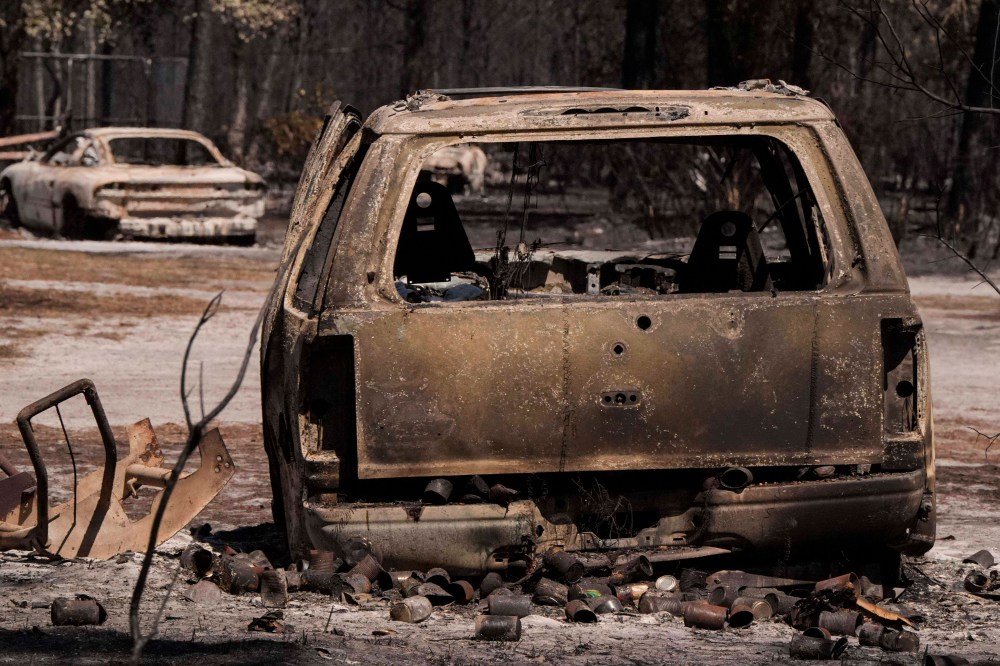
Images from the devastated areas showed the shells of charred cars and trucks sitting next to the smoldering ruins of homes nestled among blackened trees.
Many who were forced to flee this week were distraught over the homes and animals they left behind.
“I don’t know if I have a house standing or not,” said Denise Stephens, who evacuated her home near Hortense because of the fast-moving Brantley County fire. “I know what it’s taken from other people, but I don’t know what I have left standing.”
Wood debris littering the state’s southern half since Hurricane Helene churned through in September 2024 has enabled some of the blazes to spread and intensify quickly, officials said.
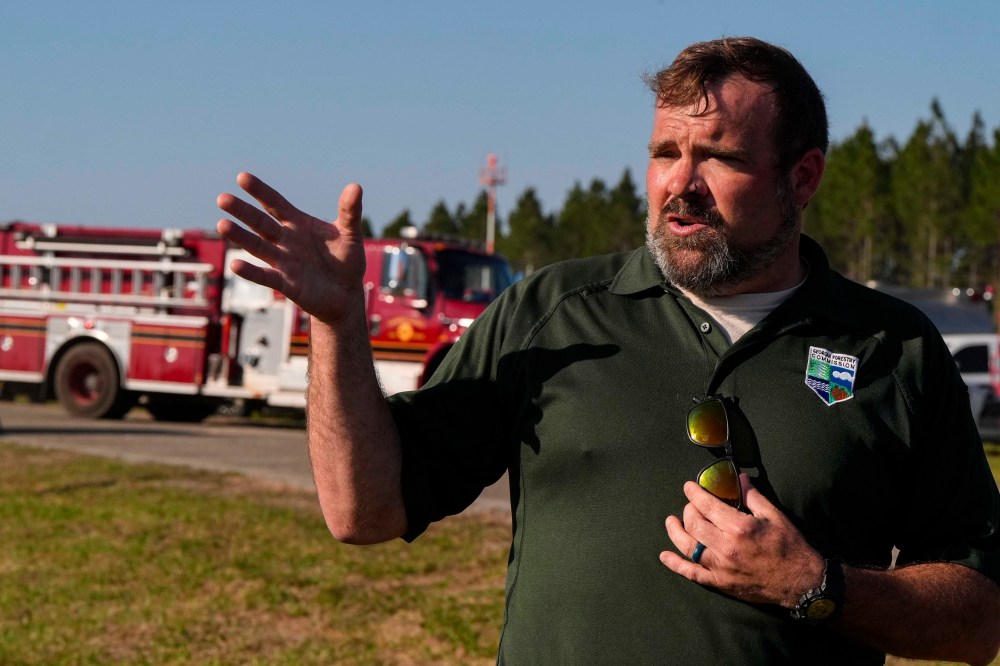
“There’s a ton of old Hurricane Helene debris down in the woods,” said Seth Hawkins, a Georgia Forestry Commission spokesperson. “It’s lying around, and it’s just a tinderbox out there.”
The forestry commission estimated that Helene swept across nearly 14,000 square miles (36,000 square kilometers) of forestland statewide, striking areas where trees are grown for paper and lumber.
In Helene’s wake, cleanup efforts were rolled out across southern Georgia. The state put up roughly $135 million to help private timberland owners remove fallen trees, and the Army Corps of Engineers hauled off millions of cubic yards of debris.
But they couldn’t get everything.
“The way Helene just threw everything down like matchsticks, there’s only so much you can do short of bulldozing everything,” Hawkins said. “There are big pockets of woods out there where people don’t walk around too much. So it just kind of gets left there.”
Brantley County, where most of the evacuations have been ordered, has less hurricane debris in its forests than some neighboring counties, County Manager Joey Cason said.
But as the wildfire continued to expand and remained unpredictable, some residents decided to stay put.
“I’ve been in the fire area today on both sides of it, and we have folks that are sitting in their front yards running sprinklers,” Brantley County Sheriff Len Davis said. “So some are leaving, and some are staying.”
It is not known yet how the wildfires started, but the bottom half of Georgia and northern Florida are both extremely dry.

In Florida, firefighters were battling more than 130 wildfires, mostly in the state’s northern half. Fire crews in Georgia responded to 34 new and relatively small blazes Wednesday, the forestry commission said.
Smoke drifted across a large area of the Southeast, making the air unhealthy Thursday for children and people with lung or heart problems in cities as far as Columbia, South Carolina. A haze hung over Atlanta’s skyline a day earlier, and there was a smoky smell across the metro area.
Officials are hoping for rain to help tame the fires, and there is a 30% to 40% chance of showers or thunderstorms in the area of both big Georgia fires this weekend, according to the National Weather Service. While showers could bring welcome relief, thunderstorms could also produce lightning capable of sparking more fires.
___
Martin reported from Atlanta, and Bynum from Savannah. Associated Press writer John Seewer in Toledo, Ohio, contributed.