B.C. bats ‘do not know the border’ — and Trump funding cuts may put them in peril
Advertisement
Read this article for free:
or
Already have an account? Log in here »
To continue reading, please subscribe:

Digital Subscription
One year of digital access for only $205*
- Enjoy unlimited reading on winnipegfreepress.com
- Read the E-Edition, our digital replica newspaper
- Access News Break, our award-winning app
- Play interactive puzzles
*First annual payment billed as $205.00 + GST for one year. This annual subscription will automatically renew at $233.00 + GST every 52 weeks (10% off the regular annual price of $259.35). Offer available to new and qualified returning subscribers only. Cancel any time.
To continue reading, please subscribe:
Add Free Press access to your Brandon Sun subscription for only an additional
$1 for the first 4 weeks*
- Enjoy unlimited reading on winnipegfreepress.com
- Read the E-Edition, our digital replica newspaper
- Access News Break, our award-winning app
- Play interactive puzzles
*Your next Brandon Sun subscription payment will increase by $1.00 and you will be charged $17.95 plus GST for four weeks. After four weeks, your payment will increase to $24.95 plus GST every four weeks.
Read unlimited articles for free today:
or
Already have an account? Log in here »
Scientists battling a deadly infection that has killed millions of bats in North America say the tiny creatures don’t care about borders, as they flit between British Columbia and Washington state.
But geopolitical realities now pose a potential threat to the winged mammals, since the administration of U.S. President Donald Trump cut off funding for B.C. researchers who had been working on both sides of the border in the fight against white-nose syndrome.
Biologist Cori Lausen, the director of bat conservation at Wildlife Conservation Society Canada, helped develop a probiotic cocktail to protect bats from the fungal infection, and in 2023, it was sprayed into bat roosts in Washington state, yielding promising results.
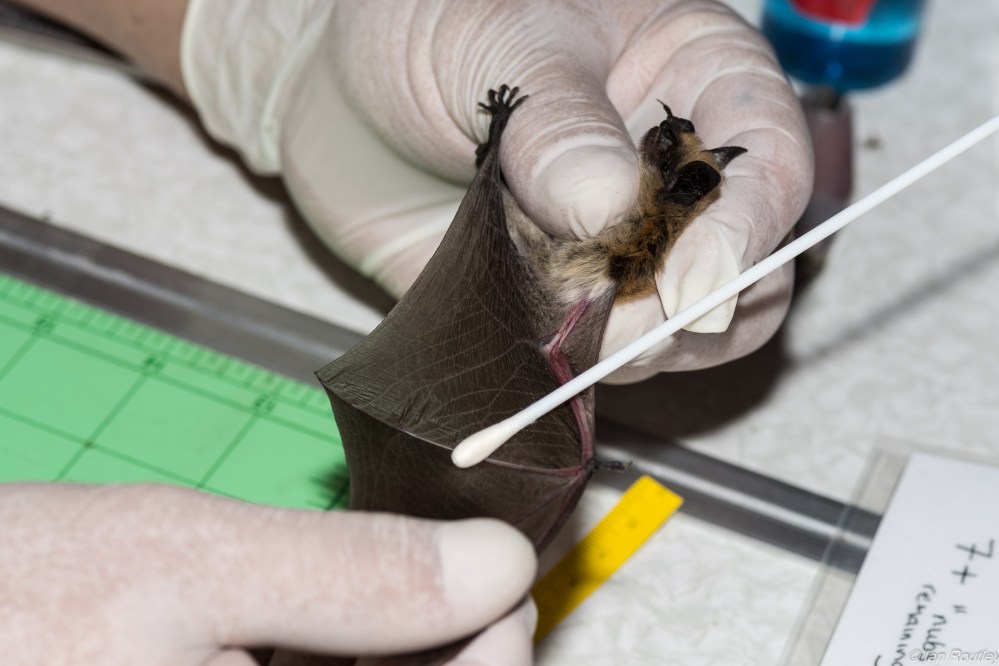
The U.S. provided about a quarter of the funding for the project through the federal government and Washington state organizations.
“But as soon as Trump got in, we got a stop-work order,” said Lausen. “So, basically, there’s no more federal money coming from the U.S. into Canada to work on this.
“And the funding isn’t there now to treat it as a transborder project,” said Lausen, adding that they’re no longer even eligible for further U.S. federal funding.
Neither the U.S. Fish and Wildlife Service nor Washington state’s Department of Fish and Wildlife immediately responded to a request for comment.
The urgency of the cross-border battle was underscored by the announcement in March of the discovery of the fungus that causes white-nose syndrome in bat excrement, or guano, collected in Metro Vancouver.
While no bats in B.C. have been confirmed to have white-nose syndrome, the fungus had previously been detected in guano in the Grand Forks area near the border in the Interior in 2022.
Mandy Kellner, bat conservation co-ordinator with B.C.’s Ministry of Water, Land and Resource Stewardship, said the fungus being detected again in the province is “pretty darn important news.”
“We haven’t found any bats with the disease yet, but the way that it usually goes is within the finding of the fungus, within two or three years usually, you are finding dead bats,” said Kellner.
White-nose syndrome has wiped out more than six million bats in North America since 2006, and Lausen said B.C. is the “last stronghold” for the creatures, as she called for the province to step in with more funding.
B.C. had previously provided about four per cent of the $2 million in funding for the probiotic project.
“It’s like watching a tidal wave coming towards us, and we’re doing nothing. It’s just a matter of time, but we are putting no effort or money toward it,” said Lausen.
“This isn’t just any wildlife. We’re talking a little more than 12 per cent of all terrestrial mammal biodiversity in B.C. is bats, and they’re basically the prime insect-eating group of mammals that we have.”
She said B.C.’s bats eat more than half their body weight in insects each night, making them important for natural pest control and benefiting agriculture and forest industries.
White-nose syndrome is caused by the fungus Pseudogymnoascus destructans, which grows on the muzzles and wings of bats, rousing them more frequently during hibernation, exhausting their energy and starving them to death.
The probiotic cocktail to fight the fungus was developed in 2017 by Lausen, McMaster University biologist Jianping Xu and Naowarat Cheeptham, a professor in the biology department of Thompson Rivers University.
Lausen said it’s good news that the disease hasn’t yet been detected in bats in B.C., given its proximity to Washington state and Alberta, where the fungus is “all over the place.”
She complained about a lack of provincial funding for tests, which Kellner said had also been delayed by labour strikes last year.
Xu said the new detection of the fungus in B.C. is “definitely a concern,” especially since it’s hard to track down hibernation and roosting sites in B.C., unlike in eastern North America, where many bats hibernate in caves, and it’s “relatively more straightforward” to find dead ones.
“Even if many of them have been affected by the white-nose syndrome (in B.C.), we really don’t know where they are,” said Xu.
Lausen said the probiotic testing in Washington had produced encouraging results, including that “when a bat has high probiotic bacteria in its wings, it has low or no fungus,” which she called a “significant correlation.”
But in early 2025, the Trump administration issued a sweeping stop-work order on foreign aid — including the bat project, even though it was being conducted partly in the United States.

Funding for work at treatment sites in Washington is set to run out in a year, Lausen said.
Lausen said the bat research needs more provincial funding, and if action on white-nose syndrome is delayed too long, B.C. could be facing the same situation as Alberta, which is experiencing “full-blown disease.”
Cheeptham said bats “do not know the border,” and as scientists, she wishes the probiotic team didn’t need to worry about politics either.
“We just want to do our good work,” she said.
This report by The Canadian Press was first published May 4, 2026.