

A gold-fueled mining rush scars Brazil’s Amazon, spiking deforestation and mercury risks
Advertisement
Read this article for free:
or
Already have an account? Log in here »
To continue reading, please subscribe:

Digital Subscription
One year of digital access for only $205*
- Enjoy unlimited reading on winnipegfreepress.com
- Read the E-Edition, our digital replica newspaper
- Access News Break, our award-winning app
- Play interactive puzzles
*First annual payment billed as $205.00 + GST for one year. This annual subscription will automatically renew at $233.00 + GST every 52 weeks (10% off the regular annual price of $259.35). Offer available to new and qualified returning subscribers only. Cancel any time.
To continue reading, please subscribe:
Add Free Press access to your Brandon Sun subscription for only an additional
$1 for the first 4 weeks*
- Enjoy unlimited reading on winnipegfreepress.com
- Read the E-Edition, our digital replica newspaper
- Access News Break, our award-winning app
- Play interactive puzzles
*Your next Brandon Sun subscription payment will increase by $1.00 and you will be charged $17.95 plus GST for four weeks. After four weeks, your payment will increase to $24.95 plus GST every four weeks.
Read unlimited articles for free today:
or
Already have an account? Log in here »
SAO PAULO (AP) — The surge in gold prices in recent years has fueled a renewed mining rush in Brazil’s Amazon rainforest, accelerating deforestation in protected areas and driving mercury contamination to hazardous levels, officials and experts say.
A study released Tuesday by the nongovernmental organization Amazon Conservation, in partnership with Brazilian nonprofit Instituto Socioambiental, found illegal mining sites drove clear-cutting inside three conservation areas in the Xingu region, one of the world’s largest expanses of protected forest, spanning the states of Para and Mato Grosso. The analysis combined satellite imagery with ground research.
The Terra do Meio Ecological Station recorded its first cases of illegal mining in September 2024. By the end of 2025, mining-related deforestation there had spread to 30 hectares (74 acres). At the Altamira National Forest, illegal mining accumulated 832 hectares (2,056 acres) of deforestation between 2016 and September 2025. A new mining front that opened in 2024 expanded to 36 hectares (89 acres) by October 2025, accounting for nearly half the mining-related deforestation recorded in the unit during that year.
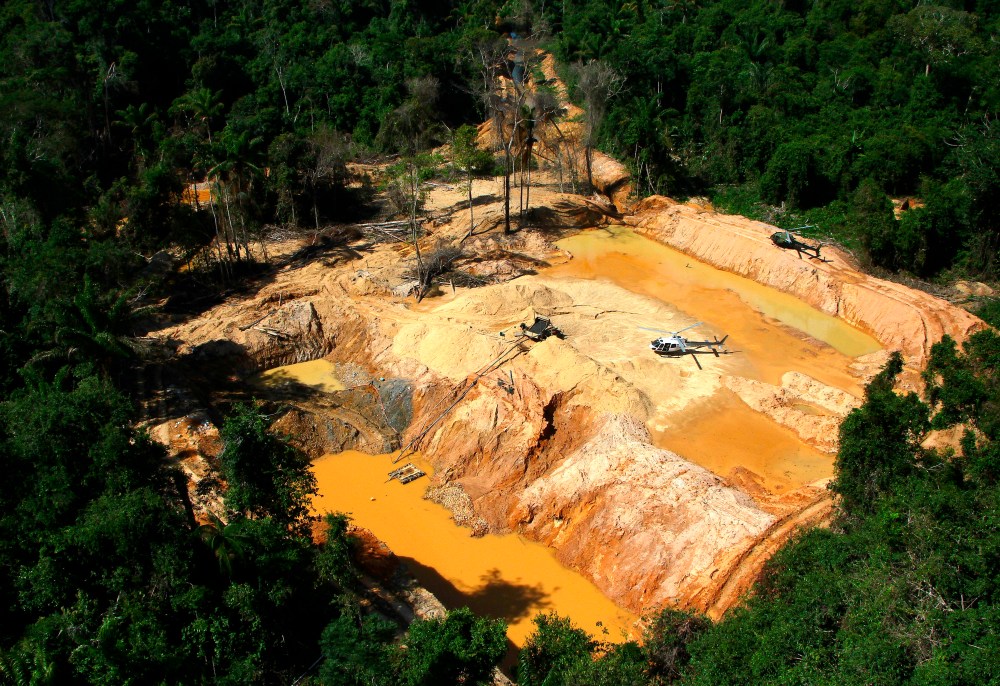
Satellite monitoring also detected a clandestine airstrip used by illegal miners at the Nascentes da Serra do Cachimbo Biological Reserve last year. Illegal mining in the reserve grew from 2 hectares (5 acres) to at least 26.8 hectares (66 acres) in 2025.
Most deforestation from mining is illegal, group says
In 2023, Amazon Conservation teamed up with Earth Genome and the Pulitzer Center to develop the Amazon Mining Watch, a platform that uses satellite imagery to track mining across the Amazon since 2018. About 496,000 hectares (1,225,640 acres) of rainforest have been cleared for mining since then, including approximately 223,000 hectares (551,045 acres) in the Brazilian Amazon. Amazon Conservation estimates that 80% of mining-related deforestation in Brazil carries a high risk of taking place illegally.
Mining remains a relatively small driver of deforestation in Brazil, where forest loss is largely linked to agribusiness expansion. In 2025, for example, some 579,600 hectares (1.432 million acres) of the Brazilian Amazon were cleared, according to official data. About 17,000 hectares (42,000 acres) were related to mining, according to the Mining Watch.
“What makes mining particularly problematic is that it targets protected areas and Indigenous territories,” said Matt Finer, director of Amazon Conservation’s Monitoring of the Andes Amazon program.
Protecting Indigenous territories is widely seen as an effective way to curb deforestation in the Amazon, the world’s largest rainforest and a key regulator of global climate. Researchers warn that continued forest loss could accelerate global warming.
Enforcement is often a ‘cat-and-mouse’ game
In 2023, Brazilian authorities launched a major crackdown on illegal gold mining in the Yanomami Indigenous territory in Roraima state, along the border with Venezuela, after a surge led to a humanitarian and health crisis. Annual growth in newly mined areas there fell sharply after that year, according to Amazon Conservation data. Although mining has not been fully eliminated, nearly all deforestation inside the Yanomami territory — about 5,500 hectares (13,590 acres) — had taken place by 2023.
Still, localized enforcement has not curbed illegal mining across the Amazon. When authorities destroy dredges and equipment in one region, miners often relocate or resume operations once officials leave. Federal prosecutor André Luiz Porreca, who investigates illegal mining in the western Brazilian Amazon, described enforcement as a “cat-and-mouse game.”
“Last year, I took part in an operation that destroyed more than 500 dredges on an Indigenous land,” Porreca said. “The following week, Indigenous people showed me photos proving the miners had already returned.”
Porreca said illegal gold mining is financed by Brazil’s largest criminal organizations, including the Red Command and the First Capital Command, or PCC, which operate in about a third of the cities in the Brazilian Amazon. “They have the money to bankroll these operations. Some dredges cost as much as 15 million reais.”
While enforcement eased pressure in Yanomami territory, illegal mining has intensified elsewhere, particularly across Indigenous lands in the Xingu River basin. The most critical situation is on the Kayapo Indigenous land, where roughly 7,940 hectares (19,620 acres) of rainforest have been cleared by illegal mining, the largest such area in the Brazilian Amazon.
Gold has driven mercury contamination
Record-breaking gold prices, driven largely by investor demand for safe assets amid rising global risks, have provided a strong incentive for illegal mining.
“It’s basic market logic. With more buyers, there are more people exploiting gold,” Porreca said. He said Brazil’s mineral export control system remains weak, allowing laundering schemes that give illicit gold the appearance of legality.
Environmental damage extends beyond deforestation. Illegal mining operations dump mercury into rivers, contaminating waterways and accumulating in fish consumed by riverine and Indigenous communities.
In April, Porreca submitted a report to the Inter-American Commission on Human Rights describing widespread mercury contamination in the Amazon. The report cited a study by Fiocruz, a state-run research institution, which found that 21.3% of fish sold in public markets across the Amazon exceeded mercury limits set by the World Health Organization. Children ages 2 to 4 were consuming mercury at levels up to 31 times higher than the recommended maximum.
Mining an increasing concern among environmentalists and Indigenous

Under Brazilian law, mining is prohibited on Indigenous lands. The Ministry of Indigenous peoples said in a statement that combating illegal mining on Indigenous lands is a priority of President Luiz Inácio Lula da Silva’s administration. The ministry said mining invasions are sustained by criminal networks and confronting them requires dismantling those economic and logistics chains.
The Ministry of Environment said mercury contamination from illegal gold mining remains a persistent problem in the Amazon, adding that it is expanding scientific monitoring while supporting enforcement efforts.
Brazil’s Federal Police did not respond to requests for comment from The Associated Press.
___
The Associated Press’ climate and environmental coverage receives financial support from multiple private foundations. AP is solely responsible for all content. Find AP’s standards for working with philanthropies, a list of supporters and funded coverage areas at AP.org.




