Help wanted: Workforce planning key for northern infrastructure, military projects
Advertisement
Read this article for free:
or
Already have an account? Log in here »
To continue reading, please subscribe:

Digital Subscription
One year of digital access for only $205*
- Enjoy unlimited reading on winnipegfreepress.com
- Read the E-Edition, our digital replica newspaper
- Access News Break, our award-winning app
- Play interactive puzzles
*First annual payment billed as $205.00 + GST for one year. This annual subscription will automatically renew at $233.00 + GST every 52 weeks (10% off the regular annual price of $259.35). Offer available to new and qualified returning subscribers only. Cancel any time.
To continue reading, please subscribe:
Add Free Press access to your Brandon Sun subscription for only an additional
$1 for the first 4 weeks*
- Enjoy unlimited reading on winnipegfreepress.com
- Read the E-Edition, our digital replica newspaper
- Access News Break, our award-winning app
- Play interactive puzzles
*Your next Brandon Sun subscription payment will increase by $1.00 and you will be charged $17.95 plus GST for four weeks. After four weeks, your payment will increase to $24.95 plus GST every four weeks.
Read unlimited articles for free today:
or
Already have an account? Log in here »
Canada’s North has an outsized presence on the list of infrastructure proposals referred to the federal major projects office so far, all while Ottawa looks to spend big on bolstering the country’s military presence in the Arctic.
The scale of the work ahead is “enormous,” Prime Minister Mark Carney said at a news conference in Yellowknife in March to announce more than $35 billion on forward operating locations and other military investments in the Northwest Territories, Nunavut and Yukon.
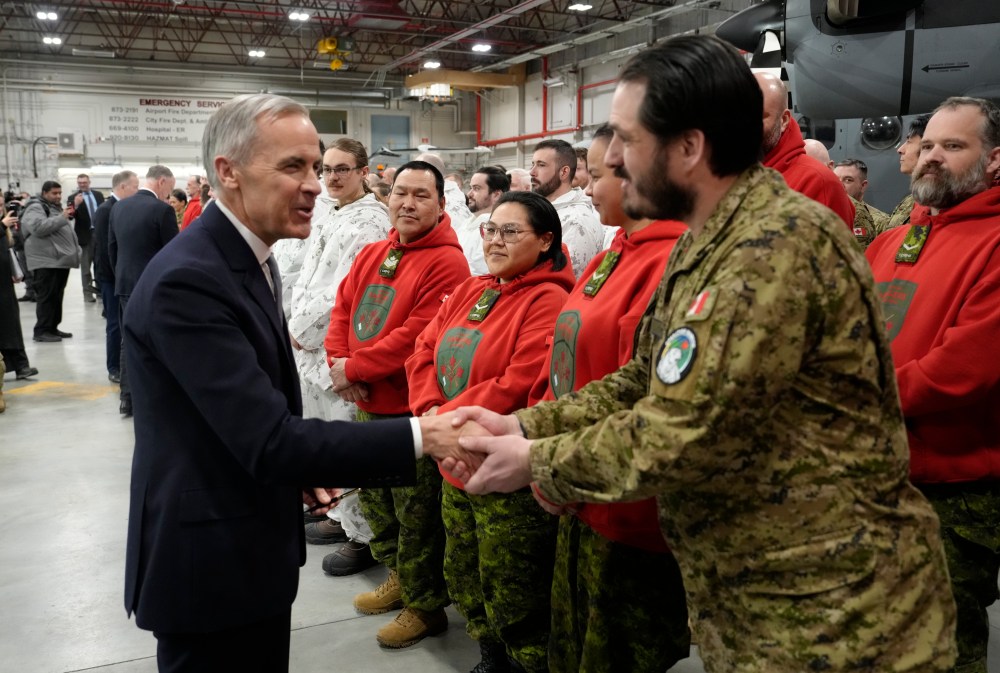
“So there’s a need to sequence and augment the construction capacity in the North,” he said.
“One of the things we collectively have to do is make sure first and foremost, the people of the North are benefiting from the construction — they’re engaged, they’re in it, they are part of it — but also that the equipment is available, it’s in the right place at the right time and it’s sequenced across a very vast land.”
The work on roads and ports, hydro dams and power lines, military buildings and airstrips is going to take a lot of people-power in a sparsely populated region where skilled labour is already in high demand. It’s doable, but experts and business leaders say it will take big-picture thinking, long-term planning and deep collaboration with local Indigenous communities to pull off.
Jim Landon, president of ATCO Frontec and a former British army colonel, told the Arctic Energy Resource Symposium earlier this year that the scale of the investment that will be needed in the North “staggers” him. His company, a unit of Calgary-based conglomerate ATCO Ltd., provides workforce accommodation and other services in remote regions.
Landon delivered the keynote speech days after ATCO announced it had acquired a 40 per cent ownership stake in a Nunavut road-and-port project, which coincidentally had been referred to the major projects office less than two weeks earlier.
He asked whether the federal government and southern construction firms “really understand the degree of extra cost involved in operating in the North.”
The element that worries him most is the lack of people in the skilled trades.
“We find it hard recruiting in the North because a lot of the talented people, the kinds of people we’re looking for, are already in employment. And it is really tough to get people through the training programs that we run. It takes time,” he said.
Landon said he has “raised eyebrows” among general construction firms by stressing how important it is in the North to have equity partnerships with local Indigenous groups and ensure they share in the benefits.
“A lot of them are not expecting this. It is not what they’re used to south of 60 and it’s going to take some different thinking.”
Fifteen proposals have been referred to the federal major projects office, set up by Carney’s government last year with the goal of speeding along approvals for projects deemed in Canada’s national interest. One-third are north of the 60th parallel — three in the Northwest Territories and two in Nunavut.
In the N.W.T., there’s the Taltson Hydro Expansion project, which would double hydroelectric power capacity in the territory. There are also two proposed all-season roads: the 800-kilometre Mackenzie Valley Highway in the west and the Arctic Economic and Security Corridor in the east. The latter aims to serve both military and civilian uses.
In Nunavut, the Grays Bay Road and Port also aims to spur military and civilian infrastructure. It involves a 230-kilometre all-season road that, along with the security corridor in the N.W.T., would create the first overland connection from the southern highway network to an Arctic deepwater port. The Grays Bay proposal also envisions a mineral export terminal and an air strip. In Nunavut, a hydroelectric project near Iqaluit has also been referred to the major projects office.
West Kitikmeot Resources Corp., the Inuit-led company spearheading Grays Bay with ATCO’s support, said in its impact statement that it anticipates 675 direct and spinoff jobs to result from construction, and 257 during operation.
Heather Exner-Pirot, director of energy, natural resources and environment at the Macdonald-Laurier Institute, said that in Nunavut, mines are already having a tough time hiring enough local Inuit under benefit agreements signed between companies and communities.
“You have to appreciate that everyone is competing for Inuit labour in the territory. There’s only so many skilled and university educated Inuit,” she said.
“The federal government wants to hire them, the territorial government wants to hire them, municipal governments want to hire them, Inuit organizations want to hire them and the mining sector wants to hire them.”
So projects will likely need to hire construction crews from the South and have them rotate through on a fly-in-fly-out basis, she said. Companies would need to offer “a ton of money” to attract workers into those kinds of positions, she said.
It would be “crazy” to have multiple projects going on in a northern territory at one time, Exner-Pirot added. There are tradespeople who are needed for vital non-megaproject work.
“You still build homes, build schools, build hospitals. You get people connected to electricity. You still need people for that.”
Not to mention it can take a year to even plan deliveries of equipment in the North, given the dearth of existing transport infrastructure and unpredictable climate, she added.
The Northwest Territories is in a bit of a different situation as its diamond mining sector winds down, freeing up workers.
The mines have accounted for about 1,000 direct and indirect jobs, said Paul Gruner, CEO of Tlicho Investment Corp., the business arm of the Tlicho Nation in the N.W.T. Many of those workers will continue in mine remediation work, but there remains the question of what can drive meaningful, high-paying employment until the N.W.T. can refocus its economy on new industries, like critical minerals.
He wants the right decisions made with a “holistic approach” in the interim before the big infrastructure and military spending gets going. In addition to the former mine workers, Gruner said it will be important to recruit from communities currently under-represented in the labour force.
“When we think about closing the infrastructure gap, which is what these projects are about, the other side of it is closing the productivity gap,” he said.

Last year, his company did a recruitment drive to support the government-led cleanup job at Giant Mine near Yellowknife, a long-closed gold mine that left behind 237,000 tonnes of toxic waste. Workers were bused in from communities outside the capital and did two-week shifts at camps. A similar setup could work on the all-season road work, he said.
“Let’s make sure we’ve got the workforce positioned, empowered, skilled and ready to go when the work begins,” he said.
“Nobody wins or succeeds if we’ve got southern companies coming in doing all of the work and you’ve got local communities and Indigenous groups that are going broke.”
This report by The Canadian Press was first published May 10, 2026.
Companies in this story: (TSX:ACO.X)