Southeast Alaskans largely critical of new direction on Tongass management plan, process
Advertisement
Read this article for free:
or
Already have an account? Log in here »
To continue reading, please subscribe:

Digital Subscription
One year of digital access for only $205*
- Enjoy unlimited reading on winnipegfreepress.com
- Read the E-Edition, our digital replica newspaper
- Access News Break, our award-winning app
- Play interactive puzzles
*First annual payment billed as $205.00 + GST for one year. This annual subscription will automatically renew at $233.00 + GST every 52 weeks (10% off the regular annual price of $259.35). Offer available to new and qualified returning subscribers only. Cancel any time.
To continue reading, please subscribe:
Add Free Press access to your Brandon Sun subscription for only an additional
$1 for the first 4 weeks*
- Enjoy unlimited reading on winnipegfreepress.com
- Read the E-Edition, our digital replica newspaper
- Access News Break, our award-winning app
- Play interactive puzzles
*Your next Brandon Sun subscription payment will increase by $1.00 and you will be charged $17.95 plus GST for four weeks. After four weeks, your payment will increase to $24.95 plus GST every four weeks.
Read unlimited articles for free today:
or
Already have an account? Log in here »
A new direction in the Tongass management plan gathered more than 300 comments from Southeast Alaskans, who asked the U.S. Forest Service to manage timber and mining, along with recreation, in the forest they call home.
The Coeur Alaska Kensington Mine said the revised plan should recognize the Tongass National Forest as a mining district, not solely as a timber or conservation reserve.
“The revised Forest Plan should affirm that responsible mineral exploration and development are fully compatible with ecological stewardship, subsistence values, and multiple use when properly planned and regulated,” wrote Steve Ball, general manager of the mine.
He also wrote Forest Service’s Roadless Area Conservation Rule prohibitions should not be applied to mining operations.
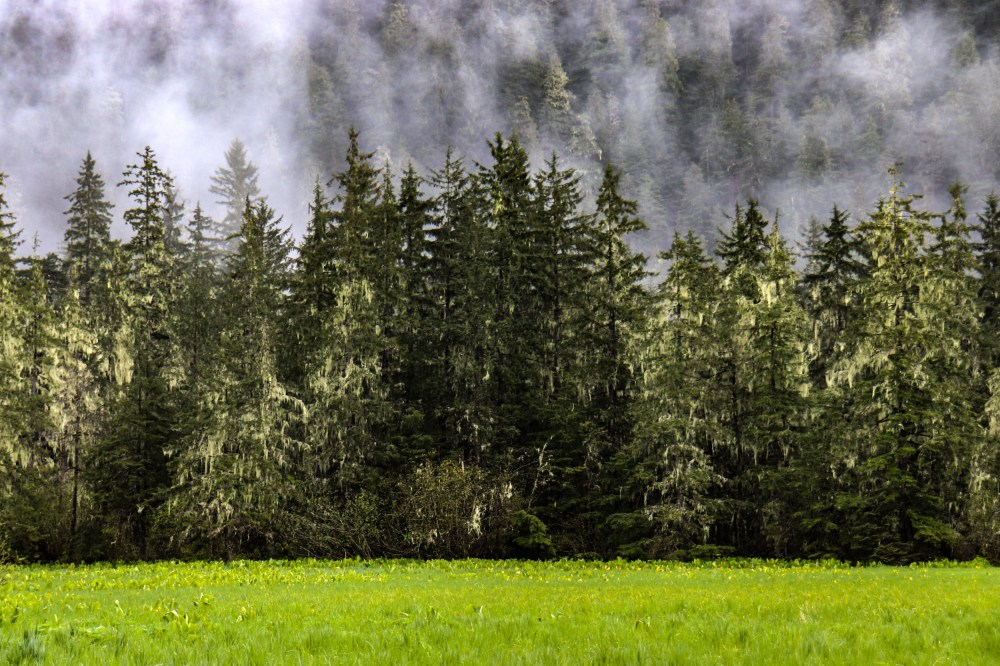
Others criticized the Trump administration and made a plea to protect old-growth forests and the wildlife that live there.
Some criticized the Forest Service itself for a rushed process.
“The rushed plan timeline threatens all other uses and important worthy and cherished treasures, especially every creature on the Tongass, including humans,” wrote James Clare. “Please provide more time for plan development, as done in the past.”
Barb Miranda, deputy forest supervisor for the Tongass National Forest, said the Forest Service is being open under a quick timeline to receive “as much public input as we can.”
“This is the Tongass,” she said. “It is our backyards. It is also a national treasure. So there’s national interest in the outcomes here. So I think the public feedback periods are really important, and we want everybody to engage in them.”
What is the forest plan and its timeline?
Forest plans set the overall management direction and guidance for national forests. During a presentation at a Juneau community workshop in April, Miranda compared it to a city zoning plan. She said the forest plan “helps guide future land use in the same way a city designates where and how future residential or commercial development is allowed.”
She said forest plans do not make site-specific decisions, such as where to put a recreation trail; rather, they aim to guide future uses of the forest by creating standards for projects and activities.
Only desired conditions and goals have been identified by the Forest Service, Miranda said, and they are not set in stone. In the past 45 days, the agency sought feedback on how to refine them. Spruce Root and the Juneau Economic Development Council assisted the Forest Service in public engagement.
Miranda said the last time public engagement took place was in April 2024, when input was gathered from 20 communities for the assessment. The assessment was developed over the course of the last two years and showed a community emphasis on recreation, protecting functioning ecosystems and sustainable timber management. The 1997 forest plan is the basis for planning documents.
“But we are in a new world with an economy where the biggest employer is tourism, and the biggest impact to communities and how we develop communities is tourism,” Miranda told workshop attendees.
“While we don’t control the cruise ships arriving or the numbers of the people on the cruise ships, we do special use permitting for the activities that occur on the Tongass off of those cruise ships,” she said.
During the assessment process, more collaboration with state, local and tribal governments, and encouragement to consider subsistence and Indigenous knowledge was also identified, according to the notice of intent.
“There might be other things that need to change, and you are welcome to share those with us too,” Miranda said.
“This is not your one and only time to provide input on the Tongass plan,” she added.
Public comments were accepted following the publication of the notice of intent in the Federal Register. The comment period for the preliminary draft plan is closed, but the Forest Service is seeking input during all phases of the forest plan, which is set to be finalized in 2028. The most recent feedback period also focused on the proposed species of conservation concern list.
A 90-day comment period will follow the publication of the draft plan and environmental impact statement this fall, according to the Forest Service. A full timeline of the revision is available here. It states the draft environmental impact statement is estimated to be published in the Federal Register this August.
The 45-day comment period for the preliminary draft plan included a series of community workshops held across Southeast Alaska.
Perspectives from Juneau’s workshop and online comments
More than 60 people attended the Juneau community workshop last month at the Juneau District Ranger Office.
April’s workshop attendees could engage in three activities: a survey on preliminary directions, maps identifying potential management areas and 14 “feedback frames,” which provided a range of alternatives for the plan.
The 2016 plan amendment includes 19 management areas, which the Forest Service is trying to narrow down, Miranda said.
“It’s very complicated and difficult to implement,” she said, adding part of the reason why the current forest plan has complexities is because of its multiple revisions.
Miranda said the new plan will provide standards for the entirety of the Tongass, but management plans may have their own specific standards and guidelines. She called the new plan “less prescriptive,” saying it allows rangers more discretion to determine paths forward for projects.
“We’ll have standards and guidelines and a vision for the entire forest that we’ll have to follow forestwide, but then areas that need to be managed differently, because they are different,” she said in an interview. “What needs to be managed differently and special? Right now, we have the old-growth areas and the watershed areas pulled out as protective areas.”
Jordynn Fulmer is a cultural ambassador at the Mendenhall Glacier with the Central Council of the Tlingit and Haida Indian Tribes of Alaska. She said she came to Juneau’s workshop “to stand strongly against clearcutting.”
“Once we take the environment away and our lands, we have nothing to depend on,” she said. “We have nothing to harvest from. We have no sources left that have been protecting us for thousands of years and multiple generations throughout.”
She added that old-growth is vital for protecting salmon streams.
In Tlingit and Haida’s online comment, the tribe wrote “a significant concern is inconsistent definitions of old growth across the plan.”
It states tribes define old growth as “as integrated cultural-ecological systems characterized by multi-century development (450–700+ years) and structural complexities overlain with layers of relationship-based tribal, clan, and family relationships,” while the Forest Service “utilized definitions based on timber-based age classifications ((tilde)150-250-year-old trees).”
The Alaska Forest Association asked the Forest Service to ensure the document is accessible to the public, and stated that old-growth forests do not need additional acres of protection. The organization added if old-growth management areas are included, they should be used to manage the timber in the Tongass “more effectively.”
“The existing industry requires durable sources of OG, and OG selections should be made in areas of the Tongass where economically viable stands exist,” wrote Tessa Axelson, AFA’s executive director. “Further, The Plan should outline how such stands can be harvested to provide sufficient timber volume to meet the demand from the forest.”
AFA also asked that all proposed alternatives “that culminate with the timber industry being dependent on YG timber should be excluded from consideration due to the NO ACTION alternative,” adding there is an insufficient volume of mature young-growth to support the industry.
Other public comments asked that the plan focus on second-growth, a shift made in the 2016 amendment, which AFA called an “error.”
In the notice of intent, the Forest Service stated it won’t “substantially alter” the old-growth conservation strategy, which was developed with scientific information in 1997. Likewise, key fishery watersheds identified in 2016 are also protected in the management area proposals.
“That’s a no change from what we’re currently doing,” Miranda said.
She added she thinks the community priorities of protecting ecosystems and managing timber production sustainably can be compatible. She said the Forest Service conducts active forest management activities to create wildlife habitat.
“By thinning young growth stands, we can create better forage for deer and better habitat for wildlife species,” Miranda said. “Whenever we’re doing a timber sale, we look at opportunities for restoring aquatic organism passages, old culverts. So I think that there is some compatibility with our active management timber production and habitat restoration and protection programs.”
An online comment submitted by Kathy Hansen, executive director of the Southeast Alaska Fishermen’s Alliance, said the plan does not adequately address protections.
“The preliminary draft plan does not adequately elevate the protection of fishery resources and habitat for consideration, instead it appears to be more managing the people’s access to the resource,” Hansen wrote. “The Tongass National Forest Service should not be managing or allocating the fishery and wildlife resources, that is the job of the State of Alaska, Board of Fish and Fishery Subsistence Board.”
Steven Grunstein worked for Wrangell Forest Products as a mechanic from 1987 to 1989. In an interview at the workshop, he said he was not a logger, but did tree thinning for three years as an independent contractor across Southeast.
“I agree that we need to protect a lot of the old growth and not put roads into it,” he said. “But at the same time, I also think that we can manage the second growth harvest responsibly.”
Grunstein said “we can do smaller mills and still not equal what we had in the past and it would give the forest a chance to recover between areas to be logged for third harvest.”
He said it’s possible by making sure mills are big enough to run and support themselves, but not so large that they have “unfillable supply.”
Nate Arrants, executive director of Haines Huts and Trails, attended forest workshops in Haines, Skagway and Juneau. He said he thought it was unhelpful the Haines and Skagway workshops only included maps for those management areas of the Tongass.
At Juneau’s workshop, maps were provided for the northern and southern Juneau Ranger District and Admiralty Island National Monument.
“I think in general, people in Southeast like Haines, care about the whole Tongass, and so they weren’t able to see on the big maps and provide feedback on those things, which was a huge issue,” Arrants said.
The map of all 19 management areas was available online, but Arrants said it would have been beneficial to have more thorough, well-explained maps in person. The Southeast Alaska Conservation Council requested the same full maps in its online comment.
Arrants added participants were generally confused by the statements posed on the feedback frames, which made it more difficult to engage. Attendees were prompted to drop chips for “agree” or “disagree” in response to the provided statement, and also had the choice to leave an additional comment.
“I think the biggest feedback is just hoping that they really are able to put a lot of time into the zoning of it,” Arrants said. “The forest is far, far larger than most of the other forests around the U.S. in such a vast, complicated landscape, so it’s something that should be taken very seriously if the plan’s going to have a lifetime of 30 years. I hope they put a lot of time into it and it seems like everyone’s been thinking the rush is pretty rushed at this point.”
He said he felt like people didn’t have enough information to help the Forest Service develop its draft plan and was concerned about missed perspectives.
Residents at the workshop and in online comments said they felt the community use areas and high-use recreation area zones didn’t accurately reflect what Southeast Alaskans want. James Taggart expressed his objection to the preliminary draft plan online.
“The area is (sic) around Barnoff Island, and Krusoff Island are designated as commercial use. These are public lands and should not have such a designation,” Taggart wrote.
The next step is for the planning team to compile responses and provide a range of alternatives for the draft environmental impact statement.
“One of the things we’ll find out from this outreach is, do these make sense?” said Michael Downs, Juneau District Forest Ranger, pointing at the zones on the map. “It may be that we didn’t come up with the best management areas. It may be that through the input, the high rec and low rec isn’t something we should do. That’s why we’re doing this, but you have to have a starting point.”
Southeast Alaska residents were encouraged to sign up for emailed updates and to keep checking the Tongass Plan Revision website. Other opportunities for public engagement are listed here.
___
This story was originally published by Juneau Independent and distributed through a partnership with The Associated Press.