Scientists find climate change is reducing oxygen in rivers worldwide
Advertisement
Read this article for free:
or
Already have an account? Log in here »
To continue reading, please subscribe:

Digital Subscription
One year of digital access for only $205*
- Enjoy unlimited reading on winnipegfreepress.com
- Read the E-Edition, our digital replica newspaper
- Access News Break, our award-winning app
- Play interactive puzzles
*First annual payment billed as $205.00 + GST for one year. This annual subscription will automatically renew at $233.00 + GST every 52 weeks (10% off the regular annual price of $259.35). Offer available to new and qualified returning subscribers only. Cancel any time.
To continue reading, please subscribe:
Add Free Press access to your Brandon Sun subscription for only an additional
$1 for the first 4 weeks*
- Enjoy unlimited reading on winnipegfreepress.com
- Read the E-Edition, our digital replica newspaper
- Access News Break, our award-winning app
- Play interactive puzzles
*Your next Brandon Sun subscription payment will increase by $1.00 and you will be charged $17.95 plus GST for four weeks. After four weeks, your payment will increase to $24.95 plus GST every four weeks.
Read unlimited articles for free today:
or
Already have an account? Log in here »
WASHINGTON (AP) — Global warming is causing rivers to slowly lose oxygen, threatening fish and other lives in the waterways, a new study shows.
Researchers in China used satellites and artificial intelligence to track and analyze oxygen levels in more than 21,000 rivers across the globe since 1985. They found oxygen levels have dropped an average of 2.1% since 1985, according to a study published Friday in Science Advances. That doesn’t seem like much but it adds up and if it continues or accelerates, rivers in the Eastern United States, India and across the tropics could lose enough oxygen by the end of the century to suffocate some fish and create dead zones, the study said.
Basic chemistry and physics dictate that warmer water holds less oxygen, scientists said. Warmer water, which happens with human-caused climate change, releases more oxygen into the atmosphere.
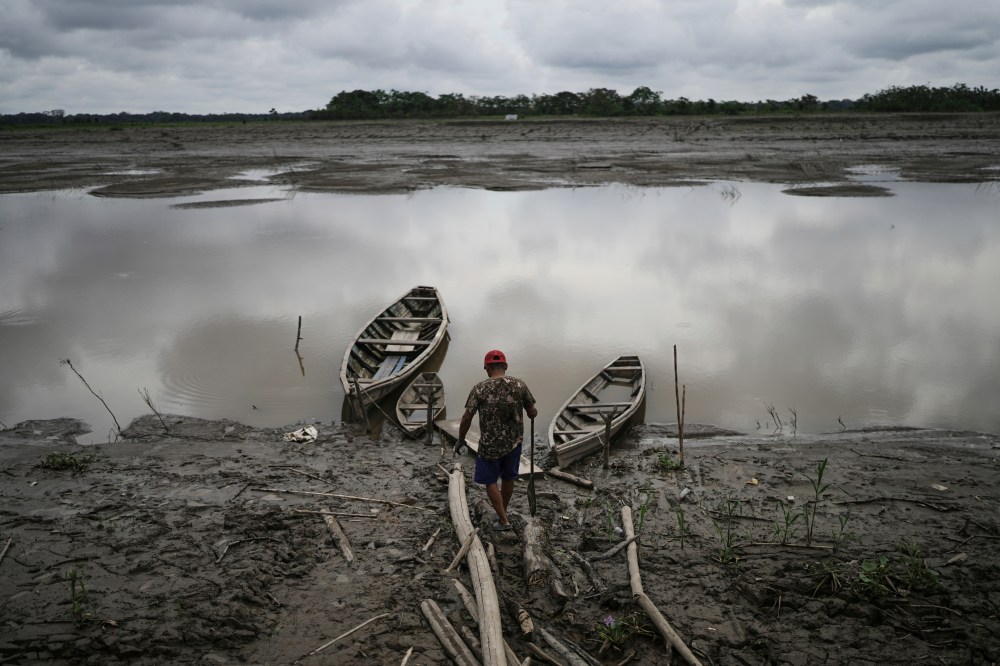
If the oxygen loss rate continues at the current pace, the world’s rivers on average will lose an additional 4% of their oxygen by the end of the century, and in some cases close to 5%, the study found. That’s when oxygen loss — called deoxygenation — becomes problematic for fish and people who rely on rivers, according to the study’s lead author Qi Guan, an environmental scientist at the Chinese Academy of Sciences in Nanjing.
More dead zones appear
Scientists worry that oxygen levels in rivers could fall so low that dead zones appear, as they have in the Gulf of Mexico, Chesapeake Bay and Lake Erie. Those are areas where fish struggle to breathe and die.
“Deoxygenation is a very slow process. If we have a long period, the negative impact will attack the river ecosystems,” Guan said. “The low level of oxygen can cause a series of ecological crises such as biodiversity decline, water quality degradation and maybe some fish will die.”
University of Arizona geoscientist Karl Flessa, who wasn’t part of the study, said in an email that losing oxygen in rivers means “a future of more stinky dead zones (hypoxia), especially during heat waves.”
Some rivers are in such bad shape that “a small change can tip them into the danger zone,” Flessa said. “if your favorite fishing hole gets too warm, oxygen levels will go down and there won’t be any fish to catch.”
India, Eastern US and the Amazon are hot spots
Earlier this century, India’s heavily polluted Ganges River was losing oxygen more than 20 times faster than the global average, the study said. Even with moderate-to-high increases in global carbon dioxide emission rates — not the implausible worst-case scenario — rivers in the Eastern United States, the Arctic, India and much of South America are projected to lose about 10% of their oxygen by the end of the century, the analysis showed.
Guan said he worries about tropical rivers especially, such as the Amazon in Brazil. Since 1980, the number of days with dead zone spots in the Amazon rose by nearly 16 days per decade, a study last year found.
Hydrology professor Marc Bierkens of Utrecht University in the Netherlands, said a study he and colleagues did last year showed oxygen stress in the world’s rivers increased by 13 days every decade and dead zone occurrences increased by nearly three days a decade since 1980. As the world continues to warm, those numbers should jump even higher, said Bierkens, who didn’t participate in the Chinese study.
Guan’s study found several reasons for oxygen loss in the world’s rivers, including nutrient pollution from fertilizer and urban runoff, along with dam construction, flow and wind issues. But nearly 63% of the problem is from warmer water, the study found.
Duke University ecologist and biogeochemist Emily Bernhardt, who wasn’t part of the study, said “as rivers warm it becomes easier and easier for the same pollution problems as before to cause more severe, more long lasting or more widespread hypoxia and anoxia.” Anoxia is the total loss of oxygen.
“Water pollution reduction is more important than ever and will be harder as rivers warm,” she said.
___
The Associated Press’ climate and environmental coverage receives financial support from multiple private foundations. AP is solely responsible for all content. Find AP’s standards for working with philanthropies, a list of supporters and funded coverage areas at AP.org.