

Parched New Brunswick adds amphibious aircraft after worst fire season in decades
Advertisement
Read this article for free:
or
Already have an account? Log in here »
To continue reading, please subscribe:
Digital Subscription
One year of digital access for only $1.44 a week*
- Enjoy unlimited reading on winnipegfreepress.com
- Read the E-Edition, our digital replica newspaper
- Access News Break, our award-winning app
- Play interactive puzzles
*Billed as $5.77 plus GST every four weeks. After 52 weeks, price increases to the regular rate of $19.95 plus GST every four weeks. Offer available to new and qualified returning subscribers only. Cancel any time.
To continue reading, please subscribe:
Add Free Press access to your Brandon Sun subscription for only an additional
$1 for the first 4 weeks*
- Enjoy unlimited reading on winnipegfreepress.com
- Read the E-Edition, our digital replica newspaper
- Access News Break, our award-winning app
- Play interactive puzzles
*Your next Brandon Sun subscription payment will increase by $1.00 and you will be charged $17.95 plus GST for four weeks. After four weeks, your payment will increase to $24.95 plus GST every four weeks.
Read unlimited articles for free today:
or
Already have an account? Log in here »
FREDERICTON – The New Brunswick government is adding four new amphibious aircraft to its firefighting fleet after last year’s forest fire season was one of the worst in decades.
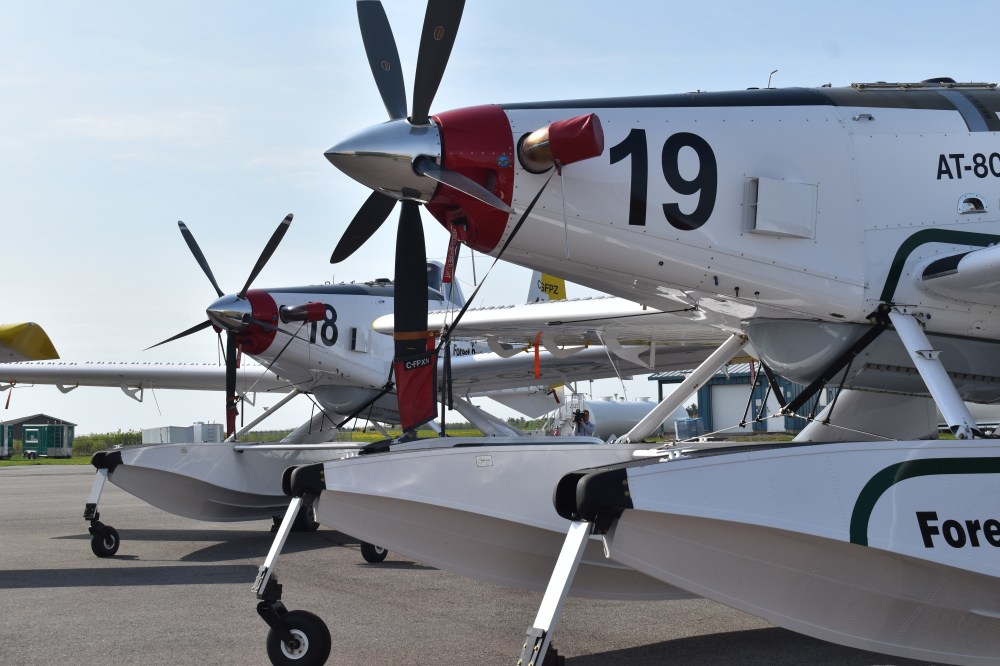
The new Fire Boss AT-802A planes can skim over lakes and rivers, loading up with about 3,000 litres of water in 20 to 30 seconds to quickly attack forest fires. Mike O’Blenis, CEO of Forest Protection Ltd., which is leasing the aircraft to the government, says they can make a drop every five to seven minutes if there’s a water source nearby and are especially useful in remote areas.
“The amphibious aircraft are really for adding as much water as you possibly can. They turn very, very quickly when you have a close water source,” O’Blenis told reporters Tuesday at the Fredericton International Airport.
He said the new aircraft are seen as a compliment to the province’s existing fleet of wheeled water bombers, which O’Blenis says need to return to base to reload and can take 20 to 30 minutes between drops, depending on the distance.
Natural Resources Minister John Herron said the existing bombers are better at attacking the flanks of a fire and preventing its spread, while the new craft can directly attack the head of a fire.
Forest Protection, founded in the 1950s, is majority-owned by the provincial government. The department did not immediately confirm the cost to lease the new planes but the Liberal government said in April it had allocated $3 million to secure the availability for four Fire Boss specialized water-scooping aircraft.
The government now leases 12 firefighting aircraft from Forest Protection. O’Blenis said pilots began their training on the new planes last fall and wrapped up this spring.
Premier Susan Holt in April kicked off wildfire season two weeks early over concerns related to record-low precipitation levels and a lack of snow over the winter. The most recent Canada Drought Monitor report from Agriculture and Agri-Food Canada on May 5 shows abnormally dry- to moderate-drought conditions across much of New Brunswick. It marks a slight improvement over the extreme drought conditions that were recorded for parts of the province in February.
Last year was one of the worst in decades for forest fires, with more than 30 square kilometres burnt.

The government has spent $6.7 million to increase the number of year-round firefighting forest rangers to 169, up from 95.
Nova Scotia’s government last week announced it was contracting four water bombers and another plane from Forest Protection. Previously, it relied on aircraft from its Natural Resources Department and other provinces.
Nova Scotia said the $6.5-million contract will increase the province’s wildfire preparedness and includes pilots and operational staff.
This report by The Canadian Press was first published May 19, 2026.
— By Devin Stevens in Halifax, with files from Eli Ridder in Fredericton.