Alberta energy deal does little to reduce Canada’s emissions: report
Advertisement
Read this article for free:
or
Already have an account? Log in here »
To continue reading, please subscribe:

Digital Subscription
One year of digital access for only $205*
- Enjoy unlimited reading on winnipegfreepress.com
- Read the E-Edition, our digital replica newspaper
- Access News Break, our award-winning app
- Play interactive puzzles
*First annual payment billed as $205.00 + GST for one year. This annual subscription will automatically renew at $233.00 + GST every 52 weeks (10% off the regular annual price of $259.35). Offer available to new and qualified returning subscribers only. Cancel any time.
To continue reading, please subscribe:
Add Free Press access to your Brandon Sun subscription for only an additional
$1 for the first 4 weeks*
- Enjoy unlimited reading on winnipegfreepress.com
- Read the E-Edition, our digital replica newspaper
- Access News Break, our award-winning app
- Play interactive puzzles
*Your next Brandon Sun subscription payment will increase by $1.00 and you will be charged $17.95 plus GST for four weeks. After four weeks, your payment will increase to $24.95 plus GST every four weeks.
Read unlimited articles for free today:
or
Already have an account? Log in here »
OTTAWA – Ottawa’s energy deal with Alberta will do little to reduce Canada’s emissions, a new study released Thursday by the Canadian Climate Institute suggests.
The analysis also said the “minimal” benefits from the Alberta memorandum of understanding, or MOU, are not enough to offset the prospect of increased oil production. That is mainly because of inefficiencies in the changes to Alberta’s industrial carbon pricing system.
“I think they have to take a look at the floor a little closer,” Dave Sawyer, the principal economist at the Canadian Climate Institute and the study’s author, told The Canadian Press.
“I think they have to think whether or not those tightening rates put the floor at risk, and so I think they have to look at the design of this thing much closer.”
Those “tightening rates” Sawyer refers to are the amounts of emissions industries can produce under Alberta’s carbon pricing system, also known as stringency rates.
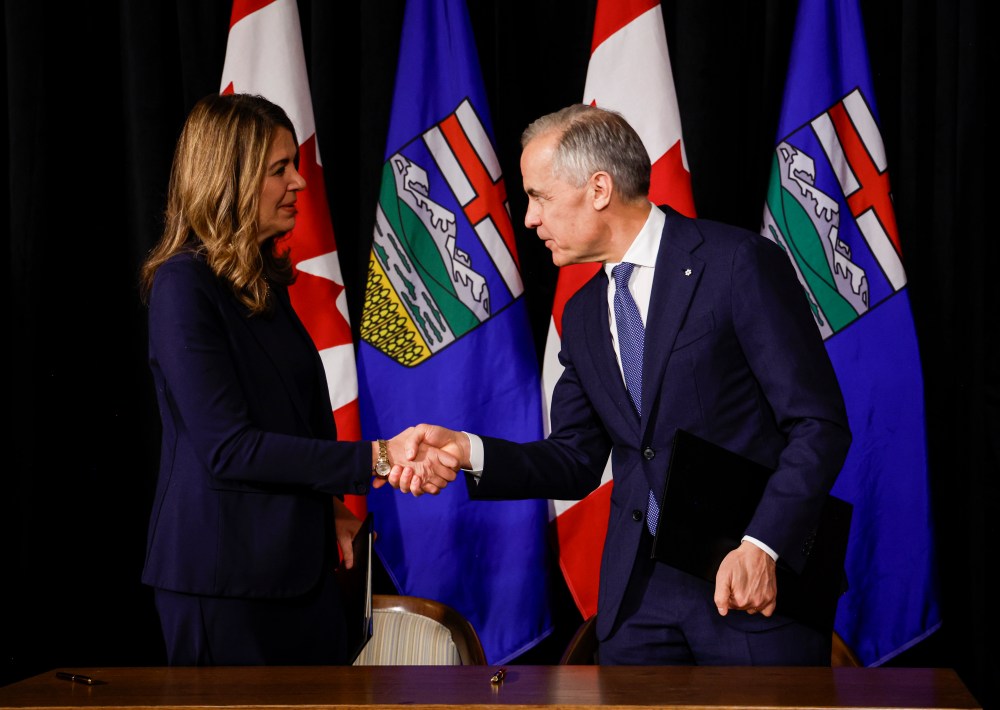
Last month, Prime Minister Mark Carney and Alberta Premier Danielle Smith signed an implementation agreement on industrial carbon pricing to bring Alberta’s effective carbon price — the market price for carbon credits — to $130 per tonne by 2040. The headline price in Alberta would also reach $100 per tonne by 2027 before rising to $130 per tonne by 2035.
The difference between the effective carbon price and the headline price is in the way companies accumulate credits to comply with their emission limits.
The agreement also relaxed those stringency rates to effectively give industries more leniency on how much they’re allowed to emit.
While the new carbon price structure is also more lenient than the previous federal carbon price backstop, Ottawa has been selling the new model as stronger because of the impact it will have on the province’s credit market — despite choosing not to enforce the federal standard that was much more stringent.
But Thursday’s study from the Canadian Climate Institute says the new system isn’t set up for market prices to rise enough to meet the government’s floor, thus discouraging investment in emissions-reduction measures.
The goal of a carbon market system is to incentivize investments to cut emissions, by making that less costly than buying credits or paying the carbon price.
Sawyer’s analysis suggests there is likely to be an oversupply of lower-cost credits after 2030, because producers can easily outperform their emissions benchmarks until then and build up a credit stockpile under the more lenient stringency rates.
“The floor maintains prices but the underlying signal to abate is lost,” the report reads. “Price maintenance does not translate into emissions reductions and instead the system mostly delivers paper compliance rather than cutting emissions.”
It remains to be seen how Ottawa and Alberta will soak up the credit oversupply.
Carney has floated the prospect of buying up credits in order to generate scarcity in the market.
“That’s off the table. What this agreement does now is it actually puts more of those credits into the system,” Sawyer said.
“Now with these tightening rates, I don’t know if it’d be worth it. I think you’d be throwing good money after bad.”
Sawyer said when details of the MOU were first reported in the media ahead of the formal announcement, the market price for carbon credits rose to $40 per tonne from a low of $17 per tonne last year.
Since the details were fully announced, however, the price has dropped to between $30 and $35 per tonne.
“The end result is a major policy intervention that leaves Canada’s long-term emissions trajectory largely where it was before the MOU agreement was finalized. It results in negligible changes to a system already weakened,” the report says.
This report by The Canadian Press was first published June 4, 2026.