Quebec municipalities and environmentalists say province’s water reserves are at risk

Advertisement

Advertise with us

A group of environmental organizations and municipalities is worried that Quebec’s groundwater reserves are dwindling due to overconsumption and the effects of climate change.

Read this article for free:


or

Already have an account? Log in here »

To continue reading, please subscribe:

Subscribe and receive a limited-edition Free Press branded hat or tote.

Digital Subscription

One year of digital access for only $205*

  • Enjoy unlimited reading on winnipegfreepress.com
  • Read the E-Edition, our digital replica newspaper
  • Access News Break, our award-winning app
  • Play interactive puzzles

*First annual payment billed as $205.00 + GST for one year. This annual subscription will automatically renew at $233.00 + GST every 52 weeks (10% off the regular annual price of $259.35). Offer available to new and qualified returning subscribers only. Cancel any time.

To continue reading, please subscribe:

Add Free Press access to your Brandon Sun subscription for only an additional

$1 for the first 4 weeks*

  • Enjoy unlimited reading on winnipegfreepress.com
  • Read the E-Edition, our digital replica newspaper
  • Access News Break, our award-winning app
  • Play interactive puzzles
Start now

*Your next Brandon Sun subscription payment will increase by $1.00 and you will be charged $17.95 plus GST for four weeks. After four weeks, your payment will increase to $24.95 plus GST every four weeks.

A group of environmental organizations and municipalities is worried that Quebec’s groundwater reserves are dwindling due to overconsumption and the effects of climate change.

In an open letter sent to the environment minister, the 12 municipalities and nine environmental organizations say the province is consuming more groundwater than is being replenished.

The municipalities, located along the Saint-Lawrence valley, say Quebec has taken its renewable freshwater for granted and are calling on the government to trigger a province-wide evaluation and increase regulation.
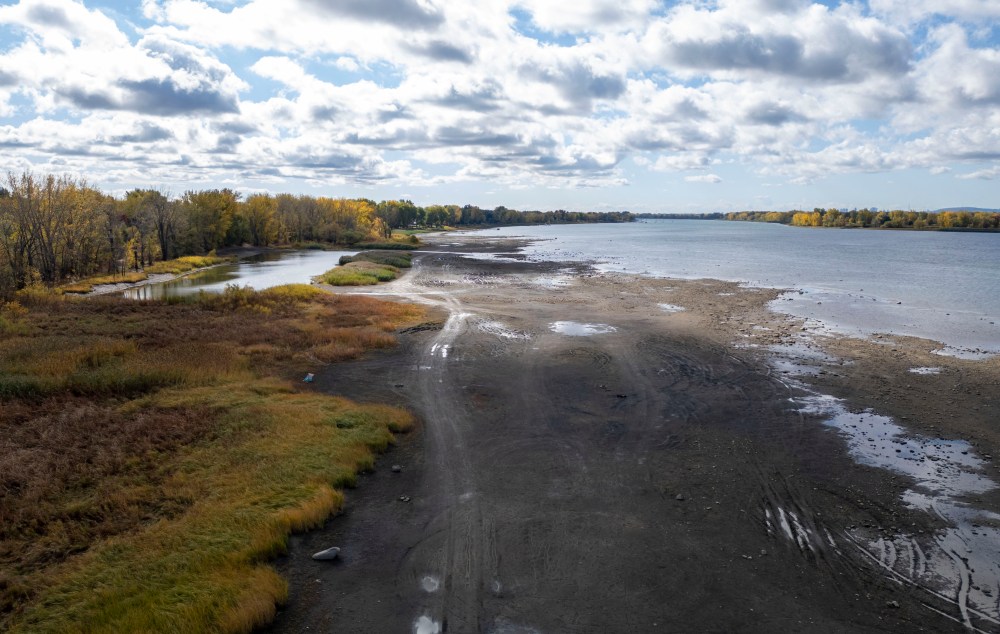
Low water levels are seen in this aerial view of the shoreline in the Montreal suburb of Boucherville on the south shore of the St. Lawrence River on Wednesday, Oct. 8, 2025. THE CANADIAN PRESS/Christinne Muschi

“In Quebec, we have long believed that water was an infinite resource. Gone are the days of rose-tinted glasses,” they wrote in the letter.

Quebec holds three per cent of the world’s renewable freshwater reserves, but water preservation groups like Eau Secours and Scabric say droughts and urban sprawl are putting pressure on the natural resource.

Aquifers – sediment saturated with freshwater – are connected to surface bodies of water, says Sabric president Daniel Pilon. While aquifers can store large amounts of water that supply human activity, depletion can cause rivers to dry up, he adds.

“In Quebec, there are lakes everywhere. We’re rich in water, that’s true. But now, we’re going through a period of drought, a time when people are overusing this resource,” Pilon said.

Scabric is a non-profit organization formed in 1993 and mandated to improve water and soil quality in the Châteauguay area’s drainage basins. Pilon says the organization started recording a strain on groundwater in 2015.

Though Pilon’s organization is limited in scope, he says other organizations monitoring drainage basins across Quebec reported similar findings.

However, he says it’s hard to know the extent of the issue and come up with solutions without a government-mandated study across the province handled by the Bureau d’audiences publiques sur l’environnement.

“We need to ask ourselves some questions because the situation is getting worse,” said Pilon.

He says that those in rural areas in the Montérégie region who depend on groundwater for daily consumption are having to dig their wells deeper each year. Some farmers struggle with irrigation, he adds.

Last year, the town of Sutton, Que. had crates of water shipped in because it feared a water shortage.

Pilon says increasingly hot summers and reduced rainfall are part of the problem. While some fluctuation is expected every year, the trend is worrying, he says.

According to the Canadian Climate Institute, climate change has made droughts more frequent and severe world-wide, making it harder to replenish natural water reserves.

Eau Secours president Rébecca Pétrin says there has also been a shift in how land is managed due to urban sprawl, which contributes to the problem. She says agricultural land has been drained and large areas have been made “waterproof,” meaning that rainwater is quickly channeled to a drainage system and into rivers.

“We’re draining our water away; we’re not retaining it. So, we’re seeing droughts occur much more quickly because the land hasn’t been able to absorb the water,” says Pétrin. “If we don’t retain the water, we don’t give it a chance to seep into the ground and eventually replenish the groundwater (that many people rely on).”

Pétrin and Pilon say that while there are some easy solutions – increasing sponge parks, marshes and retention basins, and banning lawn sprinklers – large-scale changes can only be implemented through government intervention.

Environment Minister Pascale Déry told journalists on Monday that a shortage of groundwater is “concerning,” but said there are measures in place to protect water already.

“Do we need to go further? Maybe, I think we need to have that discussion,” she said.

Déry said she would talk to her colleagues to see if the province-wide evaluation is the best tool before moving forward.

This report by The Canadian Press was first published June 8, 2026.
Report Error Submit a Tip

More Stories

Six high school hockey programs ceased operations following new Hockey Manitoba policy

Joshua Frey-Sam 7 minute read Preview

Six high school hockey programs ceased operations following new Hockey Manitoba policy

Joshua Frey-Sam 7 minute read Updated: 8:19 PM CDT

She lived the best of both worlds.

For the last three years, the 17-year-old wore a sweater for two different hockey programs — her high school team and AAA club in the Manitoba Female Hockey League — and was preparing to flourish in both colours again this winter.

Recently, however, the blue-liner was disappointed to learn she is no longer eligible to play her Grade 12 season with her school owing to a new policy imposed by Hockey Manitoba that bans players from participating in the Manitoba Women’s High School Hockey League if they are rostered on a U18 AAA team.

The rule applies to all athletes who play for both Winnipeg-based and rural AAA teams.

Read
Updated: 8:19 PM CDT

Sisters relieved hospital takes accountability after mother’s death

Scott Billeck 5 minute read Preview

Sisters relieved hospital takes accountability after mother’s death

Scott Billeck 5 minute read Yesterday at 6:39 PM CDT

Eight months after losing their mother, two Winnipeg sisters say an internal hospital review has finally given them something they had been seeking since her death: accountability.

Chelsea Mann and Samantha Burns said St. Boniface Hospital officials acknowledged mistakes were made in the care of their mother, Judy Burns, during a recent meeting to discuss the findings of a critical incident review into her death.

The acknowledgement marked a significant departure from an earlier meeting with hospital officials, when they felt their concerns were largely dismissed.

Burns, 68, died on Jan. 21, three days after being admitted, after experiencing rectal bleeding.

Read
Yesterday at 6:39 PM CDT

Man who killed two Indigenous women, was accused of killing third, back in prison less than year after statutory release

Erik Pindera 5 minute read Preview

Man who killed two Indigenous women, was accused of killing third, back in prison less than year after statutory release

Erik Pindera 5 minute read Yesterday at 4:06 PM CDT

A Winnipeg man convicted of killing two First Nations women more than a decade ago — with charges stayed in a third slaying — has been sent back to prison less than a year after he left under conditions.

Parole Board of Canada officials revoked 67-year-old Shawn Lamb’s statutory release after a hearing last week.

“Your actions are not beyond your control, yet you continue to wilfully make poor decisions that place the public at risk,” board member Arun Kundu-Thomsen wrote in a decision released this week.

Lamb gained statutory release — a legislated conditional release most federal inmates automatically qualify for after serving two-thirds of their sentence — in November last year and lived in several Ontario facilities for federal offenders.

Read
Yesterday at 4:06 PM CDT

Alouettes not short on reasons why they want to beat Bombers

Taylor Allen 5 minute read Preview

Alouettes not short on reasons why they want to beat Bombers

Taylor Allen 5 minute read 7:55 PM CDT

MONTREAL — Clinching top spot in the East isn’t the only reason why Tyson Philpot is itching to beat the Winnipeg Blue Bombers.

“Obviously, my brother (Jalen) plays for the (Calgary) Stampeders, so I’d love to help push the Stampeders above them and help him get in the playoffs,” said the star receiver for the Montreal Alouettes after Friday’s walkthrough.

While the Als are sitting comfortably at 11-3, the Bombers (7-7) are trying to fend off Calgary (7-8) while also keeping pace with B.C. and Saskatchewan, who both entered the week at 8-6.

But there’s another reason that applies to everyone on the Als: they want revenge for the embarrassing 44-28 loss they suffered in Winnipeg in Week 13.

Read
7:55 PM CDT

Kent Monkman debuts beaver sculpture in Toronto’s ambitious new waterfront park

Alex Nino Gheciu, The Canadian Press 2 minute read Preview

Kent Monkman debuts beaver sculpture in Toronto’s ambitious new waterfront park

Alex Nino Gheciu, The Canadian Press 2 minute read Updated: 3:33 PM CDT

TORONTO - Kent Monkman’s first-ever public art installation is dam good.

The celebrated Cree artist’s new permanent sculpture, dubbed “The Colony,” debuts Wednesday in Toronto’s east end.

The 15-foot-high bronze structure features beavers dancing, feasting and celebrating, evoking Indigenous ceremonies.

It highlights the vital role of beavers in the natural, Indigenous and colonial histories of Turtle Island, says a release.

Read
Updated: 3:33 PM CDT

Board game company charts winning path

Aaron Epp 5 minute read Preview

Board game company charts winning path

Aaron Epp 5 minute read 7:09 PM CDT

Dennis Northcott has launched a game without frontiers.

The Winnipeg entrepreneur is the co-designer of Galactic Cruise, a board game published last year by Kinson Key Games LLC, the business he co-founded. Since its release, Galactic Cruise has been translated into 11 languages and sold around 50,000 copies worldwide.

It’s also one of three finalists for this year’s Deutsche Spiele Preis, a prestigious community-voted board game award. Northcott will travel to Essen, Germany, later this month, where the winner will be announced at Spiel Essen, an annual board game trade fair.

“It’s been amazing,” Northcott said of the response to Galactic Cruise during an interview in his Island Lakes neighbourhood home earlier this week. “The sales have been great, but it’s also been amazing in terms of people giving their reviews.”

Read
7:09 PM CDT