Ancient squirrel feces a ‘time capsule,’ smelling as fresh as 700,000 years ago

Advertisement

Advertise with us

The scent of ancient squirrel feces filled the laboratory where researcher Tyler Murchie was working to extract the genetic material it contained, revealing the scat can still smell just as fresh today as it did some 700,000 years ago.

Read this article for free:


or

Already have an account? Log in here »

To continue reading, please subscribe:

Subscribe and receive a limited-edition Free Press branded hat or tote.

Digital Subscription

One year of digital access for only $205*

  • Enjoy unlimited reading on winnipegfreepress.com
  • Read the E-Edition, our digital replica newspaper
  • Access News Break, our award-winning app
  • Play interactive puzzles

*First annual payment billed as $205.00 + GST for one year. This annual subscription will automatically renew at $233.00 + GST every 52 weeks (10% off the regular annual price of $259.35). Offer available to new and qualified returning subscribers only. Cancel any time.

To continue reading, please subscribe:

Add Free Press access to your Brandon Sun subscription for only an additional

$1 for the first 4 weeks*

  • Enjoy unlimited reading on winnipegfreepress.com
  • Read the E-Edition, our digital replica newspaper
  • Access News Break, our award-winning app
  • Play interactive puzzles
Start now

*Your next Brandon Sun subscription payment will increase by $1.00 and you will be charged $17.95 plus GST for four weeks. After four weeks, your payment will increase to $24.95 plus GST every four weeks.

The scent of ancient squirrel feces filled the laboratory where researcher Tyler Murchie was working to extract the genetic material it contained, revealing the scat can still smell just as fresh today as it did some 700,000 years ago.

The droppings collected from ancient ground squirrel burrows preserved by permafrost for millenniums didn’t smell like anything at first, but once Murchie inserted fluid to release the ancient DNA, he said there was an “overwhelming” smell.

“It hasn’t (undergone) mineral replacement like you’d find with dinosaur coprolites or paleofeces. In this case, it’s still organic,” he said.
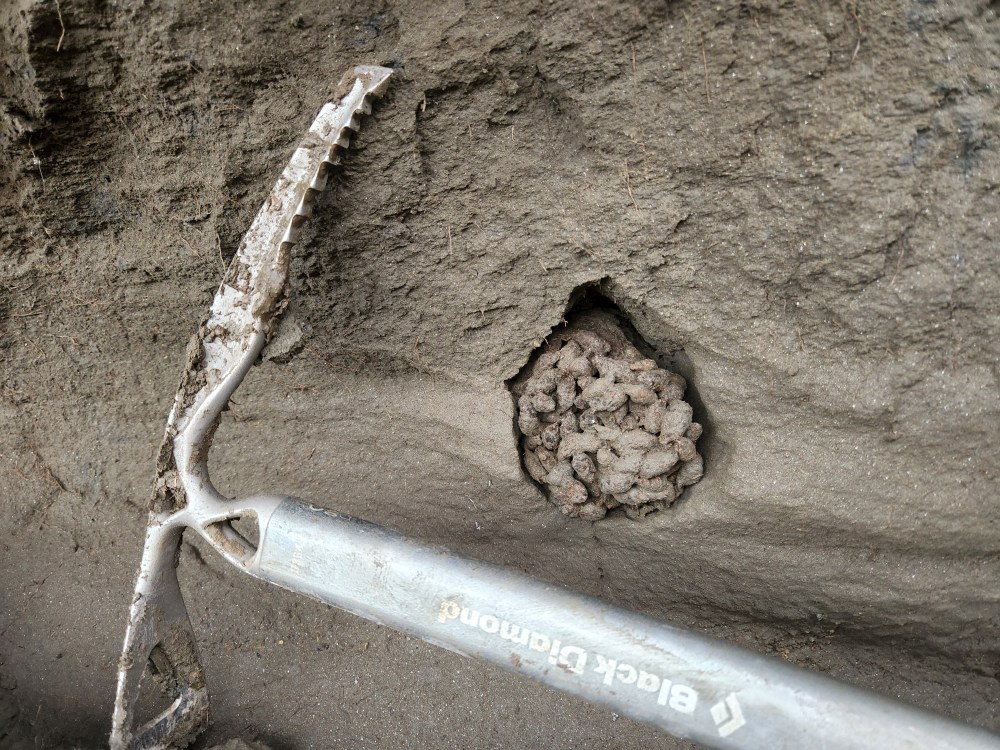
Researchers document a cluster of ancient Arctic ground squirrel faecal pellets preserved in permafrost at Hunker Creek, Yukon, in an August 2022 handout photo. These coprolites, or fossilized animal poop, contain remarkably intact ancient DNA, offering rare glimpses into Ice Age ecosystems. THE CANADIAN PRESS/Handout — Scott Cocker (Mandatory Credit)

Murchie is the lead author of a peer-reviewed study released Tuesday that used the frozen feces pellets dating from between 17,000 and 700,000 years ago to identify an array of plant and animal life in Yukon’s Klondike region, including woolly mammoths.

The palaeogenomics researcher likened the pellets to “little frozen time capsules” providing a snapshot of the environment when the squirrels were alive.

“I would have thought the microbes in the digestive system would have destroyed the DNA, but it turns out in some cases DNA can be quite resistant to degradation,” said Murchie, a scientist with the British Columbia-based Hakai Institute.

“When you combine that with being frozen perpetually for all this time, you can have some really amazing preservation of these biomolecules.”

The paper, published in the journal Nature Communications, shows the ancient droppings contained the DNA of lemming, pika, caribou, wolf or coyote, snowshoe hare, among other animals, and an array of different plants.

The scat also revealed the squirrels were likely scavenging the carcasses of mammoths along with extinct species of bison and horse, Murchie said.

He said the findings paint a picture of the Pleistocene, commonly known as the last Ice Age, when mammoths and cheetahs roamed a landscape covered in grasses and flowering herbs, with some woody vegetation and very few trees.

The squirrels may not be as “charismatic” as the larger animals, but their droppings offer “huge” information potential, bolstered by the breadth of their diet, he said.

With modern humans, or Homo sapiens, emerging about 300,000 years ago, Murchie said the oldest sample used in the study is about twice as old as humanity.

The ancient squirrel burrows in the Yukon are particularly useful because they’ve been preserved in layers of volcanic ash, allowing researchers to establish more precise estimates of their ages than similar sites in Siberia, Murchie noted.

Murchie said studying the ancient squirrel feces has the potential to help researchers understand shifts between interglacial periods and offer insight into the current epoch, the Holocene, which began about 11,700 years ago.

“One of the areas that I’m most excited to get into is the last interglacial. So, this was about 115,000 thousand years ago, when it was warmer than it is today.”

Murchie said he hopes studying that period will help researchers understand how anomalous the Holocene is, particularly given human-caused climate change that is also melting the permafrost that has kept the ancient scat frozen in time.

“It might be that we’ve broken the glacial-interglacial cycling and that we may not enter another glacial period. And what that means, who knows.”

This report by The Canadian Press was first published June 9, 2026.

Report Error Submit a Tip

More Stories

Letters, Oct. 5

7 minute read 2:01 AM CDT

Fighting the good fight

Re: Transit, roads and city council’s priorities (Oct. 2)

Many thanks to Erna Buffie for once again speaking up for transit.

When will Winnipeg finally make the shift from a car-dependent culture to a greener and more efficient way?

’Disgusting’ posters being investigated by police

Morgan Modjeski 4 minute read Saturday, Oct. 3, 2026

The Winnipeg Police Service major crimes unit is investigating what some have labelled offensive and hateful posters on full-display at a Winnipeg home.

One of the people irked by the display is Gracie Garrett. She’s has lived on Ashburn Street in Winnipeg’s Minto neighbourhood for almost ten years. She’s never felt unsafe in the neighbourhood before, but now, a set of posters plastered on a nearby house are making her feel uneasy.

The five signs, posted facing the street prominently on a front window, contain a slur, refer to Nazis as “heroes” and call Muslims, Christians and other groups “evil.”

Learning of the signs Friday, Garrett said she’ll be reporting the posters to police, as she worries they incite and promote violence.

Six high school hockey programs ceased operations following new Hockey Manitoba policy

Joshua Frey-Sam 7 minute read Preview

Six high school hockey programs ceased operations following new Hockey Manitoba policy

Joshua Frey-Sam 7 minute read Friday, Oct. 2, 2026

She lived the best of both worlds.

For the last three years, the 17-year-old wore a sweater for two different hockey programs — her high school team and AAA club in the Manitoba Female Hockey League — and was preparing to flourish in both colours again this winter.

Recently, however, the blue-liner was disappointed to learn she is no longer eligible to play her Grade 12 season with her school owing to a new policy imposed by Hockey Manitoba that bans players from participating in the Manitoba Women’s High School Hockey League if they are rostered on a U18 AAA team.

The rule applies to all athletes who play for both Winnipeg-based and rural AAA teams.

Read
Friday, Oct. 2, 2026

Connor powers Jets past Red Wings for first win of season

Ken Wiebe 8 minute read Preview

Connor powers Jets past Red Wings for first win of season

Ken Wiebe 8 minute read Yesterday at 6:26 PM CDT

DETROIT — Kyle Connor is on a mission.

Whether it’s the baby bump from the birth of his second child or his constant mission to elevate his game and find new ways to score, the Winnipeg Jets left-winger is flying out of the gate and seemingly notching goals at will.

After scoring in the season opener for an NHL record ninth consecutive time, Connor delivered a pair of goals and added an assist in his home state to lead the Jets to a 3-2 victory over the Detroit Red Wings on Sunday afternoon at Little Caesars Arena.

“The sheer amount of volume that he gets and how he gets himself in a good spot, he’s able to get that release off from anywhere,” said Jets forward Cole Perfetti. “His first one was just all skill. What a finish that was and then his second one, just reading the play so well. (Coming) off the pads like that, kind of in front of him and he put it in a small little window top shelf that no goalie could ever save. He doesn’t panic when he gets into those spots, obviously.

Read
Yesterday at 6:26 PM CDT

The election of our discontent: City at a crumbling crossroads, grumbling residents say in poll

Matthew Frank 7 minute read Preview

The election of our discontent: City at a crumbling crossroads, grumbling residents say in poll

Matthew Frank 7 minute read Yesterday at 2:37 PM CDT

There’s an undercurrent of unhappiness running through the Winnipeg electorate as the municipal election day approaches.

One-half of Winnipeggers believe the city is heading in the wrong direction, according to a new Abacus Data poll, with nearly one-third unsure if Winnipeg is regressing or progressing.

Only 21 per cent of residents believe the city is on the right track, the Free Press-commissioned poll found.

That discontentment extends to how the city spends its tax dollars, with four in 10 Winnipeggers believing they receive poor value for what they pay in property taxes.

Read
Yesterday at 2:37 PM CDT

Hydro Québec faces issue we should avoid

Editorial 4 minute read Preview

Hydro Québec faces issue we should avoid

Editorial 4 minute read 2:01 AM CDT

You might be tempted to call it a canary in an electric power generation coal mine.

But instead, it’s just another heads-up into the already-obvious problem with the proliferation of data centres.

This week, Hydro-Québec went before the Régie de l’énergie, Québec’s public utilities board, to change the rules for new and existing large data centres.

Now, it was not that long ago that Hydro Québec was actively wooing data centres — offering bulk power rates to be used to lure labour-intensive, power-hungry heavy industry (think aluminum smelters) with rates substantially lower than they offer Québec’s own residential customers. It was a way to use surplus power to create jobs and drive economic activity.

Read
2:01 AM CDT