Climate-driven heat in India’s textile factories stifles workers but coolers and ventilation help
Advertisement
Read this article for free:
or
Already have an account? Log in here »
To continue reading, please subscribe:

Digital Subscription
One year of digital access for only $205*
- Enjoy unlimited reading on winnipegfreepress.com
- Read the E-Edition, our digital replica newspaper
- Access News Break, our award-winning app
- Play interactive puzzles
*First annual payment billed as $205.00 + GST for one year. This annual subscription will automatically renew at $233.00 + GST every 52 weeks (10% off the regular annual price of $259.35). Offer available to new and qualified returning subscribers only. Cancel any time.
To continue reading, please subscribe:
Add Free Press access to your Brandon Sun subscription for only an additional
$1 for the first 4 weeks*
- Enjoy unlimited reading on winnipegfreepress.com
- Read the E-Edition, our digital replica newspaper
- Access News Break, our award-winning app
- Play interactive puzzles
*Your next Brandon Sun subscription payment will increase by $1.00 and you will be charged $17.95 plus GST for four weeks. After four weeks, your payment will increase to $24.95 plus GST every four weeks.
Read unlimited articles for free today:
or
Already have an account? Log in here »
SURAT, India (AP) — For dozens of workers at a textile manufacturer on the edge of Surat, the blazing temperatures and high humidity on a recent afternoon were amplified by steam, radiating heat and chemical smells that emerged from the heavy machines that dominate nearly every inch of the low-ceilinged factory floor.
The machines, called stenters, roared like engines, boilers hissed and drum washers released clouds of steam. The sound was relentless, the air heavy.
Soni Pande, a 27-year-old worker and single mother, said fans and coolers that spray mist help, but are overpowered on the hottest days.
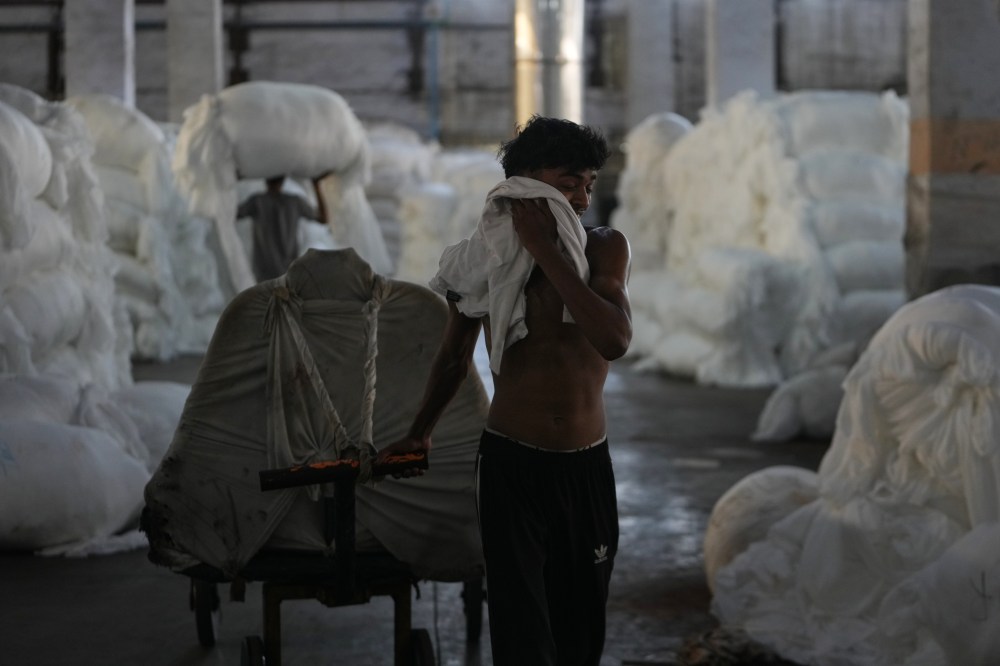
“The heat does make us weak. We sweat a lot. Some people feel dizzy, unwell,” said Pande, who came from Bihar state in eastern India. “There are fans and coolers, but it’s still so hot inside.”
At factories around the western coastal industrial hub, employees work day and night guiding damp lengths of fabric into the metal jaws of machines that use high temperatures to dry, print, dye and finish cloth. The millions of meters of polyester cloth produced at these factories are shipped to textile companies around the world to make sarees, dresses and other affordable clothing.
Like most other parts of the country, Surat is witnessing rising day and nighttime temperatures and longer summer months in part due to climate change, and workers say the heat inside factories is unbearable at times. The problem has proved stubborn, because even when factories install cooling equipment, the effects can be limited. And faced with losses due to United States tariffs and supply disruptions caused by the Iran war, factory owners seem less willing or able to invest the thousands of dollars needed to install and maintain cooling systems.
Many factories have exhaust fans, and some have installed coolers that use water evaporation to lower temperatures while circulating fresh air from outside. Unlike air conditioners, coolers don’t require sealed rooms, making them suitable for factories with open doors.
In the factory where Pande works in the Sachin industrial area near Surat, which The Associated Press visited, coolers were placed in relatively quieter areas where workers gathered for 10 to 15 minute breaks. In another factory, a centralized air duct carried cool air across the floor from coolers placed at either end. In both cases, they provided only temporary relief and were outnumbered by the roaring textile machines.
“We sweat a lot and feel dizzy sometimes,” said Kundan Kumar, a worker from Bihar who runs a dyeing machine at Vinit Fabrics, the second factory which is located at the Palsana industrial area, near Surat.
Kumar said the conditions remain challenging despite the coolers.
“Dyeing work is tough. It is difficult, but we have to do our work,” he said, adding: “We need money to help our families, so we have to work.”
Climate driven heat and humidity is oppressive for workers
India, the world’s most populous country, is also among the most vulnerable to climate change. Every year, storms, floods and extreme heat affect millions across the country, resulting in thousands of deaths and billions of dollars lost.
A 2022 World Bank report estimates that 75% of India’s workforce, or about 380 million people, is impacted by heat, ranging from construction workers to factory employees, and those temperatures can create potentially life-threatening conditions.
India has laws and guidelines that are meant to protect workers from extreme heat, but labor unions sent a letter to the government earlier this year asking for stricter laws as well as better implementation and oversight on the ground. Another challenge is that many of the labor laws do not cover the more than 550 million informal workers — nearly 90% of India’s workforce — including many of the textile workers in Surat.
Pooja Yadav, of the think tank WRI India, said humidity and heat can combine to create dangerous conditions in the Surat factories.
“In textile processing units where steam and hot water are used, indoor conditions can be worse than outside,” she said.
Inside factories, workers face a mix of hot air and chemical fumes that can trigger headaches, dehydration and fainting during shifts that can last 12 hours, she said.
“They can also develop long term issues with their lungs and kidneys,” said Yadav, who added that high heat and humidity also can cut worker efficiency.
Geopolitical tensions adding to uncertainty in the sector
Disruptions to shipping, materials and energy prices caused by the Iran war as well as the heavy tariffs levied by the Trump administration have hit Surat’s textile industry, reducing the ability of factory owners to invest in cooling equipment.
Surat is among the world’s largest hubs for producing polyester and other synthetic fabric. The textile industry employs more than 1.4 million workers and produces an estimated 30 million meters of polyester cloth every day, according to local government statistics.
Polyester is a synthetic fabric made from a type of plastic derived from petroleum, exposing the producers to price increases caused by the Iran war. Factory managers say many workers returned to their hometowns in other parts of India after production plummeted and have refused to come back to work because of the heavy heat.
Subhash Sharma, manager of textile production at Vinit Fabrics, said they usually employ about 700 people but they are running at only 60% of their capacity due to a combination of economic pressure and labor shortages.
“In the last few years, we are seeing that the number of laborers are reducing due to increasing heat,” he said.
Cooling factory floors makes some workers’ conditions better
Installing systems that either expel hot air or bring in cool air, such as turbo ventilators and air coolers, providing adequate ventilation and better insulating machines can improve working conditions, according to WRI India.
Vinit Fabrics spent about $5,300 for installing cooling systems, Sharma said. The company has also used jute bags to insulate heat radiating machines and have made sure gutters in the floor that carry hot water remain closed.
However, Yadav said most other factories in Surat still rely on fans and that more effective cooling equipment is not common.
Yadav said that policymakers also need to think about industrial areas when coming up with heat action plans.
On the factory floor, workers like Pande, the single mother, earn $7 for 10-12 hour shifts. She said that regardless of the condition, work is not optional.
“We don’t have a choice. I must provide for three kids. Heat or not, we have to work,” she said.
___
Follow Sibi Arasu on X at @sibi123.
___
The Associated Press’ climate and environmental coverage receives financial support from multiple private foundations. AP is solely responsible for all content. Find AP’s standards for working with philanthropies, a list of supporters and funded coverage areas at AP.org.