A conflict over cattle in Brazil’s Amazon highlights tensions for Indigenous peoples
Advertisement
Read this article for free:
or
Already have an account? Log in here »
To continue reading, please subscribe:

Digital Subscription
One year of digital access for only $205*
- Enjoy unlimited reading on winnipegfreepress.com
- Read the E-Edition, our digital replica newspaper
- Access News Break, our award-winning app
- Play interactive puzzles
*First annual payment billed as $205.00 + GST for one year. This annual subscription will automatically renew at $233.00 + GST every 52 weeks (10% off the regular annual price of $259.35). Offer available to new and qualified returning subscribers only. Cancel any time.
To continue reading, please subscribe:
Add Free Press access to your Brandon Sun subscription for only an additional
$1 for the first 4 weeks*
- Enjoy unlimited reading on winnipegfreepress.com
- Read the E-Edition, our digital replica newspaper
- Access News Break, our award-winning app
- Play interactive puzzles
*Your next Brandon Sun subscription payment will increase by $1.00 and you will be charged $17.95 plus GST for four weeks. After four weeks, your payment will increase to $24.95 plus GST every four weeks.
Read unlimited articles for free today:
or
Already have an account? Log in here »
FORMOSO DO ARAGUAIA, Brazil (AP) — On a vast island in northern Brazil, an unusual debate about cattle and conservation is taking place.
Federal authorities last year ordered the removal of herds from protected Indigenous territory on the world’s largest river island, Bananal Island. They argued the land was reserved for Indigenous peoples and conservation, and that the herds kept there by outside ranchers were illegal and contributed to habitat degradation.
To comply with the order, wranglers drove more than 100,000 cattle from the island when the rivers were low enough. But the removal has created new problems for Indigenous residents who had come to rely on money they earned leasing the land to ranchers.
The events underscore the challenge of balancing conservation, Indigenous interests and pressure from agribusiness, one of Brazil’s most powerful sectors. Brazil is the world’s largest beef producer, accounting for about 20% of global output and 6% of the country’s gross domestic product.
Protecting Indigenous territories is widely seen as one of the most effective ways to curb deforestation in the Amazon, the world’s largest rainforest and a key regulator of the global climate.
Brazil has made progress in reducing deforestation, but cattle ranching remains the main driver of it. Ranchers clear large swaths of forest so cattle can graze.
Tocantins state, home to Bananal Island, was among the states with Brazil’s highest deforestation levels in 2025, according to MapBiomas, a nonprofit group tracking land use. Biodiversity is threatened as trees that absorb pollution are replaced by cattle that emit methane, a greenhouse gas contributing to global warming.
Cattle brought benefits and conflicts to the island
Brazilian law prohibits commercial activity on Indigenous lands. Cattle raising is allowed only for subsistence.
In practice, however, parts of Bananal Island were leased for decades. Under the informal system, ranchers paid village leaders a monthly fee of about 15 reais ($3) per head — far below the roughly 60 reais ($12) charged outside the island.
When the over 100,000 head of cattle were on the island, monthly revenue from leasing could reach 1.5 million reais ($290,000). Payments went to Indigenous chiefs, who passed part of the money to local associations.
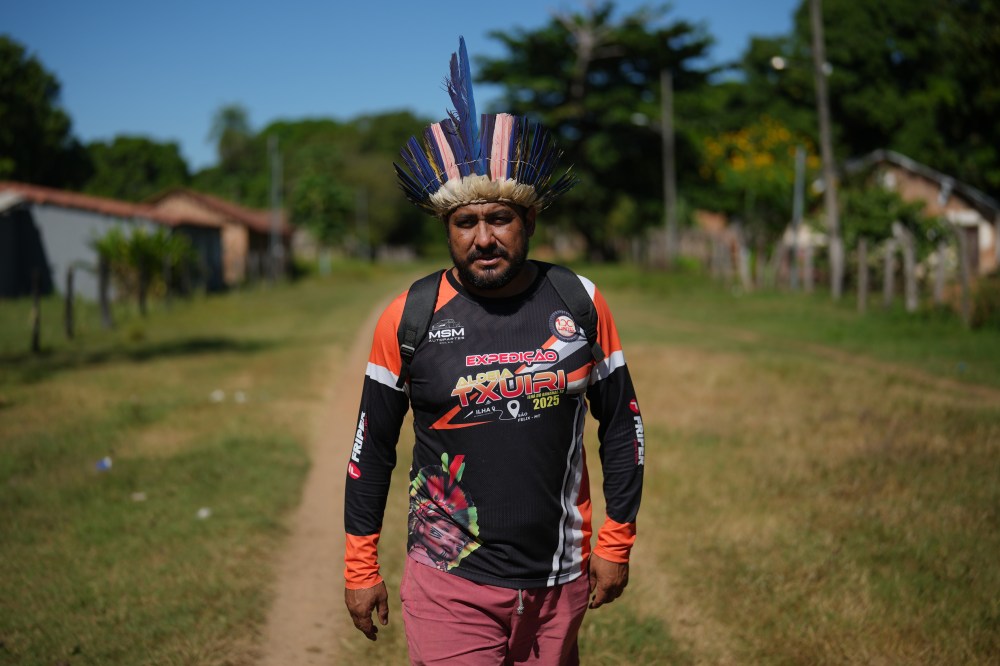
“Cattle, over the years, have covered many of our community’s expenses,” said Cleiton Javae, chief of Txuiri village, citing schools, medicine, transport and traditional festivities.
But some residents say the money was concentrated among leaders and did not benefit the roughly 5,000 people in more than 40 villages.
“The law requires consultation and shared benefits,” said Leandro Milhomem, the chief of IBAMA, Brazil’s environmental agency, in Tocantins. “Instead, some chiefs had significant resources while, in the same community, children died of malnutrition.”
Indigenous residents told the AP that wranglers also fenced off parts of the island and restricted access to farming areas that were meant for communal use.
Leaders who supported agreements with ranchers say such incidents were isolated and argue that raising cattle has been blamed for broader policy failures. Still, they acknowledge the system spiraled out of control, with ranchers bringing far more cattle than declared.
“The situation became unsustainable, and removing the cattle was the only alternative,” Javae said.
Indigenous residents say they own the remaining cattle on the island. But in March, environmental authorities seized 550 head of cattle and issued 21 citations, according to documents reviewed by The Associated Press. One cited a wrangler who said an Indigenous chief told him to falsely claim the herd was Indigenous‑owned to avoid sanctions.
Cattle ranching caused soil acidification and fueled wildfires
Bananal Island lies between the Javae and Araguaia rivers at the junction of Brazil’s top soy and cattle-producing states of Tocantins, Mato Grosso and Para.
When European colonizers reached the area in the late 18th century, they found the island inhabited by Indigenous peoples and covered with wild banana groves that inspired its name: Ilha do Bananal in Portuguese.
The region remained largely overlooked by settlers and the Brazilian government until the 1950s, when it was designated a protected area. At the same time, authorities began promoting non-Indigenous cattle ranching through leasing agreements with local communities.
Ranching offered villages a potential source of income but also fueled inequality and environmental problems.
Cattle ranching caused soil acidification and fueled wildfires, according to Brazil’s environmental agency, with investigations finding blazes often started near grazing areas. Ranchers have long used fire to manage land and renew pasture.
Three Indigenous groups live on the island: the Javae, Karaja and Ava-Canoeiro. The Javae have long maintained close ties with non-Indigenous ranchers. Many outsiders married Indigenous women and settled on the island. Through these relationships, ranchers gained access to develop economic activity inside legally protected territory.
The island’s traditional cultures and non-Indigenous practices can be seen in the contrasts. Brick houses stand alongside thatched structures of wood and straw. In Txuiri village, children play with bows and arrows near a Protestant church. In another village, Boa Esperanca, Lucirene Javae, the eldest in the community, on a recent day prepared to roast turtles for lunch while watching cooking videos on YouTube.
Brazilian Indigenous people rethink economic models
The Javae are working with The Nature Conservancy, a nonprofit dedicated to land conservation, to develop a land management plan on the island that outlines their social, environmental and economic needs, along with pathways to meet them.
In May, Javae leaders and other Indigenous representatives visited the Macuxi people in Roraima, a state in the northern Amazon seen as a model for using agriculture to generate income and strengthen land rights.
In the 1980s, Macuxi leaders began raising cattle to help reclaim territory under pressure from farmers, miners and land grabbers. The land was only officially demarcated as Indigenous territory in 2005.
Today, the Macuxi collectively own about 45,000 head of cattle, said Ivo Aureliano Macuxi, an Indigenous rights advocate and member of the Indigenous Council of Roraima.
The Macuxi and Bananal Island peoples’ experiences reflect a broader debate by Indigenous groups in Brazil to balance economic activity with protection of their rights and the environment, he said.

That debate also has advanced in mining. In February, Brazilian Supreme Court Justice Flávio Dino ruled that the Cinta Larga people, who live in a region spanning the Amazonian states of Mato Grosso and Rondonia, have the right to mine within their own territory.
Aureliano said Indigenous communities need legal frameworks that both support their territories and respect the diversity of Brazil’s 391 Indigenous peoples.
“You can’t apply a single model as a template for other Indigenous lands,” Aureliano said, but instead must tailor plans to “each region, each territory, each people.”
___
The Associated Press’ climate and environmental coverage receives financial support from multiple private foundations. AP is solely responsible for all content. Find AP’s standards for working with philanthropies, a list of supporters and funded coverage areas at AP.org.