Montana DEQ works toward impairment designation for Big Hole River
Advertisement
Read this article for free:
or
Already have an account? Log in here »
To continue reading, please subscribe:

Digital Subscription
One year of digital access for only $205*
- Enjoy unlimited reading on winnipegfreepress.com
- Read the E-Edition, our digital replica newspaper
- Access News Break, our award-winning app
- Play interactive puzzles
*First annual payment billed as $205.00 + GST for one year. This annual subscription will automatically renew at $233.00 + GST every 52 weeks (10% off the regular annual price of $259.35). Offer available to new and qualified returning subscribers only. Cancel any time.
To continue reading, please subscribe:
Add Free Press access to your Brandon Sun subscription for only an additional
$1 for the first 4 weeks*
- Enjoy unlimited reading on winnipegfreepress.com
- Read the E-Edition, our digital replica newspaper
- Access News Break, our award-winning app
- Play interactive puzzles
*Your next Brandon Sun subscription payment will increase by $1.00 and you will be charged $17.95 plus GST for four weeks. After four weeks, your payment will increase to $24.95 plus GST every four weeks.
Read unlimited articles for free today:
or
Already have an account? Log in here »
The Big Hole River, a blue-ribbon fishery that’s become a focal point in a years-long debate over nuisance algae growth, is poised to receive an impairment designation.
At an open-house meeting in Divide on Tuesday, the Montana Department of Environmental Quality announced that the Big Hole, a mellow freestone river critical to southwest Montana’s outdoor recreation and agriculture economies, is struggling as a result of ecologically detrimental nutrient loading.
The term DEQ is using in its discussion of the Big Hole is eutrophication, which describes the link between algae growth and excess nutrients such as nitrogen and phosphorus. When there’s too much algae in a river or lake, dissolved oxygen falls, imperiling fish and the aquatic life they feed on.
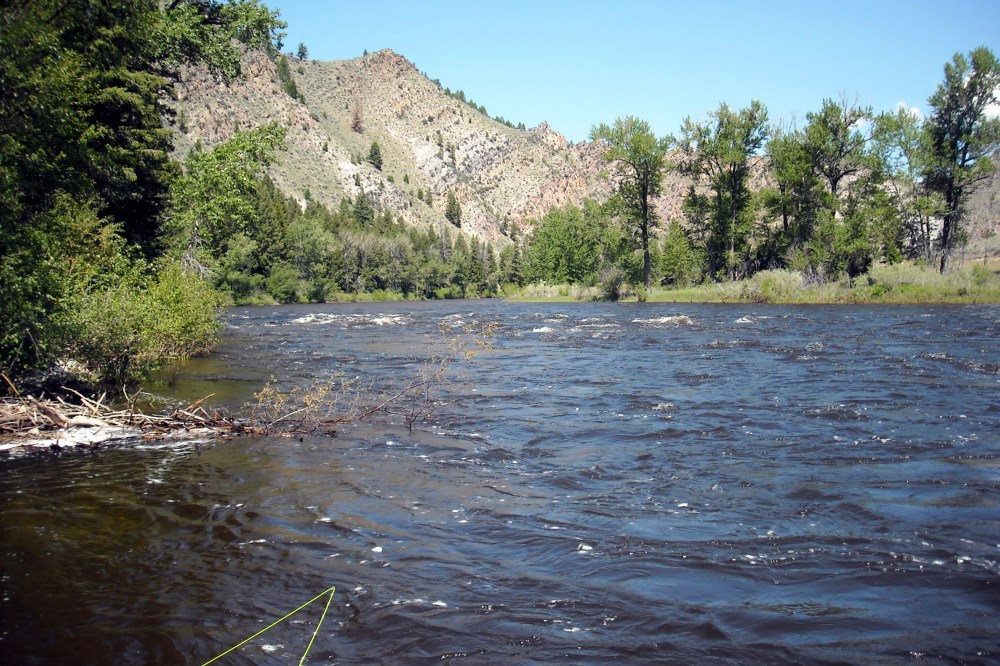
Algal growth is also unpopular with members of the recreating public because it can make wade-fishing a slipperier — and therefore more perilous — endeavor. And it drives down biodiversity in the macroinvertebrate population, which has repercussions for fish and other species higher up the aquatic food web. Andy Ulven, who leads DEQ’s water quality division, told Montana Free Press on Tuesday that a eutrophication listing would “formalize that there is an issue on the mainstem” of the Big Hole. He added that the agency proposal is still in draft stage and he doesn’t anticipate a final designation for the Big Hole until 2027 at the earliest.
The pending impairment designation is notable for a couple of reasons. In addition to establishing a new regulatory framework for the Big Hole, the designation creates a template that DEQ can use to determine if other medium-sized rivers popular with wading anglers are eligible for a eutrophication impairment.
DEQ’s Darrin Kron, who oversees the agency’s water-quality monitoring and assessment, explained that a eutrophication impairment designation would trigger regulations to reduce the inputs that contribute to poor water quality. Those standards are called Total Maximum Daily Loads, or TMDLs, and they’re often likened to a “pollution diet” for a compromised waterway.
In the case of the Big Hole, DEQ could develop TMDLs for nitrogen and phosphorus, as well as temperature-related standards to minimize new introductions of unnaturally warm water, which suppresses dissolved oxygen levels and contributes to algae growth.
Ulven anticipates that a eutrophication designation will increase the public funding that conservation groups like the Big Hole Watershed Committee and Trout Unlimited can apply for and put toward river-restoration initiatives. Projects those groups could work on — and are currently working on, if at a smaller scale — could include planting willows to add shade cover and reduce streambank erosion as well as intercepting nitrogen and phosphorus before they reach the river. Fertilizer runoff and livestock manure are common sources of nutrient pollution in agricultural valleys like the Big Hole.
The river’s algae issues have been well documented. Groups like Upper Missouri Waterkeeper, Save Wild Trout and the Big Hole River Foundation (which has since merged with Save Wild Trout) have been taking water-quality measurements and photographing summertime algae blooms on the river for six years to spur DEQ to rein in the nitrogen and phosphorus that are contributing to the algal blooms.
Guy Alsentzer with Upper Missouri Waterkeeper says the agency is playing “political hot potato” with impairment designations instead of acting with urgency to improve conditions on the Big Hole.
“It seems to be very disingenuous because it’s trying to avoid in any way, shape or form admitting that the key issue is that there are unhealthy and unnatural nutrient loading into the Big Hole River,” Alsentzer told Montana Free Press in a Wednesday morning interview. “A world-class, blue-ribbon stream for wild trout is on its knees. It has 40-year historic lows for trout recruitment.”
Alsentzer has long argued that the most proactive and scientifically sound way to reduce algal growth is to use numeric standards for nitrogen and phosphorus. But the Montana Legislature and DEQ disagree with him on this point, insisting that narrative, more subjective standards will suffice.
Last year, the Republican-controlled Legislature passed House Bill 664, which prohibits DEQ from using numeric nutrient standards. Proponents of HB 664 argued that it will result in more achievable and more affordable standards for the entities — water-treatment plants, mines and refineries, for example — that discharge nutrient-laden waters into Montana rivers.
HB 664 is the subject of an ongoing lawsuit Upper Missouri Waterkeeper filed in federal district court in January, maintaining that it doesn’t comply with the Clean Water Act, an environmental law Congress passed in 1972 to clean up polluted waterways. Alsentzer told MTFP that he anticipates the court will order a hearing on the matter at the tail end of this year and issue a ruling sometime in 2027.
Judge Brian Morris’ decision could determine whether DEQ can continue working with the eutrophication designation or whether it will be forced to return to numeric nutrient standards.
Water-quality concerns are likely to be exacerbated by the meager water supply currently in the Big Hole basin. The region received one of its worst snowpacks on record, and anxiety over a dismal summer forecast is a rare point of agreement among those who attended the Tuesday night open house.
Erik Kalsta, who ranches in the Big Hole Valley and is a longtime member of the Big Hole Watershed Committee, said he doesn’t anticipate the eutrophication-related impairment designation will drive significant changes to how he manages his land and water.
“I think the bigger worry for me is the messaging around this, especially on a bad drought year,” Kalsta told MTFP at the open house. He said he wouldn’t be surprised if the Big Hole goes dry in the next four or five weeks. That hasn’t happened since the late 1980s, and it spurred local irrigators to form the Big Hole Watershed Committee in search of cooperative water-management solutions.

“Our (irrigation) ditch right now is running about half of what it can carry,” Kalsta said. “That’s already forcing us to make choices about where we’re putting water, what kind of crops (we plant), what kind of summer we’re going to have.”
Brian Wheeler, executive director of Save Wild Trout, said the Big Hole is currently flowing at about one-quarter of its usual volume for this time of year. “It almost peaked in March, which is insane,” he added.
“If you can’t make more of it,” Wheeler said, “you can at least make sure what you have is clean.”
___
This story was originally published by Montana Free Press and distributed through a partnership with The Associated Press.