Warming climate, pollution and unplanned growth push Kashmir’s lakes toward disappearance
Advertisement
Read this article for free:
or
Already have an account? Log in here »
To continue reading, please subscribe:

Digital Subscription
One year of digital access for only $205*
- Enjoy unlimited reading on winnipegfreepress.com
- Read the E-Edition, our digital replica newspaper
- Access News Break, our award-winning app
- Play interactive puzzles
*First annual payment billed as $205.00 + GST for one year. This annual subscription will automatically renew at $233.00 + GST every 52 weeks (10% off the regular annual price of $259.35). Offer available to new and qualified returning subscribers only. Cancel any time.
To continue reading, please subscribe:
Add Free Press access to your Brandon Sun subscription for only an additional
$1 for the first 4 weeks*
- Enjoy unlimited reading on winnipegfreepress.com
- Read the E-Edition, our digital replica newspaper
- Access News Break, our award-winning app
- Play interactive puzzles
*Your next Brandon Sun subscription payment will increase by $1.00 and you will be charged $17.95 plus GST for four weeks. After four weeks, your payment will increase to $24.95 plus GST every four weeks.
Read unlimited articles for free today:
or
Already have an account? Log in here »
SRINAGAR, India (AP) — Every morning, long, narrow wooden boats called shikaras move elegantly across expansive Dal Lake in a postcard-perfect scene framed by the Himalayan mountains.
But all is not perfect in one of South Asia’s best-known lakes. Pollution from local buildings, invasive plant species that threaten biodiversity and declining water levels, in part due to climate-driven heat, are threatening the long-term existence of Dal Lake and hundreds of other lakes in Indian-controlled Kashmir.
It takes constant effort by workers employed by the local government to keep Dal Lake’s weeds at bay, and they must take precautions to avoid skin irritation from the polluted water. Yet it could be worse for the lake, which is located in Kashmir’s most populous city, Srinagar. It’s one of the few lakes in the region to receive sustained restoration work.
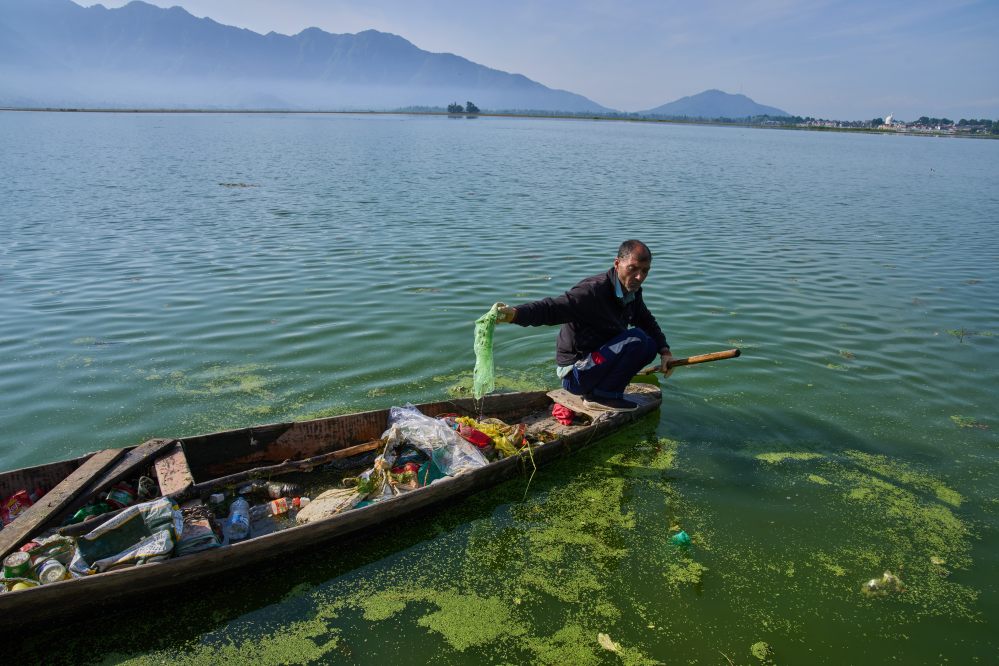
“We are afraid to touch the water with bare hands. Whenever we need to clean something by hand, we wear gloves, because without them our hands quickly develop allergies,” Ghulam Rasool, a weed cleaner employed by the local government, said on a recent afternoon.
Rasool said that sometimes it feels impossible to keep the lake clean.
“Sewage drains flow directly into the lake, and water streams coming from the mountains are bringing waste such as diapers and other garbage,” he said.
A combination of climate-driven changes, pollution and unplanned development is accelerating a decline in Indian lakes, with consequences rippling from fragile ecosystems to fishing communities and the tourism economy.
An Indian government report last year found that of the region’s 697 natural lakes, 315 have disappeared and 203 have shrunk since 1967. Hundreds recorded in earlier decades have been reduced to shallow marshes, seasonal wetlands or, in some cases, replaced by farmland and other development.
Homes and farms encroach upon lakes
Lakes in Kashmir have always been centers of activity, including Dal Lake’s famous floating markets where locals sell everything from vegetables to souvenirs. However, recent decades have seen the lakes’ boundaries shrink due to unpredictable rainfall, increased sediment from rivers and encroachment by farmland and houses. Small islands of farmland or long wooden bridges leading to illegal homes are becoming an increasingly common sight.
Farmland and homes creeping into what was once lake land is apparent in an aerial view of Dal Lake. Cattle graze freely on newly formed farmland even as the traditional fishers try to make their daily quota nearby.
Untreated sewage flowing into the lakes results in the growth of weeds, which feed off nitrogen, phosphorous and other nutrients in the waste. Plastics and other garbage dirty the lake. Dozens of weed cleaners try to clear Dal Lake every day, and small mounds of cleared weeds can be seen at various spots across the lake. Excavators and other heavy machinery are also used to pull weeds and garbage from the lake.
While acknowledging that more funds and work are needed, local government officials said they are trying their best. A government-run lake authority started in 1997 includes civil engineers, scientists, forest officials and local police officials.
While more than 75% of Srinagar’s population is connected to sewage treatment systems, sewage from the unconnected houses is a major contributor to lake pollution, said Muzamil Ahmad Rafiqui, superintending engineer for Kashmir’s Lake Conservation and Management Authority.
Climate change worsens lake depletion
Some of the world’s warmest years have meant that the Himalayan region is warming faster than the global average. Earlier snowmelt, reduced snowfall and more intense rainfall events are disrupting the timing and volume of water that feeds rivers and lakes.
Sher Muhammad, a glaciologist with the Kathmandu-headquartered International Centre for Integrated Mountain Development, said the shifting, unpredictable patterns mean lakes now face periods of sudden inflow followed by prolonged stress during drier months.
The melting of the region’s glaciers has also increased the amount of sediment carried downstream into the lakes. While the melting of glaciers can spur an initial boost in water flow, over time it will reduce the natural water storage that sustains rivers and lakes during dry periods, experts said.
Climate change has been devastating for Kashmir, said Irfan Rashid, an environmental scientist at the Srinagar-based University of Kashmir. “It has impacted every sector of our economy,” he said. Rashid said hydropower-generating capacity, tourism and highly valued apple and saffron farms have all been hit by erratic, extreme weather in recent years.
Fishing communities feel the brunt
Fishers at Wular Lake, about 65 kilometers (40 miles) northwest of Srinagar, said the lake has become shallower, its surface fragmented by new patches of vegetation. Parts of its catchment area have been taken over by tree plantations. Navigation has become harder, and fewer fish remain.
Abdul Rasheed, a 45-year-old fisherman, said he used to earn around 1,000 rupees ($11) a day. Now it’s only 100 to 200 rupees ($1 to $2) for an entire night of fishing.
“There are a lot of changes since my childhood,” said Rasheed.
As is the case with many other lakes in Kashmir, agricultural and residential development has encroached on the lake, while untreated sewage and farm runoff have hurt its water quality. Indeed, the surface in several areas is a green gunk. The most recent detailed study of Wular Lake, conducted by the conservation group Wetlands International in 2007, found that the lake had shrunk by 45% over the preceding century. The report also emphasized that the degradation of the lake increases flood risks in the Kashmir valley because it was traditionally the biggest buffer for overflows from the Jhelum River.
Many fishers at Wular Lake said they don’t believe future generations will be able to live off fishing.
Bashir Ahmed, a 55-year-old who has fished in the lake for decades, said in the past a young person with no fishing experience could return home with 4 kilograms (nearly 9 pounds) of fish.
“Now even a skilled fisherman comes home with no more than 1 kilogram (2.2 pounds),” he said.
___
Arasu reported from Bengaluru, India, and can be followed on X at @sibi123. Follow Dar Yasin on Instagram at @daryasinap
___
The Associated Press’ climate and environmental coverage receives financial support from multiple private foundations. AP is solely responsible for all content. Find AP’s standards for working with philanthropies, a list of supporters and funded coverage areas at AP.org.