China’s Inner Mongolia bets on solar and wind but coal stays close
Advertisement
Read this article for free:
or
Already have an account? Log in here »
To continue reading, please subscribe:
Digital Subscription
One year of digital access for only $1.44 a week*
- Enjoy unlimited reading on winnipegfreepress.com
- Read the E-Edition, our digital replica newspaper
- Access News Break, our award-winning app
- Play interactive puzzles
*Billed as $5.77 plus GST every four weeks. After 52 weeks, price increases to the regular rate of $19.95 plus GST every four weeks. Offer available to new and qualified returning subscribers only. Cancel any time.
To continue reading, please subscribe:
Add Free Press access to your Brandon Sun subscription for only an additional
$1 for the first 4 weeks*
- Enjoy unlimited reading on winnipegfreepress.com
- Read the E-Edition, our digital replica newspaper
- Access News Break, our award-winning app
- Play interactive puzzles
*Your next Brandon Sun subscription payment will increase by $1.00 and you will be charged $17.95 plus GST for four weeks. After four weeks, your payment will increase to $24.95 plus GST every four weeks.
Read unlimited articles for free today:
or
Already have an account? Log in here »
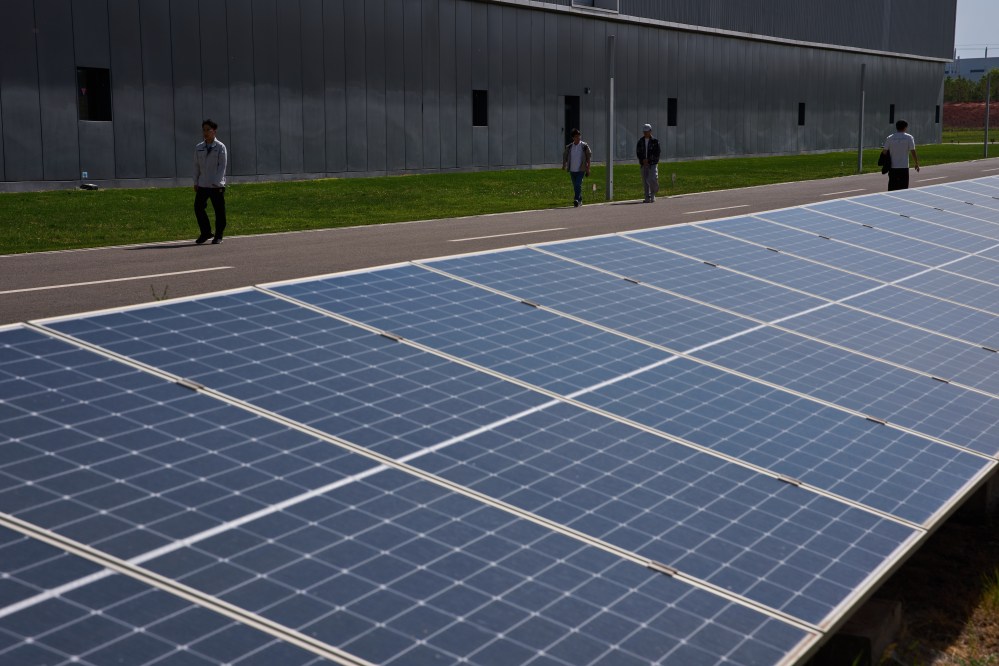
ORDOS, China (AP) — Seen from the air, the arrays of more than 3 million solar panels shimmering in the desert sun at the Dalad Banner solar farm are arranged in the shape of a galloping horse – a symbol of Inner Mongolia’s nomadic heritage. A short drive away stands one of the region’s many coal-fired power plants, one which sends electricity 700 kilometers (435 miles) to China’s capital Beijing.
The proximity of the projects embodies what experts describe as an “all-of-the-above” energy approach for Inner Mongolia, which has become China’s largest base of both renewable energy and coal production. Its energy transition mirrors China as a whole: Wind and solar capacity are expanding quickly while coal remains indispensable.
China has been installing wind and solar power faster than any other country. Yet coal-fired plants still supplied around 51% of China’s electricity in 2025, according to the latest data from the National Energy Administration.
“While China as a whole is transitioning away from coal, Inner Mongolia is most certainly the most paradoxical part of the story. In Inner Mongolia’s case, more renewables often means more coal capacity as well,” said David Fishman, an energy consultant at The Lantau Group, who has visited Inner Mongolia’s coal plants and the solar farms.
Inner Mongolia wants wind and solar power to increasingly replace electricity traditionally supplied by coal, while also meeting the country’s growing demand for power. But officials said both renewables and coal will continue to rise for now, with coal needed to supplement when weather causes interruptions in wind or solar power.
“Many people see there is a conflict or a competitive relationship between traditional energy and renewable energy,” said Gu Qing, an official of Inner Mongolia’s energy administration, standing at the edge of the Dalad Banner solar farm.
“As more renewable energy capacity is added, coal-fired power will also continue to grow, although the pace will gradually slow,” Gu said.
The Dalad Banner solar farm, which Associated Press reporters visited on a recent government-organized tour, currently generates around 2 billion kilowatt-hours of electricity annually. It is part of a broader clean energy program started in 2018 in northern China’s Kubuqi Desert.
Inner Mongolia is crucial to China’s power transmission plan
Inner Mongolia is one of the most crucial nodes in China’s “West-to-East Power Transmission Project,” which transmits electricity from the country’s resource-rich northwest to its industrialized east. In 2025, 40% of Inner Mongolia’s electricity generation, about 350 billion kilowatt-hours, was sent to other parts of China. The amount is enough to power 120 million households for a year.
Solar and wind installed capacity has more than doubled in the past five years in Inner Mongolia, but coal still dominates electricity generation. Coal-fired plants produced around 590 billion kilowatt-hours in 2025 in Inner Mongolia, while solar and wind generated about 277 billion kilowatt-hours combined.
Coal power capacity in Inner Mongolia has continued to expand over the past five years.
“Because wind and solar are intermittent…we cannot do without the support of coal-fired power,” said Huang Zhiqiang, vice governor of Inner Mongolia, during a recent news briefing.
“What is changing is that coal power units are turning from supply-guarantee units to serving as a supporting and regulating role,” he said.
Inner Mongolia mined around 1.2 billion tons of coal in recent years, accounting for one quarter of China’s total coal production. Over 60% was transported to other provinces. Ordos, the city administering the Dalad Banner, is also one of the country’s five largest coal-producing centers designated by the central government.
Managing the energy transition
Officials said renewable energy is beginning to replace existing demand conventionally provided by coal. The transition requires that coal plants ramp down when renewable output is abundant and ramp up when it is not. Huang said Inner Mongolia refurbished all coal power units so they can ramp down to operate at 15% of their capacity so less coal is burned.
But Fishman, the energy consultant, said ramping units down to 15% is “an aspirational or best-unit capability rather than something that applies across the whole fleet in day-to-day operations,” because it will cause stress both technically and financially.
Similarly, Anika Patel, China section editor at the climate change research organization Carbon Brief, said: “Just because a plant can operate flexibly doesn’t mean that it is operating flexibly.”
She said that it’s challenging to relegate coal to a supporting role because of Chinese economic and political incentives around its use. Patel said China’s long-term power contracts reduce flexibility for power grids to purchase renewable electricity, while lengthy interprovincial trading arrangements make it harder to include solar and wind.
Supporting artificial intelligence, electric vehicles and manufacturing
The government said Inner Mongolia is not only building more wind and solar projects to meet the rising electricity demand from AI computing, electric vehicle charging and manufacturing. It is also investing in energy storage, transmission infrastructure and other ways to make the grid efficient.
Gu said Inner Mongolia will encourage factories to adjust production to better match patterns of wind and solar generation so renewable energy can be used more efficiently.
For over a decade since the early 2010s, China experienced a rapid solar and wind energy expansion that was largely driven by government targets and investment incentives, leading to issues such as overcapacity.
Power generation is only one part of Inner Mongolia’s coal strategy. The region is also a big hub of coal chemical industry, in which coal is converted to chemicals or fuels to produce other products. The processes emit more carbon dioxide than using coal to generate electricity. Huang said Inner Mongolia will deploy carbon-capture technologies to curb emissions.
He said Inner Mongolia has been expanding capacity of coal-to-oil, coal-to-gas and coal chemical industries. The Iran conflict and the close of the Strait of Hormuz exposed the vulnerability of countries that rely on imported oil and liquefied natural gas.
“At the industrial level, this can help offset and ease China’s reliance on imported oil and gas, reducing dependence on overseas supplies,” Huang said.
___
Video producer Olivia Zhang contributed to this report.
___
The Associated Press’ climate and environmental coverage receives financial support from multiple private foundations. AP is solely responsible for all content. Find AP’s standards for working with philanthropies, a list of supporters and funded coverage areas at AP.org.