Indonesians fight a German cement giant over a mine and factory project
Advertisement
Read this article for free:
or
Already have an account? Log in here »
To continue reading, please subscribe:

Digital Subscription
One year of digital access for only $205*
- Enjoy unlimited reading on winnipegfreepress.com
- Read the E-Edition, our digital replica newspaper
- Access News Break, our award-winning app
- Play interactive puzzles
*First annual payment billed as $205.00 + GST for one year. This annual subscription will automatically renew at $233.00 + GST every 52 weeks (10% off the regular annual price of $259.35). Offer available to new and qualified returning subscribers only. Cancel any time.
To continue reading, please subscribe:
Add Free Press access to your Brandon Sun subscription for only an additional
$1 for the first 4 weeks*
- Enjoy unlimited reading on winnipegfreepress.com
- Read the E-Edition, our digital replica newspaper
- Access News Break, our award-winning app
- Play interactive puzzles
*Your next Brandon Sun subscription payment will increase by $1.00 and you will be charged $17.95 plus GST for four weeks. After four weeks, your payment will increase to $24.95 plus GST every four weeks.
Read unlimited articles for free today:
or
Already have an account? Log in here »
JAKARTA, Indonesia (AP) — Indonesians are trying to stop a major German cement producer from building a mine and factory under a unique supply chain law that adds to a growing number of cases legal experts say may influence European businesses in Asia.
Critics say Heidelberg Materials, one of the world’s largest cement companies, failed to properly assess and mitigate the potential harms of its plans to create a limestone mine and cement factory in Central Java’s Kendeng Mountains. They say the project may damage a rare karst ecosystem and harm the livelihoods of Indigenous people in the area.
“If the project is implemented, we face an ecological catastrophe, impoverishment, and violations of our human rights,” said Bambang Sutikyo, one of the complainants.
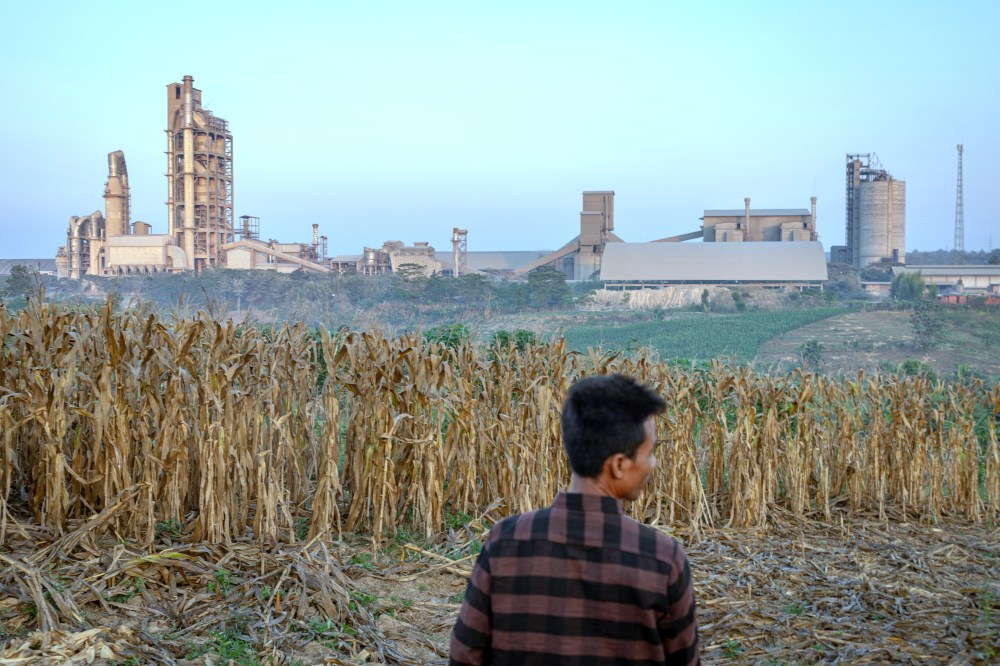
Katharina Plonsker, the senior sustainability communication manager for Heidelberg Materials, said affected communities had the opportunity to voice concerns to the company’s local subsidiary PT Indocement Tunggal Prakarsa during the project’s permitting process. Feedback from this exchange was reflected in the project planning.
So far, “no decision on the implementation of the project has been taken,” she said.
The complaint to the German Federal Office for Economic Affairs and Export Control against Heidelberg Materials and Indocement is Indonesia’s first to employ Germany’s supply chain law, which is designed to ensure that human rights are respected throughout the supply chains of big companies.
Some other European Union nations are preparing to implement similar regulations, learning from Germany as they draft their own versions of the law, said Annabell Brüggemann with the Berlin-based European Center for Constitutional and Human Rights. So, “complaints filed at this moment are quite significant,” she said.
In similar cases, plaintiffs in Cambodia, Pakistan, the Philippines and elsewhere in Indonesia are taking other major European firms — like the apparel company Adidas and energy giant Shell — to court.
This adds to financial risks for European companies that may have invested in Asia to take advantage of less stringent regulations, according to Jameela Joy Reyes with the London-based Grantham Research Institute on Climate Change and the Environment.
“The transboundary harm element of these cases is quite interesting, and we might be seeing that more in the future,” she said.
Indonesians take German cement giant to court
The complaint by 10 people backed by local and international non-profits, like Inclusive Development and Watch Indonesia, alleges that Heidelberg Materials did not fully assess the potential harm to the affected area in Central Java’s Kendeng Mountains, a major natural carbon sink and underground reservoir.
Other mining plans in Kendeng have long drawn resistance.
“It’s not just the environmental impact, the loss of land taken by the cement industry will result in our brothers and sisters having no land left,” said Gunretno, one of the plaintiffs. He belongs to the Indigenous agricultural community, the Samin, also known as the Sedulur Sikep. Like many Indonesians, he uses only one name.
“When it comes to environmental destruction of any kind, we, as global citizens, have a responsibility to figure out how we can work together to protect our one and only Earth,” Gunretno said.
Syamsuddin Arief, a lawyer with the Semarang Legal Aid Institute, which supports the Samin, hopes the complaint will “achieve the shared goal of upholding citizens’ rights to a sustainable life, a healthy and good environment, and ensuring the sustainability of the Kendeng Mountains.”
Climate cases increase in Asia
Globally, there were at least 226 lawsuits over climate issues filed in 2024, according to the Grantham Research Institute, which tracks nearly 3,000 cases across 60 countries.
Four fisher people from Indonesia’s Pari Island filed a legal complaint in 2023 against the Swiss construction company Holcim, which refutes their assertion that its climate change-causing emissions threaten their homes and livelihoods.
Holcim said it plans to appeal a Swiss court’s decision to hear the case. If it proceeds, this would be one of the first climate litigation cases against a Swiss corporation.
Nearly 70 survivors of a 2021 super typhoon Rai in the Philippines used a similar argument in a complaint filed last year against Shell. The plaintiffs say the company’s historic emissions made the disaster worse and are seeking compensation for deaths and damages. Shell says it’s not legally liable.
Around 40 farmers in Pakistan also filed a legal complaint against Heidelberg Materials and German energy giant RWE last year. They likewise contend that those companies’ emissions worsened climate change, intensifying devastating 2022 floods, the worst in Pakistan’s history at the time.
This move was inspired by a parallel case from Peru against RWE.
“All of these factors are coming into play in this bigger conversation about reparations and what this might mean for those in the Global South, whose land and whose resources many of these corporations have been profiting off of,” said Reyes at the institute.
Initial cases may influence EU laws
Germany’s supply chain law has changed how communities in affected environments around the world can counter corporate activity, said Laurie Parsons of the Royal Holloway, University of London and author of “Carbon Colonialism.”
“It also changed the mindsets of companies and governments about what’s possible,” he said.
With regulations similar to Germany’s expected across the 27-nation EU by 2028, more cases are inevitable, said Brüggemann with the ECCHR.

The Indonesian cement project case “shows how strong the movement is for corporate accountability and how big the need is for regulation of the globalized economy,” she said.
___
Delgado reported from Bangkok. Associated Press writer Sam McNeil in Brussels contributed to this report.
___
The Associated Press’ climate and environmental coverage receives financial support from multiple private foundations. The AP is solely responsible for all content. Find AP’s standards for working with philanthropies, a list of supporters and funded coverage areas at AP.org.