From the Mexican border to Washington: A tiny Texas town fights Trump’s wall plan
Advertisement
Read this article for free:
or
Already have an account? Log in here »
To continue reading, please subscribe:

Digital Subscription
One year of digital access for only $205*
- Enjoy unlimited reading on winnipegfreepress.com
- Read the E-Edition, our digital replica newspaper
- Access News Break, our award-winning app
- Play interactive puzzles
*First annual payment billed as $205.00 + GST for one year. This annual subscription will automatically renew at $233.00 + GST every 52 weeks (10% off the regular annual price of $259.35). Offer available to new and qualified returning subscribers only. Cancel any time.
To continue reading, please subscribe:
Add Free Press access to your Brandon Sun subscription for only an additional
$1 for the first 4 weeks*
- Enjoy unlimited reading on winnipegfreepress.com
- Read the E-Edition, our digital replica newspaper
- Access News Break, our award-winning app
- Play interactive puzzles
*Your next Brandon Sun subscription payment will increase by $1.00 and you will be charged $17.95 plus GST for four weeks. After four weeks, your payment will increase to $24.95 plus GST every four weeks.
Read unlimited articles for free today:
or
Already have an account? Log in here »
WASHINGTON (AP) — On one side: a small community in rural Texas. On the other: the Trump administration.
A tiny Texan town along the border with Mexico is fighting the administration’s efforts to build a border wall running through a levee system protecting the community. The town argued in court Tuesday that the wall could cause flooding and that the administration isn’t following the law as it rushes forward with its plans.
The hearing in federal court came as the Department of Homeland Security charges forward with its $46 billion plan to complete a border wall from the Pacific Ocean to the Gulf of Mexico and deliver on what has long been a signature promise of President Donald Trump. But the department is running into opposition by landowners, environmental groups, Native American tribes and others who argue that the government’s rapid construction endangers historical and religious sites and a way of life along the border, when crossings from Mexico are already at extreme lows.
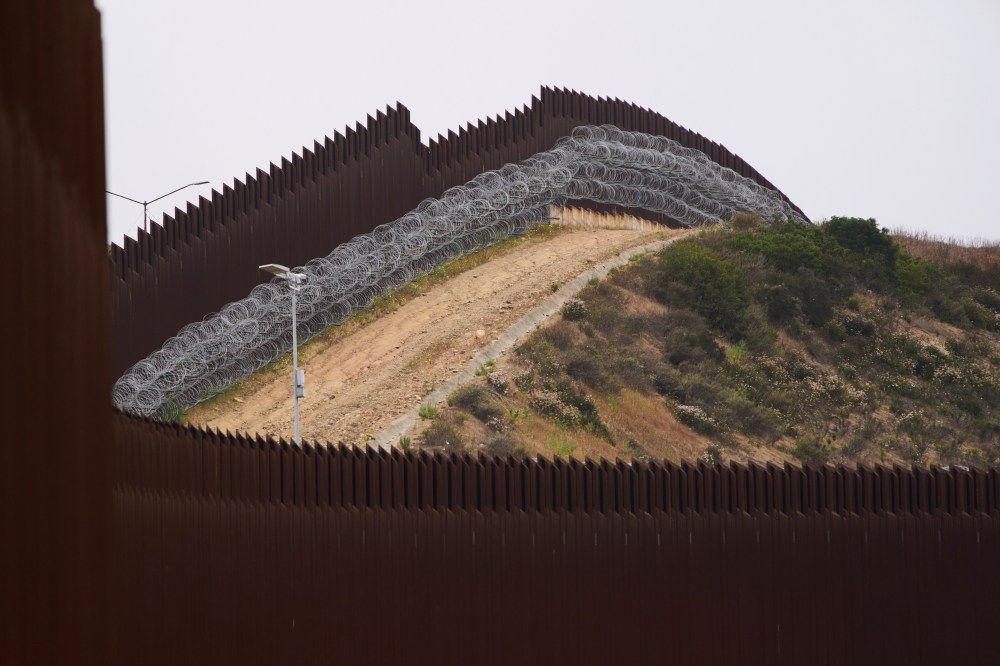
The lawsuit brought by the development district of Presidio pits a small town of a little over 3,200 residents against a department key to the Trump administration’s plans to carry out its mass deportations agenda. It also showcases a context that has long been important to many Americans, particularly Republicans: the scratchiness that sometimes arises between the most local of municipalities and the federal government in Washington.
Lawyers for the development district contend the government’s plans could compromise the levee system protecting the town from flash flooding — a formidable problem in Texas — and that the government flouted a key act that requires it to seek permission from the Army Corps of Engineers before building on or near the levees.
The government argues that there is no final plan for where the border wall will go or how it will be built. Regardless, the administration asserts it has the authority to waive a vast swath of regulations to build the wall as it seeks to get the number of people crossing the border every day to zero.
The town worries about levees along the Rio Grande
The town is worried about the effect the wall would have on a series of berms and levees built in the 1970s and 1980s along the Rio Grande and tributaries to combat flooding.
In court documents, Presidio’s development district said Customs and Border Protection plans to “replace the earthen slope of the existing levee with a concrete wall, with 30-foot steel bollard panels installed on top.” The district says it has asked the agency for more details but has been told they can’t be shared due to “national security.”
“There is unfortunately a long history here of CBP construction causing or increasing flood risks,” said Laura Bakst, a lawyer for Democracy Forward, which is representing Presidio’s development district in the case.
A lawyer for the government said during Tuesday’s hearing that it’s too soon to argue that the proposed wall could harm Presidio because Customs and Border Protection hasn’t actually decided on a final plan for it.
The department has waived numerous regulations to build the wall faster
In the race to build the wall, both former Homeland Security Secretary Kristi Noem and the current secretary, Markwayne Mullin, have waived numerous requirements protecting the environment or archaeological sites that the federal government normally has to follow when building infrastructure projects.
Under legislation passed by Congress, Homeland Security does have the authority to waive certain requirements specifically to speed up the building of walls along the U.S.-Mexico border. But critics argue the department is going much further than Congress intended by issuing broad waivers all along the 2,000-mile or 3,200-kilometer length of the frontier.
In Presidio’s case, the development district is arguing that Homeland Security is running afoul of the Rivers and Harbors Act. The department has waived it, but lawyers for Presidio argued that because of the wording of the Act, Homeland Security was still required to consult with the Army Corps of Engineers before launching the project.
Louis Katz, a lawyer for Democracy Forward, warned that the way the department was waiving state and federal laws as it moves forward with the wall is an “extraordinary exertion of authority.”
Construction could start as early as August or as late as October
A key question: When would construction start? Timing has been an issue beyond Presidio as landowners up and down the border look for an answer. Construction crews have pre-positioned supplies — including the steel bollard wall panels — but no actual wall-building has started in the area.
A lawyer for the Justice Department gave some insight into the government’s timeline. In response to questions about whether construction could start as early as the beginning of August, Alexander Yun told the judge that it was unlikely to start that early. Yun said construction could begin in late August or September or October.
Homeland Security has indicated that getting the wall built is a priority.
Mullin said during congressional testimony in June that the preliminary layer of the wall will be finished by “this time next year.” The head of Customs and Border Protection, Rodney Scott, has said the agency is putting up 6 miles (10 kilometers) of wall a week.
The judge seemed a bit skeptical of both sides
The Trump administration is pushing forward with the wall when border crossings are at the lowest levels in decades. The Big Bend Sector has not experienced the high number of border crossings seen in recent years in other areas farther south along the Rio Grande or in Arizona or California, owing to the remote and challenging terrain on both sides of the border.
But the Justice Department lawyer said low border crossing numbers seen over the last year are an “anomaly” and the goal is “zero illegal crossings.”
Judge Reggie Walton scoffed at that idea, saying that it’s “just a reality” that people will always try to cross the border.
Walton also said he was struggling with the issue of how much authority he had to limit the department considering that Congress had given it the ability to waive certain requirements.
The judge said he would issue a ruling in the coming week.