Florida researchers bring endangered elkhorn coral ashore to protect them
Advertisement
Read this article for free:
or
Already have an account? Log in here »
To continue reading, please subscribe:

Digital Subscription
One year of digital access for only $205*
- Enjoy unlimited reading on winnipegfreepress.com
- Read the E-Edition, our digital replica newspaper
- Access News Break, our award-winning app
- Play interactive puzzles
*First annual payment billed as $205.00 + GST for one year. This annual subscription will automatically renew at $233.00 + GST every 52 weeks (10% off the regular annual price of $259.35). Offer available to new and qualified returning subscribers only. Cancel any time.
To continue reading, please subscribe:
Add Free Press access to your Brandon Sun subscription for only an additional
$1 for the first 4 weeks*
- Enjoy unlimited reading on winnipegfreepress.com
- Read the E-Edition, our digital replica newspaper
- Access News Break, our award-winning app
- Play interactive puzzles
*Your next Brandon Sun subscription payment will increase by $1.00 and you will be charged $17.95 plus GST for four weeks. After four weeks, your payment will increase to $24.95 plus GST every four weeks.
Read unlimited articles for free today:
or
Already have an account? Log in here »
KEY BISCAYNE, Fla. (AP) — Scientists working to save a coral species from extinction transported 30 pieces from nurseries off the Florida coast to a hatchery on land Wednesday, fearing that warming waters could trigger a mass bleaching event this summer that could wipe them out.
Elkhorn coral populations were decimated by a 2023 heat wave and a less severe one in 2024 that left them functionally extinct — meaning remaining colonies are too small and far apart to reproduce in the wild — from Broward County to the Florida Keys, said Diego Lirman, associate professor of marine biology at the University of Miami. Heat causes coral to bleach, which can be fatal if it lasts long enough.
Researchers have been propagating them at coastal nurseries, but decided to bring some ashore now because of indications that 2026 will be “a really bad year” for bleaching — perhaps even worse than 2023, Lirman said. Coral has been showing indications of heat stress as water temperatures rise.
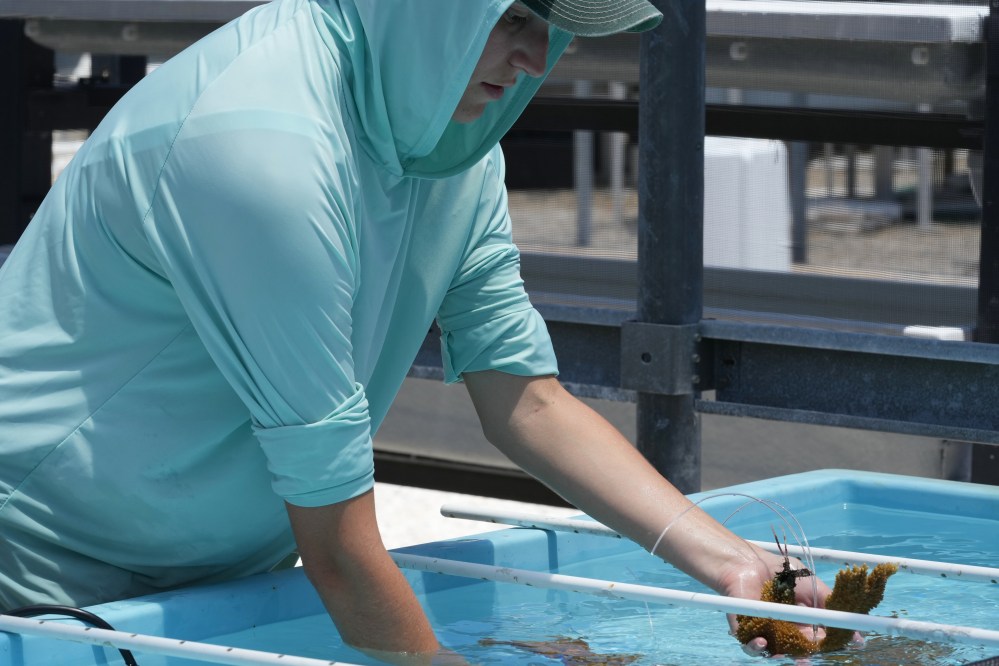
Coral populations are living creatures that form reefs, globally important for seafood production, protecting coastlines from storm surges and tourism. But scientists fear they could be lost because of climate change: Florida coral has experienced four mass bleaching events in the past decade.
“They seem to be blending into each other and corals are not getting time to recover,” Lirman said.
Divers focused Wednesday on collecting genetically diverse coral pieces, wrapping each in wet bubble wrap and placing them in coolers before sanitizing them and putting them in tanks at the hatchery.
The university exchanges coral with other researchers and facilities to preserve as much original genetic diversity as possible in nurseries and in hatcheries, “so if one goes down you don’t lose the last remaining genetic information,” Lirman said.
“You never know: You may have some that are resistant to disease, some that are resistant to temperature, some that are resistant to acidification,” he said. “Once we lose them, then that information is lost.”

___
The Associated Press’ climate and environmental coverage receives financial support from multiple private foundations. AP is solely responsible for all content. Find AP’s standards for working with philanthropies, a list of supporters and funded coverage areas at AP.org.