South American trade bloc’s top court takes up unprecedented Peru illegal mining case

Advertisement

Advertise with us

BOGOTA, Colombia (AP) — The Andean Court of Justice, which interprets and enforces the laws of the Andean Community trade bloc, has admitted an unprecedented case against Peru over alleged failures to combat illegal mining, marking the first time the court will examine whether a member state has met its regional obligations in fighting illegal mining.

Read this article for free:


or

Already have an account? Log in here »

To continue reading, please subscribe:

Subscribe and receive a limited-edition Free Press branded hat or tote.

Digital Subscription

One year of digital access for only $205*

  • Enjoy unlimited reading on winnipegfreepress.com
  • Read the E-Edition, our digital replica newspaper
  • Access News Break, our award-winning app
  • Play interactive puzzles

*First annual payment billed as $205.00 + GST for one year. This annual subscription will automatically renew at $233.00 + GST every 52 weeks (10% off the regular annual price of $259.35). Offer available to new and qualified returning subscribers only. Cancel any time.

To continue reading, please subscribe:

Add Free Press access to your Brandon Sun subscription for only an additional

$1 for the first 4 weeks*

  • Enjoy unlimited reading on winnipegfreepress.com
  • Read the E-Edition, our digital replica newspaper
  • Access News Break, our award-winning app
  • Play interactive puzzles
Start now

*Your next Brandon Sun subscription payment will increase by $1.00 and you will be charged $17.95 plus GST for four weeks. After four weeks, your payment will increase to $24.95 plus GST every four weeks.

BOGOTA, Colombia (AP) — The Andean Court of Justice, which interprets and enforces the laws of the Andean Community trade bloc, has admitted an unprecedented case against Peru over alleged failures to combat illegal mining, marking the first time the court will examine whether a member state has met its regional obligations in fighting illegal mining.

The lawsuit challenges the government’s repeated extensions of REINFO, Peru’s mining formalization program created to help informal small-scale miners become legal. Critics say the repeated extensions have instead allowed illegal mining operations to continue under temporary legal protection.

Illegal gold mining has become one of the Amazon’s greatest environmental threats, driving deforestation, mercury pollution of rivers and violence against Indigenous communities across the region. In Peru, the activity has expanded beyond the southern Madre de Dios region into other parts of the Amazon, including the Nanay River basin near the city of Iquitos.
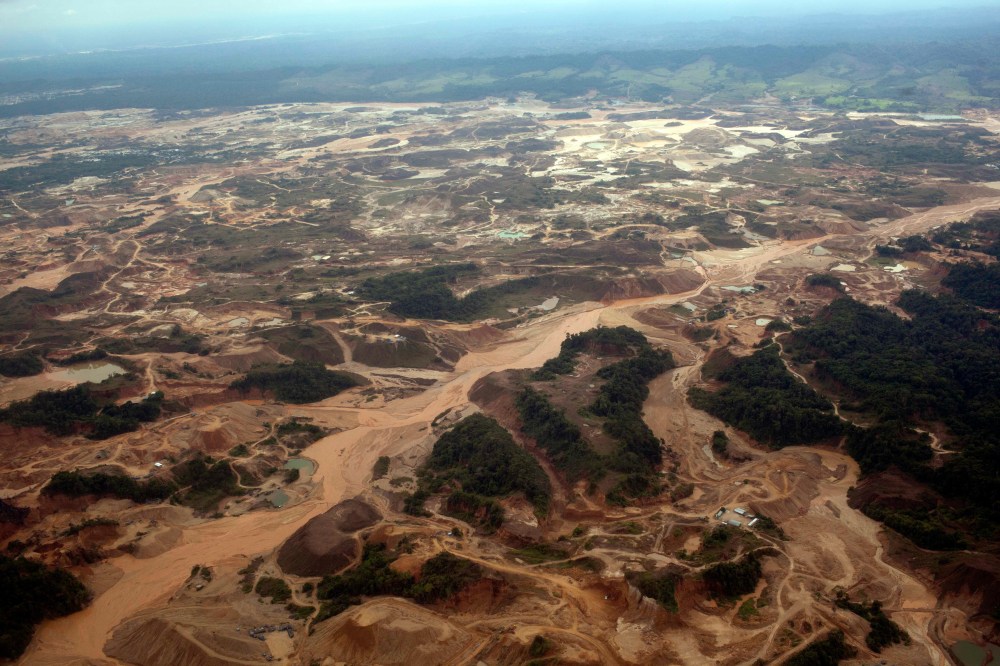
FILE - This aerial photo shows tailings produced by informal mining in Peru's Madre de Dios region, Sept. 13, 2013. (AP Photo/Rodrigo Abd, File)

The South American court admitted the case in an order dated July 15 and notified the parties on July 20, giving Peru 40 calendar days to respond. It has yet to rule on the plaintiffs’ request for precautionary measures, including temporarily suspending REINFO while the case proceeds.

The lawsuit was filed by an Indigenous and rural communities organization from Peru’s Nanay River basin, along with seven local residents of Peru’s Amazon, who argue the government has failed to strengthen measures against illegal mining, money laundering and related crimes despite obligations under Andean Community law. The Andean Community comprises Bolivia, Colombia, Ecuador and Peru.

The case stems from a 2025 decision by the General Secretariat of the Andean Community, the bloc’s executive body, which concluded Peru had failed to adequately strengthen measures to combat illegal mining and related crimes, including asset forfeiture mechanisms targeting illegal mining operations.

The secretariat also found Peru’s repeated extensions of REINFO were incompatible with the country’s obligations under Andean Community law. Environmental organizations and Indigenous groups argue successive extensions have allowed illegal mining to continue under the guise of formalization. The Peruvian government has said the extensions were necessary because thousands of miners have yet to complete the formalization process.

The Peruvian Ministry of Energy and Mines and the country’s Ministry of Environment did not respond to requests for comment by the time of publication.

Why the case matters

Environmental lawyer César Ipenza, who represents the plaintiffs, described the case as unprecedented.

“This is the first time a person or organization has sued one of the Andean countries for failing to comply with obligations established under the Andean integration system,” he said.

While admitting the lawsuit is a procedural step, Ipenza said it already represented an important milestone because it meant the regional court would now examine whether a member state had failed to meet its obligations to combat illegal mining.

If the court ultimately rules against Peru and the country fails to comply with its judgment, the case could eventually carry economic consequences under the bloc’s legal framework, Ipenza said.

“Without a doubt, this is an important precedent,” he said. “It could lead the other countries to reconsider and understand that these obligations must be fulfilled.”

___

The Associated Press’ climate and environmental coverage receives financial support from multiple private foundations. AP is solely responsible for all content. Find AP’s standards for working with philanthropies, a list of supporters and funded coverage areas at AP.org.


Report Error Submit a Tip

More Stories

South American trade bloc’s top court takes up unprecedented Peru illegal mining case

Steven Grattan, The Associated Press 3 minute read Preview

South American trade bloc’s top court takes up unprecedented Peru illegal mining case

Steven Grattan, The Associated Press 3 minute read Wednesday, Jul. 22, 2026

BOGOTA, Colombia (AP) — The Andean Court of Justice, which interprets and enforces the laws of the Andean Community trade bloc, has admitted an unprecedented case against Peru over alleged failures to combat illegal mining, marking the first time the court will examine whether a member state has met its regional obligations in fighting illegal mining.

The lawsuit challenges the government’s repeated extensions of REINFO, Peru’s mining formalization program created to help informal small-scale miners become legal. Critics say the repeated extensions have instead allowed illegal mining operations to continue under temporary legal protection.

Illegal gold mining has become one of the Amazon’s greatest environmental threats, driving deforestation, mercury pollution of rivers and violence against Indigenous communities across the region. In Peru, the activity has expanded beyond the southern Madre de Dios region into other parts of the Amazon, including the Nanay River basin near the city of Iquitos.

The South American court admitted the case in an order dated July 15 and notified the parties on July 20, giving Peru 40 calendar days to respond. It has yet to rule on the plaintiffs’ request for precautionary measures, including temporarily suspending REINFO while the case proceeds.

Read
Wednesday, Jul. 22, 2026

What’s open, what’s closed, what’s up in Winnipeg on National Day for Truth and Reconciliation Sept. 30, 2026

Free Press staff 4 minute read Preview

What’s open, what’s closed, what’s up in Winnipeg on National Day for Truth and Reconciliation Sept. 30, 2026

Free Press staff 4 minute read Sunday, Sep. 27, 2026

The National Day of Truth and Reconciliation, or Orange Shirt Day, as it's known in Manitoba, happens Sept. 30 with many commemorative community events scheduled.

Read
Sunday, Sep. 27, 2026

What does the PC stand for in party’s name? Seems to be Pretty Confused

Tom Brodbeck 5 minute read Preview

What does the PC stand for in party’s name? Seems to be Pretty Confused

Tom Brodbeck 5 minute read 1:11 PM CDT

It should have been obvious from the beginning that the Manitoba Progressive Conservative party was going to have trouble holding itself together under Obby Khan.

The warning came in April 2025, when the now-former PC party leader narrowly won the leadership over far-right populist candidate Wally Daudrich.

Technically, Khan won. Politically, however, it was a more complicated result.

Daudrich received more votes than Khan, but Khan prevailed because the party used a constituency-weighted points system that gave him just enough of an advantage to put him over the top.

Read
1:11 PM CDT

Furby Street residents fed up with inaction on drug houses

Carol Sanders 6 minute read Preview

Furby Street residents fed up with inaction on drug houses

Carol Sanders 6 minute read Updated: Yesterday at 8:39 AM CDT

Anxious Furby Street residents contacted the city and their elected officials Friday to — once again — report people coming and going from a boarded-up house they call a dangerous “drug centre” and “den of thieves” that’s just steps away from a house under construction.

Linda Zak, who was holding a yard sale with a group of neighbours Friday morning, described the trouble the home attracts, while a woman slumped on the front steps and a man standing in the yard yelled to someone inside it.

“It is a drug centre,” said Zak, 77. “We know that. A couple of days ago, a person lit the front on fire. Now, as you look at it, you can see where the facade was burning and they were trying to harm people inside.”

“We’re very concerned about it being next to the home this man is building,” she said, pointing to the two-storey that’s nearly completed. The boarded-up house is in the 500 block of Furby.

Read
Updated: Yesterday at 8:39 AM CDT

Canada resorting to its tried and true playbook

Niigaan Sinclair 5 minute read Preview

Canada resorting to its tried and true playbook

Niigaan Sinclair 5 minute read Yesterday at 6:00 AM CDT

In 1846, Britain faced an emergency influenced by the Irish famine, so leaders repealed the country’s “Corn Laws” and restrictions on imported food and grain, transitioning to a system of free trade.

This created a crisis in the then Province of Canada, which had relied on British “preferential” status to prop up its agricultural and resource industries.

As a result, Canada looked south for new markets and eventually negotiated a free trade agreement with the United States.

This required land to be acquired and converted for industrial use quickly, so Canada quickly dispatched Commissioner William Robinson to negotiate with Indigenous communities along Lake Huron and Lake Superior for land.

Read
Yesterday at 6:00 AM CDT

Khan cites infighting, quits as Tory leader

Carol Sanders 5 minute read Preview

Khan cites infighting, quits as Tory leader

Carol Sanders 5 minute read Updated: 9:56 AM CDT

Manitoba’s Leader of the Opposition is stepping down.

Progressive Conservative Leader Obby Khan announced late Monday afternoon he is quitting caucus and will sit in the legislature as an independent MLA, effective today.

He cited internal party fighting for his decision.

The former Winnipeg Blue Bombers offensive lineman survived a caucus confidence vote Friday. He said there were 13 votes for him to remain and six against, with one person absent.

Read
Updated: 9:56 AM CDT