Water hauling is the new chore no rancher asked for
Advertisement
Read this article for free:
or
Already have an account? Log in here »
To continue reading, please subscribe:

Digital Subscription
One year of digital access for only $205*
- Enjoy unlimited reading on winnipegfreepress.com
- Read the E-Edition, our digital replica newspaper
- Access News Break, our award-winning app
- Play interactive puzzles
*First annual payment billed as $205.00 + GST for one year. This annual subscription will automatically renew at $233.00 + GST every 52 weeks (10% off the regular annual price of $259.35). Offer available to new and qualified returning subscribers only. Cancel any time.
To continue reading, please subscribe:
Add Free Press access to your Brandon Sun subscription for only an additional
$1 for the first 4 weeks*
- Enjoy unlimited reading on winnipegfreepress.com
- Read the E-Edition, our digital replica newspaper
- Access News Break, our award-winning app
- Play interactive puzzles
*Your next Brandon Sun subscription payment will increase by $1.00 and you will be charged $17.95 plus GST for four weeks. After four weeks, your payment will increase to $24.95 plus GST every four weeks.
Read unlimited articles for free today:
or
Already have an account? Log in here »
MONTROSE, Colo. (AP) — As water shot into an open stock tank atop a high country mesa, a trickle soaked the dusty earth below. Scott Snyder rose from the shade to fasten a hose and stop the spillage.
“It’s just so much work. I hate dropping any of it,” said Snyder, who operates Mex and Sons Ranch near Montrose, Colorado, with his family.
It took eight trips in three vehicles over nine hours in sweltering heat before the 800 cow-calf pairs finally had enough water to make it through to the next day — maybe two.
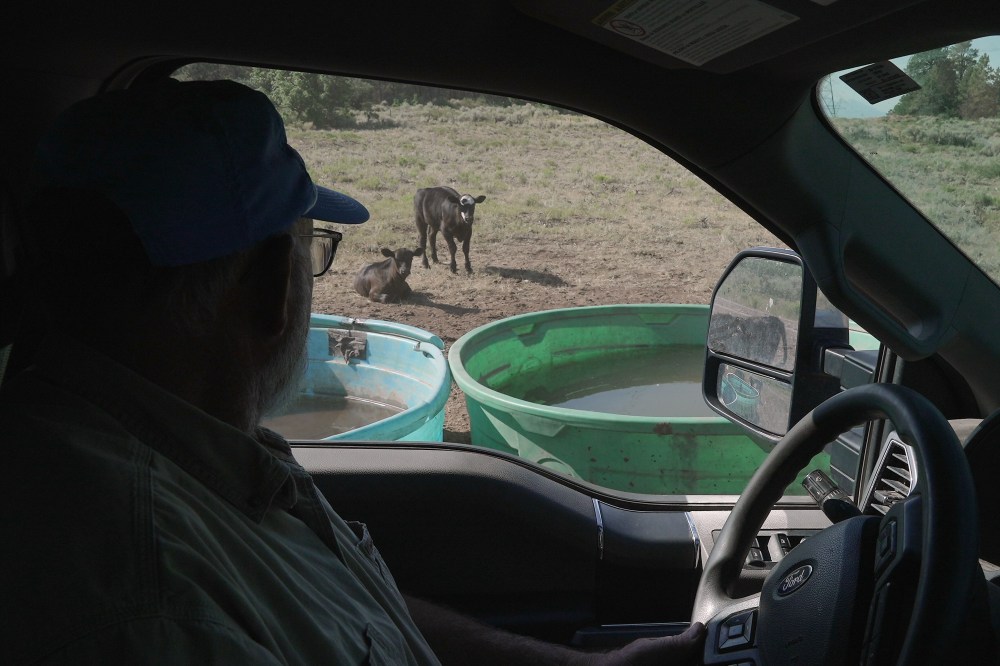
Hauling water across rugged landscapes has become a daily chore for many ranchers in the U.S. Rockies. They historically relied on snowmelt to sustain stock ponds, springs and creeks for livestock to drink throughout the summer, but this year’s snowpack was the worst on record in the Upper Colorado River Basin, which includes Wyoming, Colorado, Utah and New Mexico. Human-caused climate change made the snow drought about 14 times more likely, a new study confirms.
Coping with the impacts of minimal snow and a so far lackluster monsoon season is requiring more time, money and stress from producers who are already struggling to maintain family legacies and meet America’s demand for beef.
Finding water is a common challenge
Snyder and his brother Monte are adapting. Like many other ranchers, they shrunk their herd, bought hay to supplement what little they could grow, shuttled cows farther to reach grazable land, and are constantly monitoring whether wildfires are blowing their way. And now, they are hauling drinking water.
“If Mother Nature doesn’t want to help out here, we’re probably in a lot of trouble,” Snyder said.
Still, the Snyders count themselves lucky. A nearby landowner charges them to refill their 6,500-gallon (24,600-liter) water tanker from a reservoir. Late last week, he pulled up alongside another truck carrying a 3,000-gallon (11,360 liter) tank to water sheep.
Mark Ragsdale’s phone rings off the hook with neighbors asking the same question: Where can I find water?
During the day, he works as the state’s water commissioner for Norwood, where his cousin Snyder ranches. But morning, afternoon and evening, he is also hauling water to his small herd of 45 cow-calf pairs. He counts his luck that his solar-powered well is still producing and his herd is nearby.
His Dodge Ram’s tires churned through a muddy depression on a dirt road on a recent morning water run — a welcome sign of the first monsoonal rain that arrived the night before.
“It’s gonna take 10 years of above-normal (precipitation) to get back to what I consider normal,” Ragsdale said.
The good news about this drought
The good news is that this year’s snow drought in the Upper Colorado River Basin was so severe, the odds of a repeat this bad in the near future is low, said Adrienne Marshall, assistant professor of geology at the Colorado School of Mines and lead author on the study. Still, multiple years of lesser droughts can compound, and the odds of an extreme snow drought grow each year as greenhouse gas emissions, the main driver of climate change, continue to rise, she explained.
The record-setting low snow, after years of drought, prompted the Brays to expand their water truck fleet this year. Lance Bray, who owns 500 head with his brother Zandon, bought a flatbed truck with more than 300,000 miles (482,800 kilometers) on it to haul a 2,600-gallon (9,842-liter) water tank. It’s now their third flatbed dedicated for the chore.
Ranchers can apply for reimbursement from the U.S. Department of Agriculture to cover above-normal costs to transport water and feed due to drought, but there’s no getting back their time.
Drought takes a toll on ranchers
“I’m gonna fight like hell this year so I can turn around and fight like hell next year,” Zandon Bray said. He and his brother restarted the cattle operation two years after the 2018 drought season prompted their dad to sell the herd.
They love ranching and are trying to operate more sustainably, running fewer head than their father did when grass was more plentiful and nutritious. But the emotional toll grows heavier as each year passes without meaningful moisture.
“Sometimes it’s by 10 o’clock in the morning or by the end of the day, you’re just like, man, I can’t do this anymore,” Zandon Bray said.
The weight of water tanks on Stanford Salazar’s trailer caused a tire blowout that obliterated the rim. He was already running late to his day job at the Jicarilla Apache planning office in northern New Mexico.
It has been five years since hauling stock water became a daily chore for Salazar. Few of his 14 ponds hold any water these days.
“With the changing of weather, we’re not getting big winters. We used to get 4 to 5 feet (1.2 to 1.5 meters) of snow in winter. Now we’re lucky to get a foot,” Salazar said.
In central Utah, Jeff Christensen is drilling two 500-foot (152-meter) deep wells he hopes will reduce his hauling chores. But first they need to reach the water table, which is lower now without as much snowmelt to refill it.

“I think they’re dang close to 20 grand a well now. So if we don’t hit water, we’re in trouble,” he said.
Half the cost is being covered with a grant from Utah’s Grazing Improvement Program, which invests millions annually to create more sustainable, productive ranches.
“I spend the majority of my time on water,” Christensen said. “I’m either hauling it, cussing the lack of it, or trying to find more of it.”
_____
The Associated Press receives support from the Walton Family Foundation for coverage of water and environmental policy. The AP is solely responsible for all content. For all of AP’s environmental coverage, visit https://apnews.com/hub/climate-and-environment