To find the root of Canada’s wildfire emissions, look below the trees: study
Advertisement
Read this article for free:
or
Already have an account? Log in here »
To continue reading, please subscribe:

Digital Subscription
One year of digital access for only $205*
- Enjoy unlimited reading on winnipegfreepress.com
- Read the E-Edition, our digital replica newspaper
- Access News Break, our award-winning app
- Play interactive puzzles
*First annual payment billed as $205.00 + GST for one year. This annual subscription will automatically renew at $233.00 + GST every 52 weeks (10% off the regular annual price of $259.35). Offer available to new and qualified returning subscribers only. Cancel any time.
To continue reading, please subscribe:
Add Free Press access to your Brandon Sun subscription for only an additional
$1 for the first 4 weeks*
- Enjoy unlimited reading on winnipegfreepress.com
- Read the E-Edition, our digital replica newspaper
- Access News Break, our award-winning app
- Play interactive puzzles
*Your next Brandon Sun subscription payment will increase by $1.00 and you will be charged $17.95 plus GST for four weeks. After four weeks, your payment will increase to $24.95 plus GST every four weeks.
Read unlimited articles for free today:
or
Already have an account? Log in here »
Most of the carbon emitted by Canada’s record 2023 wildfires came not from burning trees, but from peat and soil, according to a new study that warns a warming climate is making the country’s vast underground carbon deposits increasingly vulnerable to fire.
The study says it estimates, for the first time, that about 76 per cent of those emissions came from burning peat and soil, while the rest was trees and other aboveground vegetation.
As wildfires become larger and more intense, long-term carbon stored in peatlands and soils could become a growing source of greenhouse-gas emissions, the study warns, contributing to a feedback loop in which global warming fuels fires and fires fuel further warming.
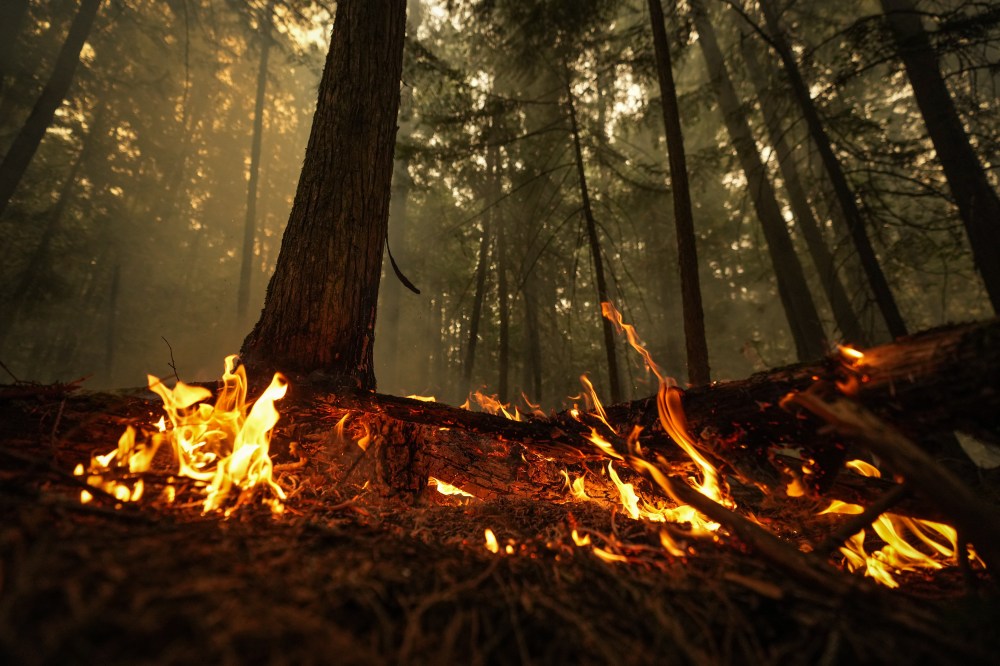
“As Canada stores about one‐fifth of the world’s soil organic carbon, these findings underscore the growing vulnerability of northern soil carbon stocks to intensifying wildfires, amplifying climate feedback risks,” said the study, published Monday in Geophysical Research Letters.
The findings land as Canada battles another intense 2026 wildfire season. Historic fires in Ontario are edging into the carbon-rich Hudson Bay Lowlands, the world’s second-largest peat complex.
Those fires have prompted criticism from U.S. President Donald Trump, who blamed Canada’s forest management for cross-border smoke and used the issue to threaten new tariffs. But co-author Alemu Gonsamo, a McMaster University researcher, says the findings point to a different conclusion.
Since so much of what’s burning lies underground, better managed forests won’t necessarily solve the core problem: only steep cuts to global emissions can, he said.
“There is no alternative than reducing the greenhouse gas emissions,” said Gonsamo, an associate professor at McMaster who studies how forest ecosystems respond to climate change.
The study estimates the 2023 fires burned about 150,000 square kilometres and released roughly three times as much carbon dioxide as Canada’s total annual reported greenhouse-gas emissions.
To figure out how much of that came from soil and peat, the researchers trained a machine-learning model on 20 years of data from a NASA field project in Alaska and Western Canada measuring actual wildfire conditions. The team then applied that model to data from across Canada.
This ground-up approach produced similar findings as other researchers who estimated total emissions by instead working backwards from what showed up in the atmosphere.
Monday’s study found peatlands were responsible for about 33 per cent of those emissions. Peatlands store large amounts of carbon because their waterlogged, low-oxygen landscapes slow decomposition and allow for the buildup of organic matter over thousands of years.
But hotter and drier conditions fuelled by climate change can dry out peatlands, making it more vulnerable to burning
“Now, some of this carbon is released in just one week in a large fire, the carbon that took millennia to accumulate in the ecosystem,” he said.
The study also has its limitations, Gonsamo said. Most of the field data used to train the model came from Western Canada and Alaska, with fewer observations from Central and Eastern Canada. He also noted that estimating soil combustion is challenging because researchers rely on indirect indicators, such as moisture conditions, rather than direct observations of what’s burning underground.
“We need more data, more ground measurements in Eastern Canada and generally in many parts of Canada to represent all the ecosystems in Canada that potentially can burn,” he said.
This report by The Canadian Press was first published July 27, 2026.
Related Articles
Video shows smouldering aftermath of wildfire outside Clinton, B.C.
Advertisement Advertise With Us
Advertisement Advertise With Us