Hungary’s government plans interventions on Danube River to keep nuclear plant running
Advertisement
Read this article for free:
or
Already have an account? Log in here »
To continue reading, please subscribe:

Digital Subscription
One year of digital access for only $205*
- Enjoy unlimited reading on winnipegfreepress.com
- Read the E-Edition, our digital replica newspaper
- Access News Break, our award-winning app
- Play interactive puzzles
*First annual payment billed as $205.00 + GST for one year. This annual subscription will automatically renew at $233.00 + GST every 52 weeks (10% off the regular annual price of $259.35). Offer available to new and qualified returning subscribers only. Cancel any time.
To continue reading, please subscribe:
Add Free Press access to your Brandon Sun subscription for only an additional
$1 for the first 4 weeks*
- Enjoy unlimited reading on winnipegfreepress.com
- Read the E-Edition, our digital replica newspaper
- Access News Break, our award-winning app
- Play interactive puzzles
*Your next Brandon Sun subscription payment will increase by $1.00 and you will be charged $17.95 plus GST for four weeks. After four weeks, your payment will increase to $24.95 plus GST every four weeks.
Read unlimited articles for free today:
or
Already have an account? Log in here »
BUDAPEST, Hungary (AP) — Authorities in Hungary will begin taking steps to raise the level of the Danube River this week in order to ensure the country’s only nuclear power plant can continue operating, Prime Minister Péter Magyar said on Wednesday.
Persistent drought and successive extreme heat waves in recent months have deprived one of Europe’s largest rivers of water, bringing Danube levels to record lows and pushing the Paks nuclear power plant to the brink of shutting down for the first time in its 44-year history.
The Soviet-built plant, which uses water from the Danube to cool its four reactors, is currently operating at little more than 10% of its 2,000 megawatt capacity due to low water levels. It supplies Hungary with around a third of its electricity.
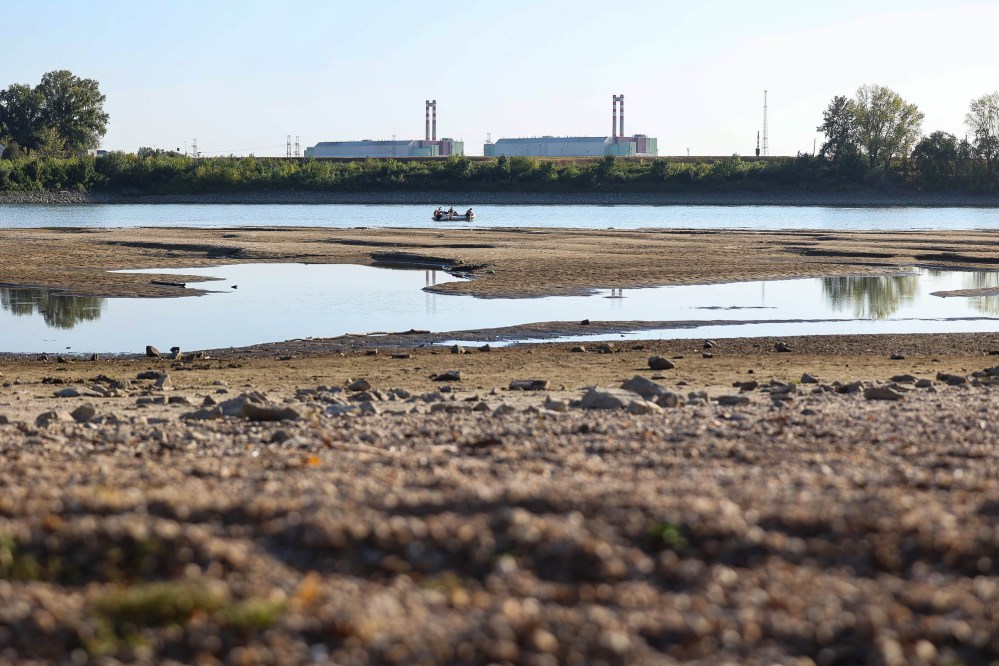
In a video posted to Facebook on Wednesday, Magyar said authorities would begin building a bed sill — a low concrete or stone structure built into the riverbed to slow the current and raise upstream water levels — on Thursday on a section of the Danube just upriver from the plant.
Delivery of some 145,000 cubic meters of rocks used in its construction would begin on Wednesday evening, Magyar said, adding that the intervention could raise the level of the Danube by up to a meter (3 feet).
Meanwhile, two 80-meter (262-foot) barges will be transported to the site near Paks and may be sunk in order to raise the Danube up to a further 20 centimeters (8 inches) at the plant’s cooling pumps. A decision on whether to sink them will be made on Friday, Magyar said.
“We can no longer consider this extraordinary situation as a one-time natural extreme,” he said, adding that the work must be carried out quickly to avoid a full Paks shutdown.

Magyar referred to the construction of the bed sill as a “long-term” solution which could ensure that water levels never fall below the threshold at which reactors at Paks must be powered down.
He said that after a recent temporary rise in water levels, they were expected to begin falling again in coming days which, without external intervention, could lead to the complete shutdown of the Paks plant.
“The Danube has given us days, not months,” he said.
Similar measures were taken in Romania last week when authorities sank four barges laden with rock into the Danube in an attempt to redirect water downstream toward the Cernavoda nuclear plant, which had already shut down one of its two reactors due to low water levels.
On Wednesday, Magyar said the Paks plant operating at its current output is costing Hungary’s economy up to 50 billion forints ($158 million) per month. By contrast, he said the planned interventions on the Danube will cost around 6 billion forints ($19 million).