After deadly floods in India’s Assam, experts call for better warnings and long-term planning
Advertisement
Read this article for free:
or
Already have an account? Log in here »
To continue reading, please subscribe:

Digital Subscription
One year of digital access for only $205*
- Enjoy unlimited reading on winnipegfreepress.com
- Read the E-Edition, our digital replica newspaper
- Access News Break, our award-winning app
- Play interactive puzzles
*First annual payment billed as $205.00 + GST for one year. This annual subscription will automatically renew at $233.00 + GST every 52 weeks (10% off the regular annual price of $259.35). Offer available to new and qualified returning subscribers only. Cancel any time.
To continue reading, please subscribe:
Add Free Press access to your Brandon Sun subscription for only an additional
$1 for the first 4 weeks*
- Enjoy unlimited reading on winnipegfreepress.com
- Read the E-Edition, our digital replica newspaper
- Access News Break, our award-winning app
- Play interactive puzzles
*Your next Brandon Sun subscription payment will increase by $1.00 and you will be charged $17.95 plus GST for four weeks. After four weeks, your payment will increase to $24.95 plus GST every four weeks.
Read unlimited articles for free today:
or
Already have an account? Log in here »
GUWAHATI, India (AP) — Rojo Neog left his house in India’s Assam state on the evening of July 19 to buy candles after heavy rain knocked out electricity. As he rode back on his bicycle, the Dikhow River suddenly rose and the current intensified.
The floodwaters swept him away, and his body was found three days later, said his niece Priyakshi Gogoi, who lives nearby. Gogoi said floodwaters around her uncle’s village Hulang Katoni rose from knee-deep to neck-deep in about 30 minutes.
“There was no warning, nothing,” she said. “In the morning we thought it’s fine, there is little flooding but it will subside, but we didn’t expect it to become so bad.”
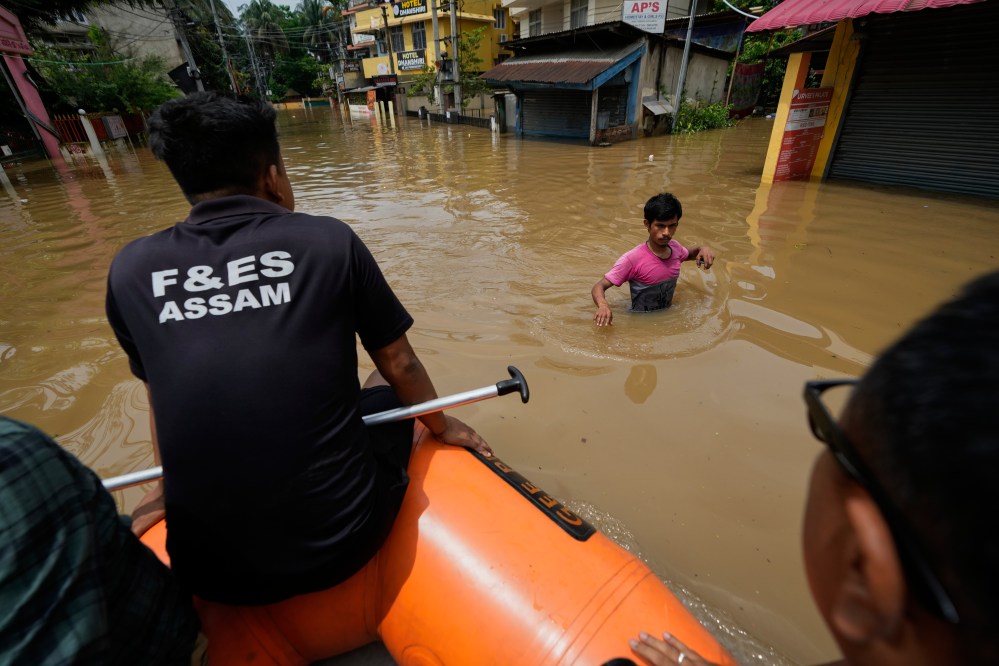
More than 100 people have died in flooding in Assam this year in what state officials have described as its worst flooding in about six decades. While flooding is frequent in Assam, climate and disaster experts said increasingly intense rainfall, sand mining, upstream deforestation, wetland loss, urbanization and heavy reliance on embankments are making floods more unpredictable and destructive.
Experts said Assam and other states upstream must move beyond spending millions of dollars on flood-control structures and relief toward better early warnings, scientific mapping of changing risks and restoring the ability of forests, wetlands and floodplains to absorb water.
“It’s very important to study and understand flood risks better in Assam,” said Himanshu Thakkar, coordinator of the environmental group, South Asia Network on Dams, Rivers and People. “Once we understand, we can also forecast well. Then we can prepare well and less people will be affected. India is very good at rescuing people or providing relief after the disaster, but is particularly bad in doing anything significant to reduce the possibilities of such disasters.”
Each year from June to September, a series of heavy rains known as monsoons sweep through India, providing relief from heat, irrigating the country’s farms and replenishing its rivers. However, as global heat increases, the rain is becoming more erratic and intense, creating the conditions for deadly floods.
India, one of the world’s largest greenhouse gas emitters, is also among the hardest hit by climate change. Assam state is among India’s most flood-prone, with about 40% of its land vulnerable to inundation from the Brahmaputra River and smaller rivers.
Floodwaters rose in minutes
The floods have displaced more than 700,000 people and submerged farmland while damaging roads and other infrastructure. Although many residents have begun returning home as floodwaters recede, thousands remain in relief camps.
Krishna Karamkar jumped into floodwaters on July 19 when one of his two sons inadvertently fell into the overflowing Dikhow, which is a tributary of the Brahmaputra. The 42-year-old was able to save his son, but he perished.
“He pushed our son to safety, but he got swept away by the river,” said Sumi Karamkar, his wife. The family lives in Nepalikhuti village, one of the worst affected with over 1,000 animals washed away and 200 houses destroyed.
“I am now staying at my mother’s home nearby. I have received some assistance from the government but that’s not enough. Our family’s future has suddenly become so uncertain,” she said.
In Bihubor village, 26-year-old Shravan Kumar said he took his parents to higher ground and returned with relatives and five boats to rescue neighbors. Kumar said people were clinging to trees and rescuers had to break through a home’s roof to pull out two children and their parents.
“I have grown up in the area and have never seen such severe flooding before,” Kumar said in a phone interview.
River experts said flooding has long replenished farmland and shaped farming and settlement patterns across Assam. But they said increasingly intense bursts of rain combined with other human-caused factors can overwhelm rivers and communities more quickly, leaving less time to react.
In Nepalikhuti village in Assam, dairy farmer Prakash Sharma said he had finished milking his 24 cows in the morning when people began talking about the Dikhow rising.
By 10 a.m., the only road out of the village was submerged. Sharma said he put a ladder against his house and helped his 75-year-old father and 65-year-old mother onto the roof. By about 1:30 p.m., he said, the village was under roughly 9 feet of water.
“Some were taking shelter on rooftops, some on trees,” Sharma said. “For me, it was not just floods, it was a natural calamity of humongous proportion we had never seen before.”
While Sharma’s family was saved by rescuers that afternoon, he said he’s still grappling with the tremendous losses he suffered.
India has expanded flood forecasting and early-warning systems, but researchers said forecasting is only useful if information reaches the people at risk, they understand it and have somewhere safe to go.
Mirza Zulfiqar Rahman, an independent researcher who has studied the Brahmaputra, said warnings sometimes fail to travel from government offices into communities and are rarely paired with enough drills and preparedness.
Experts urge a shift from controlling rivers to living with them
A recent report by World Weather Attribution said the flooding across Assam and neighboring northeastern states was worsened by rapid urbanization, deforestation and local vulnerabilities.
The Brahmaputra and its tributaries carry enormous amounts of sediment from the Himalayas, continually reshaping channels, banks and river islands. River experts said this makes seasonal flooding difficult to eliminate, but human changes to the landscape have increased the danger.
Sneha Ganguly of the Red Cross Red Crescent Climate Center, a co-author of the WWA report, said research increasingly points to unplanned urbanization, deforestation, degraded wetlands, poor drainage and inadequate flood management as factors that worsen flood risk.
Assam has invested heavily in embankments, erosion-control structures, flood walls and other engineering. Experts said such infrastructure remains necessary in some places but can create additional risks if natural drainage isn’t preserved.
“True adaptation requires moving towards living with rivers through wetland restoration and proactive early action before floodwaters strike,” said Emmanuel Raju, director of the Copenhagen Centre for Disaster Research at the University of Copenhagen who also worked on the WWA report.
Rahman, the independent researcher, said flood planning should follow the natural contours of river basins rather than state and international borders. Rainfall, deforestation, mining and other changes upstream can alter how quickly water and sediment reach the Brahmaputra basin.
Disaster management, he said, also remains too heavily focused on flooding aftermath, rather than reducing risks beforehand.
Nihal Ranjit, a climate and disaster expert at the Indian Institute for Human Settlements, said communities in historically flood-prone areas once structured farming and daily life around seasonal inundation. Climate change is pushing some events beyond what people are accustomed to and able to cope with, causing people to move, he said.

“This always existed, but climate change and climate impacts like floods are increasing this movement,” said Ranjit.
___
Arasu reported from Bengaluru, India, and can be followed on X at @sibi123. Reach him at sarasu@ap.org.
___
The Associated Press’ climate and environmental coverage receives financial support from multiple private foundations. AP is solely responsible for all content. Find AP’s standards for working with philanthropies, a list of supporters and funded coverage areas at AP.org.