Premiers at odds over leveraging potash in Canada’s trade war with U.S.

Advertisement

Advertise with us

OTTAWA - Premiers are sharply divided over whether to use Canada's natural resources as leverage in the trade war with the U.S., and potash has emerged as a key point of contention.

Read this article for free:


or

Already have an account? Log in here »

To continue reading, please subscribe:

Subscribe and receive a limited-edition Free Press branded hat or tote.

Digital Subscription

One year of digital access for only $205*

  • Enjoy unlimited reading on winnipegfreepress.com
  • Read the E-Edition, our digital replica newspaper
  • Access News Break, our award-winning app
  • Play interactive puzzles

*First annual payment billed as $205.00 + GST for one year. This annual subscription will automatically renew at $233.00 + GST every 52 weeks (10% off the regular annual price of $259.35). Offer available to new and qualified returning subscribers only. Cancel any time.

To continue reading, please subscribe:

Add Free Press access to your Brandon Sun subscription for only an additional

$1 for the first 4 weeks*

  • Enjoy unlimited reading on winnipegfreepress.com
  • Read the E-Edition, our digital replica newspaper
  • Access News Break, our award-winning app
  • Play interactive puzzles
Start now

*Your next Brandon Sun subscription payment will increase by $1.00 and you will be charged $17.95 plus GST for four weeks. After four weeks, your payment will increase to $24.95 plus GST every four weeks.

OTTAWA – Premiers are sharply divided over whether to use Canada’s natural resources as leverage in the trade war with the U.S., and potash has emerged as a key point of contention.

Canada is a major global supplier of potash, a key ingredient in fertilizers that are vital for the agricultural sector. The U.S. imports about 85 per cent of its potash from Canada.

While Ontario’s Doug Ford is pushing to pull the most damaging levers with the U.S., Saskatchewan’s Scott Moe and Alberta’s Danielle Smith are warning about a harmful long-term backlash.
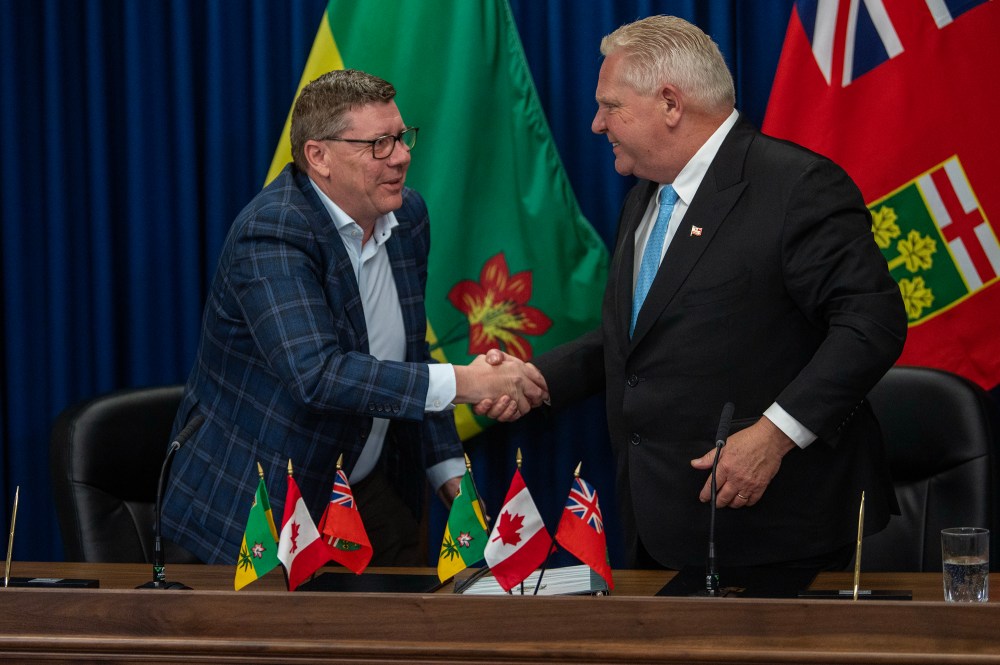
Premier of Saskatchewan Scott Moe, left, and Premier of Ontario Doug Ford shake hands during a media event to sign a Memorandum of Understanding in Saskatoon on Sunday, June 1, 2025. THE CANADIAN PRESS/Liam Richards

Federal politicians are also weighing in. NDP leader Avi Lewis called for an export tax on “oil, gas, thermal coal, potash and other minerals to hit Trump where it hurts.”

Federal Green Party leader Elizabeth May agrees.

“If you’re dealing with a really large bully who’s beating you up, you really need to get out your keys, put them between your fingers, and go for soft, fleshy parts that are gonna hurt,” she told The Canadian Press.

“And that for us would be withholding potash.”

At a news conference Wednesday, Ford said cutting the U.S. off from potash would kill the American agricultural sector “overnight.”

But Moe, whose province supplies the U.S. with more than 86 per cent of the potash coming in from Canada, has said that such a move would backfire and harm Canadians.

“That would be a tremendous economic hit to our province and to our nation,” Moe said at a news conference this week, warning of job losses and price hikes.

He said Saskatchewan would not support any kind of export taxes or withholding supply, but did open the door to leveraging access to additional production in trade negotiations.

“The United States of America, most assuredly, would switch to buying potash from other nations around the world. We would lose a long-term customer to some degree.”

And while the drastically differing viewpoints of Ford and Moe may suggest cracks in the “Team Canada” approach that premiers and the prime minister have championed over the past year, one expert says it’s a matter of perspective.

“Ontario and B.C., are the provinces that are going to be hit the most by the tariffs that Trump is rolling out,” said Jim Farney, the director and Stauffer Dunning chair at the School of Policy Studies at Queen’s University.

He said he has seen some analysis suggesting Alberta and Saskatchewan will be “hardly touched” by the U.S. tariffs.

Heather Exner-Pirot, a senior fellow and director of natural resources, energy and environment at the Macdonald-Laurier Institute, also said the tariff impact is “much more pungent” in places like Ontario with the auto and steel sectors being hit.

“Out west, we don’t talk about CUSMA, we don’t talk about the tariffs. They’re a very small part of our lives and our economy, and we’re not getting damaged and it’s not really affecting us,” Exner-Pirot, who’s also an adviser with the Business Council of Canada, told The Canadian Press.

“It is having such a different impact out West, and we don’t want it to have the same impact.”

Taking questions from reporters Wednesday, Moe said one way to leverage natural resources in trade negotiations is to barter with “access to additional production” of potash, uranium and oil.

But Exner-Pirot said such a move with potash might not make much of an impact.

“In the United States, it’s not the growing market for potash. It’s pretty saturated. They use as much as they can use, and they’re efficient at it,” she said.

She also said potash companies like Nutrien started stockpiling supply in the United States to get ahead of any potential tariffs or export taxes.

“So when we say, ‘well, we’ll put an export tax on it,’ well, that won’t apply to what’s already there,” she said.

Trump administration officials have repeatedly pointed out how the U.S. has not tariffed Canadian oil, energy, uranium and potash. White House officials have indicated there’s no intention at this point to change course.

This report by The Canadian Press was first published Aug. 27, 2026.

— With files from Sarah Ritchie, and Kelly Geraldine Malone in Washington

Report Error Submit a Tip

More Stories

Living the dream

Ken Wiebe 7 minute read Preview

Living the dream

Ken Wiebe 7 minute read 4:48 PM CDT

DETROIT – As Tyrel Bauer took a left turn out of the tunnel from the Winnipeg Jets dressing room and into the stands, he was met with a hearty round of applause from the 25 friends and family members who had made the trek from various points around North America.

Bauer had just realized a childhood dream and the significance of the moment was not lost on some of his biggest supporters.

“It was a special walk, for sure. A special walk,” Bauer said on Saturday afternoon before the Jets departed for a two-game road trip that begins on Sunday in Detroit against the Red Wings. “Those people who came – and many more that weren’t there and were cheering on from afar – they’ve always been there.

“I wanted that for my family, maybe even more than I wanted it for me. They’ve been through thick and thin. I’ve stressed mom out quite a bit over the years doing my job. That meant a lot for them and I’m really happy they could be there for it.”

Read
4:48 PM CDT

Sisters relieved hospital takes accountability after mother’s death

Scott Billeck 6 minute read Preview

Sisters relieved hospital takes accountability after mother’s death

Scott Billeck 6 minute read Thursday, Oct. 1, 2026

Eight months after losing their mother, two Winnipeg sisters say an internal hospital review has finally given them something they had been seeking since her death: accountability.

Chelsea Mann and Samantha Burns said St. Boniface Hospital officials acknowledged mistakes were made in the care of their mother, Judy Burns, during a recent meeting to discuss the findings of a critical incident review into her death.

The acknowledgement marked a significant departure from an earlier meeting with hospital officials, when they felt their concerns were largely dismissed.

Burns, 68, died on Jan. 21, three days after being admitted, after experiencing rectal bleeding.

Read
Thursday, Oct. 1, 2026

Moving drama at MTYP gives voice to boy who changed law

Holly Harris 5 minute read Preview

Moving drama at MTYP gives voice to boy who changed law

Holly Harris 5 minute read 2:37 PM CDT

The heroic true tale of Norway House Cree Nation-born Jordan River Anderson came home Friday night, as Manitoba Theatre for Young People presented Yvette Nolan’s Jordan.

The touring production, a collaboration with Geordie Theatre, runs weekends through Oct. 11, with additional stops in Toronto, Vancouver and Ottawa’s National Arts Centre.

Having several of Anderson’s family members witness the local première underscored the evening with poignancy. Elder and Pine Creek First Nation member Barbara Nepinak added her own dignified presence and prayers following MTYP artistic director Pablo Felices-Luna’s welcoming remarks.

The season-opener also marks the Winnipeg-raised playwright’s homecoming; the Algonquin playwright, director, dramaturg, actor and educator was a fixture in our local theatre community for many years before going on to serve as artistic director for Native Earth Performing Arts from 2003 to ‘11, among other contributions.

Read
2:37 PM CDT

Puzzles Palace

1 minute read Monday, Jul. 27, 2026

To solve our puzzles, please subscribe with this special offer: |

Blown lead spoils Jets opener

Mike McIntyre 7 minute read Preview

Blown lead spoils Jets opener

Mike McIntyre 7 minute read Yesterday at 11:09 PM CDT

Younger. Faster. Stronger.

They may still be a long ways from a finished product, but it’s safe to say the new-look Winnipeg Jets made a mostly favourable first impression on Friday night in front of a sold-out crowd at Canada Life Centre.

Sure, a 4-3 overtime loss to a hard-nosed Boston Bruins outfit is going to sting a little, especially since the home team was just 98 seconds away from a regulation victory.

But if the Jets can bottle up this kind of energy and effort, they should enjoy plenty of success over the course of the 84-game campaign.

Read
Yesterday at 11:09 PM CDT

Letters, Oct. 3

7 minute read 2:01 AM CDT

A morning in the life …

My very first lesson does not start when I walk into that lecture hall, oh no — it starts long before. It begins when I walk to my car, check the estimated arrival time to the University of Manitoba and hope that Winnipeg traffic agrees with it.

A drive that appears completely manageable changes almost immediately when I’m greeted by a tsunami of orange pylons and a line of cars that appears to go on forever. Traffic moves by the inch, lanes magically disappear and the detour I took yesterday now has a detour of its own. These factors make me do a calculation that I have become all too familiar with. How late can I arrive and still find parking, run to my class across campus and get to class with enough time left to make it worth it?

I have grown used to people saying, “Why not just leave earlier?” I do. But when I’m already leaving for my 8:30 a.m. class at 7 a.m., there’s only so much I can do. This drive that some would think is relaxing is one that feels like an assignment that I didn’t know I had to complete and is due at 8:30 a.m.