A stronger-than-normal El Nino alarms scientists over Galápagos wildlife and forests
Advertisement
Read this article for free:
or
Already have an account? Log in here »
To continue reading, please subscribe:

Digital Subscription
One year of digital access for only $205*
- Enjoy unlimited reading on winnipegfreepress.com
- Read the E-Edition, our digital replica newspaper
- Access News Break, our award-winning app
- Play interactive puzzles
*First annual payment billed as $205.00 + GST for one year. This annual subscription will automatically renew at $233.00 + GST every 52 weeks (10% off the regular annual price of $259.35). Offer available to new and qualified returning subscribers only. Cancel any time.
To continue reading, please subscribe:
Add Free Press access to your Brandon Sun subscription for only an additional
$1 for the first 4 weeks*
- Enjoy unlimited reading on winnipegfreepress.com
- Read the E-Edition, our digital replica newspaper
- Access News Break, our award-winning app
- Play interactive puzzles
*Your next Brandon Sun subscription payment will increase by $1.00 and you will be charged $17.95 plus GST for four weeks. After four weeks, your payment will increase to $24.95 plus GST every four weeks.
Read unlimited articles for free today:
or
Already have an account? Log in here »
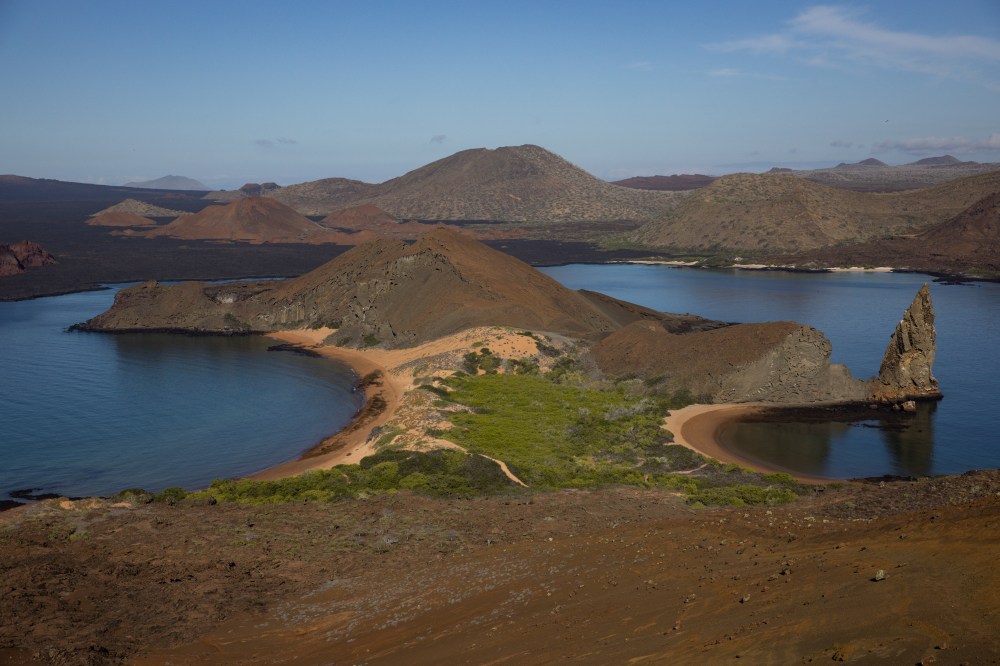
QUITO, Ecuador (AP) — The prediction that this season’s El Nino phenomenon will be stronger than normal has alarmed the Ecuadorian scientific community, which has warned of its impact on the flora and fauna of the Galapagos Islands, home to the highest concentration of species not found elsewhere on Earth.
The archipelago of more than 230 islands — of which only four are inhabited — is located in the middle of the Pacific Ocean, 1,000 kilometers (620 miles) off the coast of Ecuador.
The climatic phenomenon occurs periodically and in the equatorial Pacific is characterized by an increase in sea temperature and intense rainfall. Its strength is determined by measuring the water temperature in that area and comparing it to the normal average. If it is 2 degrees Celsius (3.6 Fahrenheit) above normal, it is considered “very strong.”
The sea temperature will be about 2.2 degrees Celsius (4 F) above normal, according to the latest projection from the U.S. National Oceanic and Atmospheric Administration (NOAA), which means that “the impact will be significant,” said Franklin Ormaza, a professor and researcher at the Faculty of Maritime Engineering and Marine Sciences of the Higher Polytechnic School of the Coast (ESPOL).
Wildlife at risk
Animals and fish will be at risk because as the water temperature rises, “plankton, algae, and smaller fish species, which are food for larger marine animals, practically disappear,” explained Washington Tapia, director of Biodiversa Ecuador, a conservation organization in the archipelago, to the AP.
He specified that the species most at risk are the iconic Galápagos penguins, blue-footed boobies, petrels, flightless cormorants, albatrosses, and even sea lions. Coral colonies could also be seriously affected, as could tuna fishing.
In the absence of food, “animal colonies stop reproducing,” disperse in search of food, and die of starvation in the process, explained scientist Gustavo Jiménez, from the Charles Darwin Foundation.
If the phenomenon occurs with the expected magnitude, the archipelago’s vertebrate population could decrease by at least 20% this year, Jiménez added.
One of the most closely monitored species in the islands, the Galápagos penguins, serves as a marker of the impact of this climate phenomenon on the archipelago’s fauna.
According to data from the Charles Darwin Foundation, after the 1998 El Nino — one of the most powerful and destructive cycles — only 400 of the 1,300 existing Galápagos penguins remained.
Effects on the flora
If El Nino strikes with the expected force, the last three remaining Scalesia forests could be at risk of disappearing, scientist Heinke Jager of the Charles Darwin Foundation said.

Opuntia cacti, which grow along the seashore, would also be threatened.
These plants, found only in the Galápagos Islands, support various ecosystems of insects, birds and other smaller plants that are part of the archipelago’s unique biodiversity.
Jager explained that “these species need human support” because the heavy rains brought by El Nino will cause the territory they occupy to be overrun by invasive plants, such as blackberries, which have shorter reproductive cycles.
Therefore, they have organized a plan that includes the eradication of invasive plants, the collection of seeds and the creation of nurseries to conserve threatened species. The Ecuadorian government, foundations, and nongovernmental organizations working in the archipelago are participating in the program.
The Galápagos Islands were declared a Natural World Heritage Site in 1978 for their unique animal and plant species, which served as the basis for the English scientist Charles Darwin to develop his theory of evolution.