To bring back historic herring populations, volunteers get down and dirty
Advertisement
Read this article for free:
or
Already have an account? Log in here »
To continue reading, please subscribe:

Digital Subscription
One year of digital access for only $205*
- Enjoy unlimited reading on winnipegfreepress.com
- Read the E-Edition, our digital replica newspaper
- Access News Break, our award-winning app
- Play interactive puzzles
*First annual payment billed as $205.00 + GST for one year. This annual subscription will automatically renew at $233.00 + GST every 52 weeks (10% off the regular annual price of $259.35). Offer available to new and qualified returning subscribers only. Cancel any time.
To continue reading, please subscribe:
Add Free Press access to your Brandon Sun subscription for only an additional
$1 for the first 4 weeks*
- Enjoy unlimited reading on winnipegfreepress.com
- Read the E-Edition, our digital replica newspaper
- Access News Break, our award-winning app
- Play interactive puzzles
*Your next Brandon Sun subscription payment will increase by $1.00 and you will be charged $17.95 plus GST for four weeks. After four weeks, your payment will increase to $24.95 plus GST every four weeks.
Read unlimited articles for free today:
or
Already have an account? Log in here »
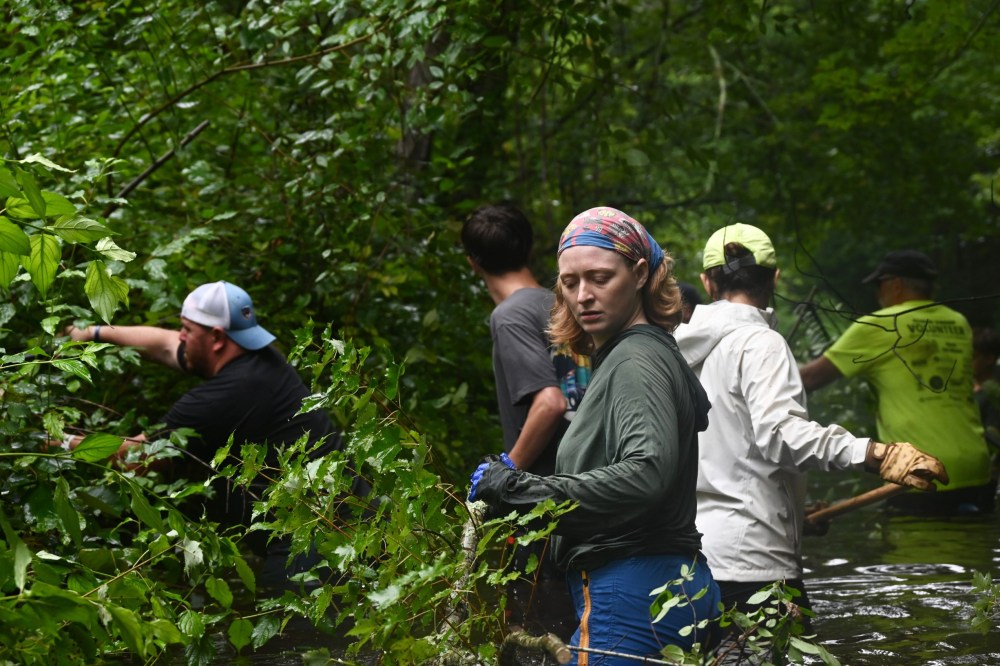
Submerged waist-deep in the Acushnet River, Marcus Hendricks let out a howl that echoed through the forest and brush. The Wampanoag tribal member and land manager had just sawed through a fallen tree 10 inches thick and stretched across the width of the waterway, spraying sawdust into the cloudy water. Two volunteers heaved the cut-up trunk aside, opening up the northern section of river to humans and fish for the first time in decades.
“I’m trying not to get emotional,” Hendricks said, taking a step back.
This summer, Hendricks began leading cleanups of the Acushnet River, to clear the way for herring to swim upstream to their spawning grounds at the old New Bedford Reservoir.
Since 2002, state and local scientists have been working to restore the Acushnet River’s herring population to historic levels. They’ve cleared overgrowth and debris and built infrastructure to help the tiny bait fish migrate upriver and spawn. Their efforts led to an early uptick — local herring numbers rose to nearly 15,000 a decade ago — but they’ve stagnated since then.
This summer, Hendricks and his colleagues at the Fairhaven Acushnet Land Preservation Trust launched a renewed cleanup effort, with volunteers from New Bedford, Acushnet, Fairhaven and beyond and aided by scientists from the Massachusetts Division of Marine Fisheries and Buzzards Bay Coalition.
It’s an effort John Sheppard, a marine fisheries research biologist with DMF, is “extremely grateful” for. For over 20 years, Sheppard led cleanups of his own.
“Oftentimes I’d be out there by myself or with one other person,” Sheppard said.
Over a dozen volunteers joined the Aug. 22 community river cleanup, which spanned from the old White’s Factory on Hamlin Road downstream towards Mill Pond. Every week for the past two months, a core group of volunteers has returned to clear more.
Their work isn’t done until Hendricks can kayak the length of the river, he said.
“In the Indigenous culture, when you want to connect to a certain species, you become that species,” Hendricks said. “You have to get in the water and swim.”
Run, run, run
Four hundred years ago, before European settlers arrived in Acushnet, hundreds of thousands of Atlantic herring traveled yearly each spring from the ocean to fresh water to spawn. Some historic estimates place their numbers closer to one million. The silvery bait fish, no more than 14 inches long, are a key food source for larger species like striped bass, hake, cod, sharks and seabirds.
But settlers erected dams, first for agricultural use and later for mills and factories. The lower Acushnet River, once the site of Ishmael and Queequeg’s sail to Nantucket in “Moby-Dick,” became one of the nation’s first EPA Superfund sites after manufacturers dumped toxic PCB “forever chemicals” into the waterway.
For decades, the herrings’ historic migratory route, from the harbor all the way up to the former New Bedford reservoir, has been rife with litter, fallen branches, and overgrowth. New Bedford conservation agent Chance Perks said in the past, beavers would have cleared away that brush for herring — but they’re not around anymore and couldn’t solve the problem now.
“(Beavers) don’t care about property boundaries,” Perks said. “Even if we brought back the beaver, we’d have even bigger headaches, because beavers were not living in a landscape hemmed in by Mrs. Smith’s orchards and pipe culverts and so on.”
In 2002, midway through the EPA’s cleanup of the lower Acushnet, MassDMF and Buzzards Bay Coalition built a “fish ladder” near the former saw mill on the upper Acushnet River, a tunnel designed to help the small forage fish upstream. Since then, the coalition has worked with the National Oceanic and Atmospheric Administration (NOAA) to replace two dams in the Acushnet River with tunnel-like fishways, Senior Restoration Ecologist Sara Quintal said in a statement. Their efforts saw early success — herring numbers jumped from 2,000 to 14,000 — but the population has declined since then.
“I’d love to see 200,000 fish being produced there annually,” Sheppard said. “We haven’t reached that yet.”
Meanwhile, state and federal efforts to restore local herring populations have expanded. In 2006 and 2012, the state enacted moratoriums on commercial herring fishing, and since then has also closed most rivers to commercial and recreational herring fishing. (Hendricks advocated for and won an exemption for Indigenous tribal members, allowing them to maintain ancestral fishing practices.)
In more recent years, undamming — removing dams to reopen rivers to wildlife — has become something of a national trend. Last year, more than 100 dams were removed across 30 states, reconnecting roughly 4,900 miles of waterways.
New Bedford field technician Harrison Letourneau has volunteered at four of the past six cleanups. He recalled one particularly tough effort in which a large tree had fallen sideways, allowing layers of silt and mud to build up beneath it and block the water’s flow. It took multiple people over an hour to saw through the trunk and clear out the muck, he said.

At Saturday’s cleanup, volunteers recovered seven tires and 177 glass bottles from the riverbed, wading through cloudy, waist-deep water and bushwhacking through thickets of invasive plants. Hendricks instructed volunteers to leave native species like cardinal flower and elderberry alone so they could continue to shore up the river’s banks from erosion.
Perks said collaborations like these — between multiple municipalities, nonprofits, and state agencies — can be a model for all larger conservation goals. The cleanups themselves also serve as a reminder that modern conservation is hands-on practice, he said, not “put up a fence around it and don’t touch it.”
“There are small slivers of the planet that can still benefit from that… but everything else that we’ve impacted and continue to impact, we need to actively conserve and manage and steward,” Perks said. “We need people getting in the river, getting muddy, destroying their shoes to get out there and cut back brush.”
___
This story was originally published by The New Bedford Light and distributed through a partnership with The Associated Press.