EU plans new firefighting fleet after deadly summer heat wave
Advertisement
Read this article for free:
or
Already have an account? Log in here »
To continue reading, please subscribe:

Digital Subscription
One year of digital access for only $205*
- Enjoy unlimited reading on winnipegfreepress.com
- Read the E-Edition, our digital replica newspaper
- Access News Break, our award-winning app
- Play interactive puzzles
*First annual payment billed as $205.00 + GST for one year. This annual subscription will automatically renew at $233.00 + GST every 52 weeks (10% off the regular annual price of $259.35). Offer available to new and qualified returning subscribers only. Cancel any time.
To continue reading, please subscribe:
Add Free Press access to your Brandon Sun subscription for only an additional
$1 for the first 4 weeks*
- Enjoy unlimited reading on winnipegfreepress.com
- Read the E-Edition, our digital replica newspaper
- Access News Break, our award-winning app
- Play interactive puzzles
*Your next Brandon Sun subscription payment will increase by $1.00 and you will be charged $17.95 plus GST for four weeks. After four weeks, your payment will increase to $24.95 plus GST every four weeks.
Read unlimited articles for free today:
or
Already have an account? Log in here »
BRUSSELS (AP) — A scorching summer that dried up rivers and killed tens of thousands across the European Union from Portugal to Hungary has shown that the bloc needs to develop new tools to meet a worsening climate, European Commission President Ursula von der Leyen said Wednesday.
She said that this instability led her to propose a new European Heatwave Plan as well as a future European firefighting fleet of airplanes. Currently, the EU operates a small fleet itself but coordinates a network of aircraft, water trucks and volunteers that move across the 27-nation bloc as fires ignite.
“This summer was the summer of truth. Almost no part of our continent was spared,” said the EU executive during her annual State of the European Union address in Strasbourg.
“Key rivers like the Danube, the Rhine or La Garonne are disappearing before our eyes. More than 35,000 additional deaths during the heat waves. Care homes and hospitals dangerously overheated.”
The extreme heat, which hit Europe exceptionally hard and early this year appears to have led to a much higher spike in deaths than expected. Where Von der Leyen’s figure of 35,000 comes from is unclear, but it is triple the estimates of “excessive deaths” by monitoring groups in July.
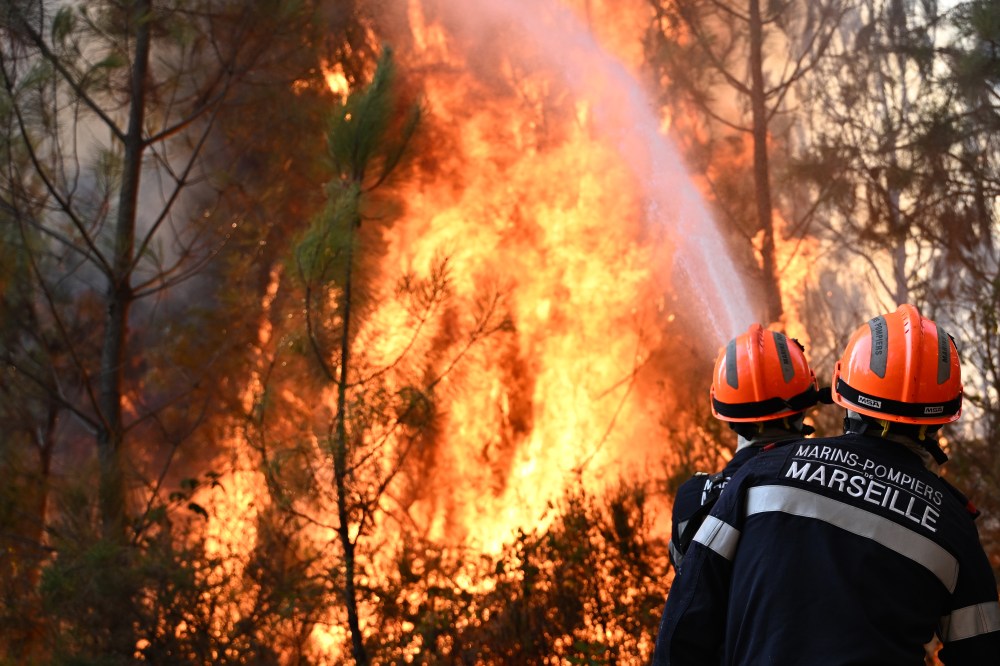
Fires in France and Spain drove hundreds of thousands of people to flee their homes, shut down nuclear reactors in Hungary and France, ignited century-old munitions on Belgium’s border with Germany and revealed previously lost ships sunk on riverbeds like a tugboat in Serbia.

The heat and humidity that broke many records during the summer would not have been possible without climate change, according to a study by the World Weather Attribution group.
“All of this is a mere preview. These were the hottest summer months ever, but probably the coolest of the years to come,” von der Leyen said. “Science is clear: Europe is warming at double the global rate.”
While commending those who battled blazes this summer, von der Leyen said that she’s asked emergency responders and senior firefighters to “think bigger and learn faster” to design “new capabilities” for the EU to tackle climate instability.
When she praised a Danish helicopter pilot named Rune Kyndal, who died in August while fighting fires in Greece, the assembly erupted in applause.
“Rune gave his life to save others and today, all of Europe owes him,” von der Leyen said.