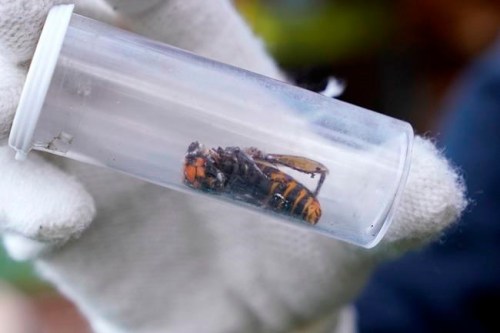
First live ‘murder hornet’ sighted near U.S.-Canada border, say scientists
Advertisement
Read this article for free:
or
Already have an account? Log in here »
To continue reading, please subscribe:
Digital Subscription
One year of digital access for only $1.44 a week*
- Enjoy unlimited reading on winnipegfreepress.com
- Read the E-Edition, our digital replica newspaper
- Access News Break, our award-winning app
- Play interactive puzzles
*Billed as $5.77 plus GST every four weeks. After 52 weeks, price increases to the regular rate of $19.95 plus GST every four weeks. Offer available to new and qualified returning subscribers only. Cancel any time.
To continue reading, please subscribe:
Add Free Press access to your Brandon Sun subscription for only an additional
$1 for the first 4 weeks*
- Enjoy unlimited reading on winnipegfreepress.com
- Read the E-Edition, our digital replica newspaper
- Access News Break, our award-winning app
- Play interactive puzzles
*Your next Brandon Sun subscription payment will increase by $1.00 and you will be charged $17.95 plus GST for four weeks. After four weeks, your payment will increase to $24.95 plus GST every four weeks.
Read unlimited articles for free today:
or
Already have an account? Log in here »
Hey there, time traveller!
This article was published 12/08/2021 (1896 days ago), so information in it may no longer be current.
OLYMPIA, Wash. – Scientists from the Washington State Department of Agriculture say they’ve found the first so-called live murder hornet for the year.
In a news release Thursday, entomologists say the Asian giant hornet was seen about a kilometre from the U.S.-Canada border.
They say the hornet was reported by a Whatcom County resident on Wednesday and confirmed the following day where a photograph showed it attacking a paper wasp nest, about three kilometres from where the department eradicated a nest last October.
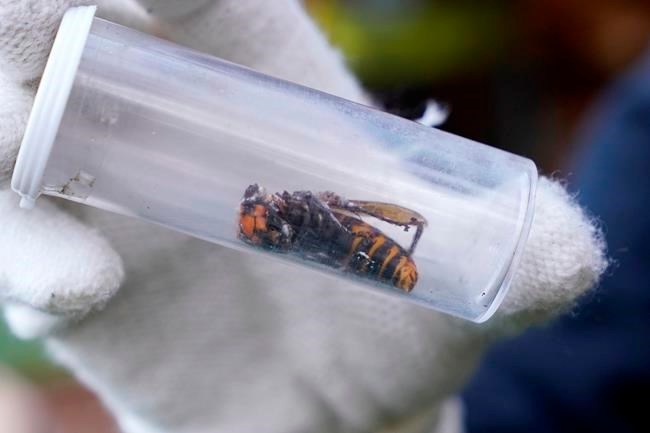
They say U.S. and B.C. officials will be setting up traps in the area to catch a live hornet, tag it and track it back to its nest.
The five-centimetre-long invasive insects are the world’s biggest hornets and prey on honey bees and other hornets — a small group can kill an entire honey bee hive in a matter of hours.
While they are not particularly aggressive toward humans, in rare cases a person stung repeatedly by murder hornets could die.
This report by The Canadian Press was first published Aug. 12, 2021.