Infrastructure bank to invest $10 billion in priority areas for pandemic recovery

Advertisement

Advertise with us

OTTAWA - The Liberal government is promising to finally spend $10 billion that has sat in the accounts of its infrastructure financing agency for years, hoping to create thousands of post-pandemic jobs.

Read this article for free:


or

Already have an account? Log in here »

To continue reading, please subscribe:

Subscribe and receive a limited-edition Free Press branded hat or tote.

Digital Subscription

One year of digital access for only $205*

  • Enjoy unlimited reading on winnipegfreepress.com
  • Read the E-Edition, our digital replica newspaper
  • Access News Break, our award-winning app
  • Play interactive puzzles

*First annual payment billed as $205.00 + GST for one year. This annual subscription will automatically renew at $233.00 + GST every 52 weeks (10% off the regular annual price of $259.35). Offer available to new and qualified returning subscribers only. Cancel any time.

To continue reading, please subscribe:

Add Free Press access to your Brandon Sun subscription for only an additional

$1 for the first 4 weeks*

  • Enjoy unlimited reading on winnipegfreepress.com
  • Read the E-Edition, our digital replica newspaper
  • Access News Break, our award-winning app
  • Play interactive puzzles
Start now

*Your next Brandon Sun subscription payment will increase by $1.00 and you will be charged $17.95 plus GST for four weeks. After four weeks, your payment will increase to $24.95 plus GST every four weeks.

Hey there, time traveller!
This article was published 01/10/2020 (2200 days ago), so information in it may no longer be current.

OTTAWA – The Liberal government is promising to finally spend $10 billion that has sat in the accounts of its infrastructure financing agency for years, hoping to create thousands of post-pandemic jobs.

Prime Minister Justin Trudeau said the three-year plan would create 60,000 jobs by expanding access to high-speed internet, building out agricultural irrigation infrastructure in western provinces and greening transit fleets.

He didn’t outline any specific projects — or any new money — but highlighted priority areas in which the bank intends to invest.
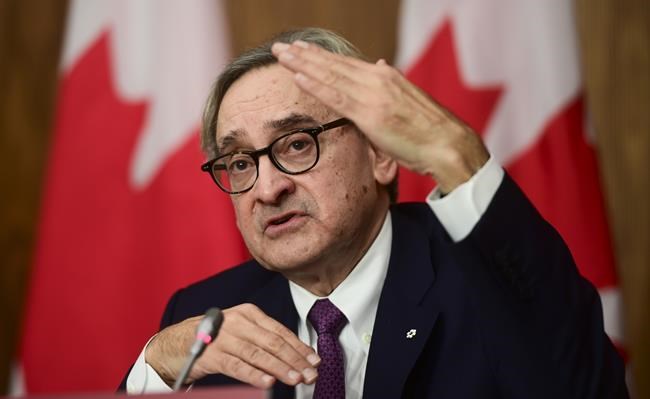
Chair of the Board of the Canada Infrastructure Bank Michael Sabia takes part in a press conference in Ottawa on Thursday, Oct. 1, 2020. THE CANADIAN PRESS/Sean Kilpatrick

The reshaped spending will front the costs for things like energy retrofits of buildings, offer low-cost financing for the purchase of zero-emission buses, or de-risk agriculture projects with uncertain returns due to commodity price fluctuations.

All told, the government has retooled $10 billion from the bank’s allocation of $35 billion, some of which had already been earmarked for rural broadband and greening transit fleets.

Michael Sabia, chairman of the Canada Infrastructure Bank board, vowed the money wouldn’t sit idle. He said he expected the agency to announce projects by the end of this year.

“There is a substantial amount of work that has been done on that, but there is a substantial amount of work to do,” Sabia said Thursday at a news conference in Ottawa.

“To get that investment program moving … that’s our top priority.”

Sabia, the former head of Quebec’s pension fund, was named chairman of the board in April amid a shakeup of the infrastructure bank’s senior executives. A new chief executive has yet to be named.

At that time, he and the government predicted that the bank would play a major role in stimulating the economy after the pandemic.

The Liberals created the agency in 2017 to entice funding from private-sector partners, particularly big institutional investors like pension funds, to pay for what the government called “transformational” infrastructure projects.

However, the bank has been criticized for the relatively few investments it has made thus far, in just nine projects. During last fall’s federal election campaign, both the Conservatives and the NDP promised to abolish the bank if elected.

Conservative Leader Erin O’Toole reiterated that promise on Thursday, calling the Liberals’ plan just another re-announcement.

“Construction workers in New Brunswick, commuters in Montreal, and agricultural workers in the Prairies don’t need more Liberal hashtags and photo ops,” he said in a statement.

“They need an actual plan to build roads, bridges, and railways.”

The Liberals say the investment plan is part of the government’s promise in last week’s throne speech to create one million jobs and revive an economy ravaged by the COVID-19 pandemic. It is also intended to help the government meet its goal of net-zero carbon emissions by 2050.

Among the new allocations are $1.5 billion for agricultural infrastructure in the West, and $2.5 billion for clean power, or half the $5 billion previously given for so-called green infrastructure.

There is also $2 billion for broadband to connect some 750,000 households and businesses, up from the $500 million the bank in 2018 was asked to invest. The Liberals promised in summer 2019 to spend $6 billion through to 2030 to expand broadband to all corners of the country.

A further $500 million is to help speed up the things that need to be done before starting construction, such as studies and technical reports.

Sabia said projects that get the bank’s backing would require them to contribute to economic growth, draw in private capital to turn $1 of public funding into $2 or $3 of spending, and help the bank earn back what it pays out.

He said the bank has already started the work needed to identify and review proposed and existing projects.

“The analyses have been done because we know where these projects are,” Sabia said. “So this plan, as I said, is very real, very concrete, bottom-up build and we have a lot of confidence in it.”

New Democrat infrastructure critic Taylor Bachrach said the infrastructure bank has proven to be the wrong tool for getting projects built.

“The public-private approach the Liberals continue to push consistently ends up costing Canadians more over the long term, while private investors can make millions,” he said.

Bloc Québécois critic Xavier Barsalou-Duval said in a statement that provinces and cities need direct and unconditional federal funding to pay for projects. Instead, Barsalou-Duval said, the Trudeau Liberals are offering more loans.

This report by The Canadian Press was first published Oct. 1, 2020.

Report Error Submit a Tip

More Stories

Jets’ game flies south against Ducks

Mike McIntyre 7 minute read Preview

Jets’ game flies south against Ducks

Mike McIntyre 7 minute read Yesterday at 10:38 PM CDT

The Winnipeg Jets sure looked like a team that was running on fumes Friday night.

Playing for the fifth time in eight days, the club suffered its first regulation loss of the young season — a lacklustre 5-1 showing against the Anaheim Ducks at Canada Life Centre.

While we won’t question the effort, the execution was a different story. Sloppy plays, missed passes, porous defensive-zone coverage and iffy goaltending made this a tough watch for the 13,693 fans in attendance.

“Just some mental things that happened. Obviously some physical things as well,” said head coach Scott Arniel.

Read
Yesterday at 10:38 PM CDT

A dozen straight titles for Indigenous trainers at Downs

GEORGE WILLIAMS 6 minute read Preview

A dozen straight titles for Indigenous trainers at Downs

GEORGE WILLIAMS 6 minute read Yesterday at 9:49 PM CDT

THAT’S a wrap!

The 69th season of live racing at Assiniboia Downs came to a close on Wednesday and for the 12th consecutive year the training title was won by an Indigenous horseman.

Trainer Jerry Gourneau of the Turtle Mountain Band of Chippewa in North Dakota won his sixth trainer title at the Downs with a record of 54-45-43 from 280 starts and purse earnings of US$559,191.

And for the eighth straight year, Gourneau’s main owner, former champion race car driver Henry S. Witt, Jr. won the owner title at the Downs. He compiled a record of 46-41-40 from 242 starts and purse earnings of US$535,983.

Read
Yesterday at 9:49 PM CDT

A Rocky day on the mayoral campaign trail for Kevin Klein

Malak Abas 12 minute read Preview

A Rocky day on the mayoral campaign trail for Kevin Klein

Malak Abas 12 minute read Yesterday at 12:00 PM CDT

Kevin Klein acknowledges it’s hard to foresee what he’ll wake up to each morning in the final weeks of a mayoral campaign.

But the seasoned politician, who has served as both a city councillor and a provincial cabinet minister, couldn’t have predicted the events — what he describes as “drama” — that unfolded last Sunday.

Fellow mayoral candidate Mike Vogiatzakis accused Klein’s campaign team of offering him a job to drop out of the race, while a guest writer’s column in the Winnipeg Sun that questioned the deaths of Indigenous children at residential schools, just days after the National Day for Truth and Reconciliation, sparked condemnation from a prominent Indigenous organization. (Klein is the CEO of the Klein Group, the company that owns the Sun. He has maintained he is not involved in its operations while running for mayor.)

The Free Press had already been scheduled to join Klein on the campaign trail Monday, intending to document a day in the life of the front-running candidate to unseat incumbent Scott Gillingham, before the controversies hit.

Read
Yesterday at 12:00 PM CDT

Nurses disciplined for botched IV infusion

Nicole Buffie 3 minute read Preview

Nurses disciplined for botched IV infusion

Nicole Buffie 3 minute read Thursday, Oct. 8, 2026

Two nurses working at the Grace Hospital have been reprimanded and fined $2,500 each for an IV infusion gone bad and an attempted coverup.

The incident happened on November 23, 2023 when a nurse asked a colleague to set up an IV infusion on him in an unused operating room.

During the attempted IV start, the nurse lost consciousness. The nurse who attempted the IV drip and another who was in the room called for help and several staff responded.

The nurse regained consciousness and vomited, but recovered and continued to work his shift, a March 18 decision by the College of Registered Nurses of Manitoba says.

Read
Thursday, Oct. 8, 2026

Dozens of Uber, Lyft drivers switched to cheaper insurance coverage: MPI probe

Erik Pindera 5 minute read Preview

Dozens of Uber, Lyft drivers switched to cheaper insurance coverage: MPI probe

Erik Pindera 5 minute read Thursday, Oct. 8, 2026

Ride-service drivers have been defrauding Manitoba Public Insurance by improperly insuring their vehicles as for personal use.

The public insurer and the City of Winnipeg, which regulates ride-hailing services like Uber and Lyft, discovered the widespread fraud after MPI conducted a review in December last year.

“When a driver changes their coverage from ride-share insurance to a personal vehicle coverage and continues to operate as a ride-share driver, that is fraud, plain and simple,” said MPI chief executive officer Satvir Jatana at a news conference Thursday.

MPI’s review looked at a random sample of 408 ride-hailing vehicles and found 108 were operating without the proper vehicle-for-hire insurance coverage. In order to register with the city as a ride-service driver, a vehicle must have such insurance and proof must be provided to the ride-booking company.

Read
Thursday, Oct. 8, 2026

Manitoba last province requiring physical stakes on mineral claims

Gabrielle Piché 5 minute read Yesterday at 8:06 PM CDT

Potential Manitoba mine sites bear decor not seen in other provinces: GPS-enabled claim markers.

All other provinces permitting mining have dropped requirements for prospectors to physically stake land claims.

They’ve all moved to digital systems.

As Manitoba politicians trumpet plans to triple mining production, exploration companies and the local prospectors association warn outdated staking methods will slow progress.