Lava streams from crater as Indonesia’s Mount Merapi erupts
Advertisement
Read this article for free:
or
Already have an account? Log in here »
To continue reading, please subscribe:

Digital Subscription
One year of digital access for only $205*
- Enjoy unlimited reading on winnipegfreepress.com
- Read the E-Edition, our digital replica newspaper
- Access News Break, our award-winning app
- Play interactive puzzles
*First annual payment billed as $205.00 + GST for one year. This annual subscription will automatically renew at $233.00 + GST every 52 weeks (10% off the regular annual price of $259.35). Offer available to new and qualified returning subscribers only. Cancel any time.
To continue reading, please subscribe:
Add Free Press access to your Brandon Sun subscription for only an additional
$1 for the first 4 weeks*
- Enjoy unlimited reading on winnipegfreepress.com
- Read the E-Edition, our digital replica newspaper
- Access News Break, our award-winning app
- Play interactive puzzles
*Your next Brandon Sun subscription payment will increase by $1.00 and you will be charged $17.95 plus GST for four weeks. After four weeks, your payment will increase to $24.95 plus GST every four weeks.
Read unlimited articles for free today:
or
Already have an account? Log in here »
Hey there, time traveller!
This article was published 24/06/2021 (1939 days ago), so information in it may no longer be current.
YOGYAKARTA, Indonesia (AP) — Indonesia’s most volatile volcano erupted Friday, releasing plumes of ash high into the air and sending streams of lava with searing gas clouds flowing down its slopes. No casualties were reported.
Clouds of hot ash shot 1,000 meters (3,280 feet) into the sky and an avalanche of lava and searing gas spilled down Mount Merapi’s trembling slopes up to 3 kilometers (1.8 miles) at least six times since the morning as the volcano groaned and rumbled, said Hanik Humaida, the head of Yogyakarta’s Volcanology and Geological Hazard Mitigation Center.
A series of strong pyroclastic flows were released from the actively growing lava dome in the inner summit crater of the 2,968-meter (9,737-foot) high volcano, Humaida said.
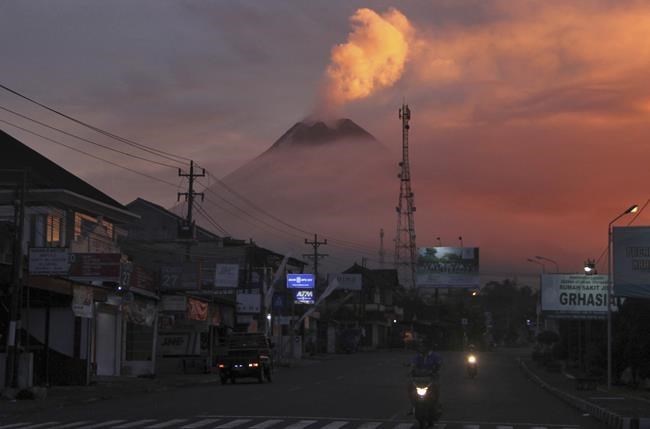
Pyroclastic flow is a volcanic phenomenon includes turbulent and hot avalanches of hot lava rocks, ash and volcanic gasses mixed together.
She described the volcano’s lava dome as growing rapidly, causing hot lava and gas clouds to flow down its slopes. Parts of the lava dome were collapsing, sending rocks and ash flowing down the southwest flank of the volcano.
Ash covered several villages and nearby towns, she said.
Mount Merapi has seen increased volcanic activity in recent weeks and ash plumes extended about 1.8 kilometers (1.2 miles) to the southwest of the volcano before dawn, Humaida said.
Indonesia’s Volcanology and Geological Hazard Mitigation Center did not raise Merapi’s alert status, which already was at the second-highest of four levels since it began erupting last November.
Villagers living on Merapi’s fertile slopes are advised to stay 5 kilometers (3.1 miles) from the crater’s mouth and should be aware of the peril of lava, the agency said.
The volcano is on densely populated Java island near the ancient city of Yogyakarta. It is the most active of more than 120 active volcanoes in Indonesia and has repeatedly erupted with lava and gas clouds recently.
Merapi’s last major eruption in 2010 killed 347 people.
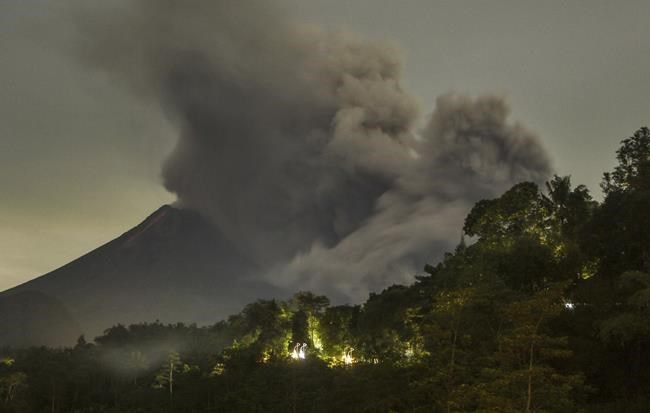

Indonesia, an archipelago of 270 million people, is prone to earthquakes and volcanic activity because it sits along the Pacific “Ring of Fire,” a horseshoe-shaped series of seismic fault lines around the ocean.
____
Associated Press writer Niniek Karmini in Jakarta, Indonesia, contributed to this report.
___
This version has corrected that the volcano’s alert status was at the second-highest, not third-highest, level.