Manitoba greenhouse gas emissions keep rising
Advertisement
Read this article for free:
or
Already have an account? Log in here »
To continue reading, please subscribe:

Digital Subscription
One year of digital access for only $205*
- Enjoy unlimited reading on winnipegfreepress.com
- Read the E-Edition, our digital replica newspaper
- Access News Break, our award-winning app
- Play interactive puzzles
*First annual payment billed as $205.00 + GST for one year. This annual subscription will automatically renew at $233.00 + GST every 52 weeks (10% off the regular annual price of $259.35). Offer available to new and qualified returning subscribers only. Cancel any time.
To continue reading, please subscribe:
Add Free Press access to your Brandon Sun subscription for only an additional
$1 for the first 4 weeks*
- Enjoy unlimited reading on winnipegfreepress.com
- Read the E-Edition, our digital replica newspaper
- Access News Break, our award-winning app
- Play interactive puzzles
*Your next Brandon Sun subscription payment will increase by $1.00 and you will be charged $17.95 plus GST for four weeks. After four weeks, your payment will increase to $24.95 plus GST every four weeks.
Read unlimited articles for free today:
or
Already have an account? Log in here »
Hey there, time traveller!
This article was published 27/04/2020 (2363 days ago), so information in it may no longer be current.
Manitoba is among several provinces lagging behind in efforts to reduce Canada’s greenhouse gas emissions, according to the newest data released in the federal government’s inventory report.
Canada emitted 729 megatonnes of carbon dioxide equivalent in 2018 — a 15-Mt increase from 2017, and a single megatonne decrease from the evaluation of emissions in 2005. 2018 is the latest data available due to the lag time in reporting.
Canada has promised to decrease its annual emissions by 30 per cent from 2005 levels by 2030, but the latest projections demonstrate the country will miss that mark. The federal analysis attributes emissions increases year-over-year from 2017 to higher fuel consumption for transportation, winter heating and oil and gas extraction.
Half of the country’s provinces and territories have moved in the right direction in lowering emissions, while the other half have increased emissions — in some instances, drastically.
Manitoba’s emissions have increased by 8.3 per cent since 2005, to 21.8 megatonnes in 2018 from 20.1 Mt of CO2 equivalent in 2005. It marks the third-most significant growth rate among provinces (fifth if the territories are also considered). Alberta experienced a growth rate in the same period of 14 per cent, while Saskatchewan’s emissions grew by 12 per cent.
Ontario had the most significant drop in emissions across the country since 2005, due in large part to the closure of coal-fired power plants. However emissions did rise by 10 Mt again year-over-year from 2017 to 2018.
While emissions increases in a province such as Alberta can largely be attributed to one industry (oil and gas extraction), the increases in Manitoba are more spread out across industries and sources.
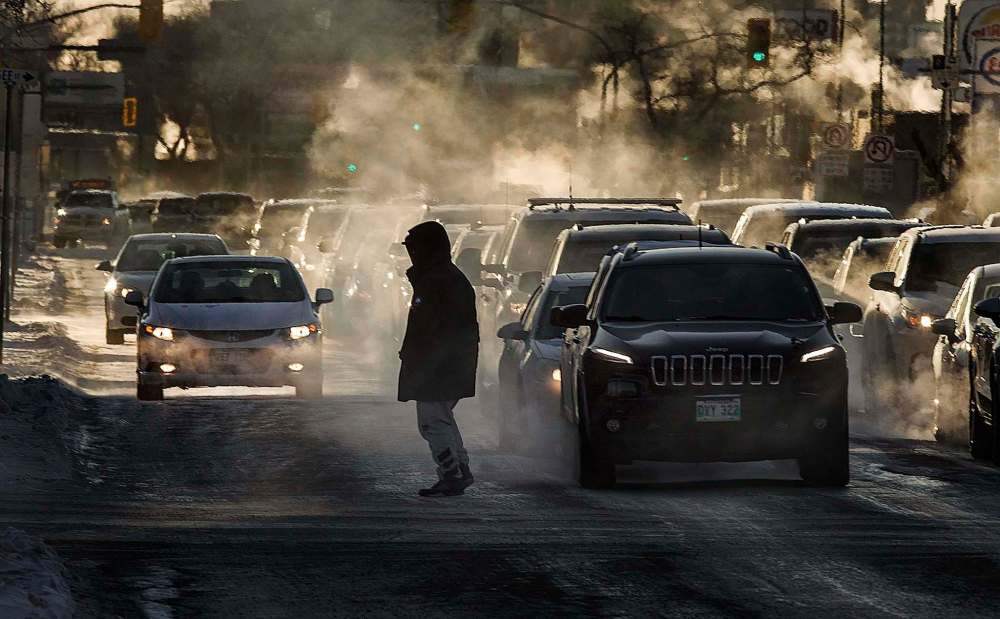
In Manitoba, ground transportation is one area that has recorded a significant increase. In 1990, 3.26 megatonnes were estimated to have been emitted by the province’s cars and trucks; by 2005, that had risen by 28 per cent.
Figures from 2018 show road transportation in Manitoba has risen by 84 per cent since 1990, and 44 per cent since 2005, accounting for roughly 27.6 per cent of the province’s total emissions in 2018.
In an email statement to the Free Press, Minister of Conservation and Climate Sarah Guillemard said the provincial government is committed to its goal of a one-megatonne decrease in emissions between 2018 and 2022 (a roughly four per cent decrease).
“Manitoba should be assessed on what is achieved by year 5, not by year 1,” she said. “To date, our actions demonstrate our commitment towards achieving that goal.”
Guillemard added new provincial initiatives were launched in 2019 and 2020, so the impact of those programs wouldn’t yet be seen.
Earlier this year, the province announced it would be implementing its own carbon tax, but the move was backtracked with the arrival of the COVID-19 pandemic and the subsequent economic impacts.
The recent greenhouse gas emission figures are disconcerting for climate advocates: not only is Manitoba and Canada not decreasing emissions fast enough, they’re even moving in the wrong direction still.

“Manitoba has reached a record high. We’ve got more emissions than we’ve ever seen before,” said Curt Hull, project director of Manitoba’s Climate Change Connection, an online resource centre.
Hull pointed to the findings of the Intergovernmental Panel on Climate Change — an international consortium of scientific experts — that has given the world just a matter of years to change its course and reduce emissions if catastrophic changes are to be avoided.
“We need to be on a trajectory that is dramatically different from what we’re on right now,” Hull said. “The trend line is up, not down. And we all need to very, very seriously look at reducing our emissions — and I mean that at the government level and the individual level.”
sarah.lawrynuik@freepress.mb.ca
Twitter: @SarahLawrynuik
History
Updated on Monday, April 27, 2020 9:58 PM CDT: Updates lede paragraphs.