Heat wave over Western Canada now linked to sudden deaths in Metro Vancouver: RCMP
Advertisement
Read this article for free:
or
Already have an account? Log in here »
To continue reading, please subscribe:

Digital Subscription
One year of digital access for only $205*
- Enjoy unlimited reading on winnipegfreepress.com
- Read the E-Edition, our digital replica newspaper
- Access News Break, our award-winning app
- Play interactive puzzles
*First annual payment billed as $205.00 + GST for one year. This annual subscription will automatically renew at $233.00 + GST every 52 weeks (10% off the regular annual price of $259.35). Offer available to new and qualified returning subscribers only. Cancel any time.
To continue reading, please subscribe:
Add Free Press access to your Brandon Sun subscription for only an additional
$1 for the first 4 weeks*
- Enjoy unlimited reading on winnipegfreepress.com
- Read the E-Edition, our digital replica newspaper
- Access News Break, our award-winning app
- Play interactive puzzles
*Your next Brandon Sun subscription payment will increase by $1.00 and you will be charged $17.95 plus GST for four weeks. After four weeks, your payment will increase to $24.95 plus GST every four weeks.
Read unlimited articles for free today:
or
Already have an account? Log in here »
Hey there, time traveller!
This article was published 29/06/2021 (1927 days ago), so information in it may no longer be current.
Police say a sweltering heat wave that has settled over Western Canada for several days is believed to be a contributing factor in dozens of sudden-death calls they have responded to in Metro Vancouver.
Cpl. Mike Kalanj of Burnaby RCMP said Tuesday the 25 sudden-death calls the detachment responded to relate to a single 24-hour period starting on Monday.
The deaths are still under investigation and many of the deceased were seniors, he said.
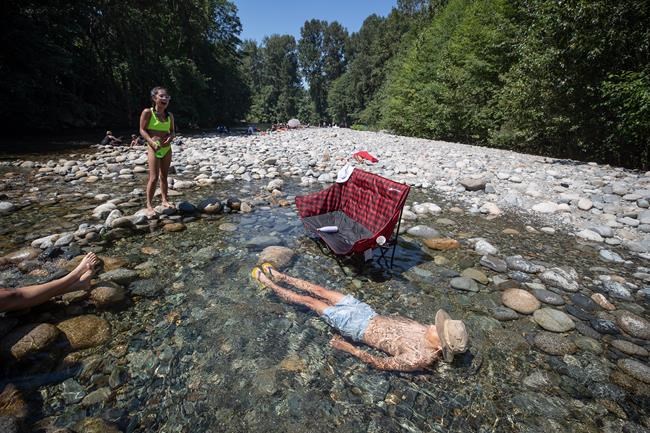
Temperatures in the Vancouver area reached just under 32 C Monday, but the humidity made it feel close to 40 C in areas that aren’t near water, Environment Canada said.
The record-breaking heat wave could ease over parts of British Columbia, Yukon and the Northwest Territories by Wednesday, but any reprieve for the Prairie provinces is further off.
In a news release, Kalanj urged residents to check on their neighbours and family members.
“We are seeing this weather can be deadly for vulnerable members of our community, especially the elderly and those with underlying health issues,” he said in the statement.
In Vancouver, the police department said it had redeployed dozens of officers and asked the public to only call 911 during emergencies because heat-related deaths had depleted front-line resources and delayed response times.
“Vancouver has never experienced heat like this, and sadly dozens of people are dying because of it,” Sgt. Steve Addison said in a news release. “Our officers are stretched thin, but we’re still doing everything we can to keep people safe.”
As of mid-afternoon on Tuesday, he said police had responded to more than 65 sudden deaths since the heat wave began on Friday.
“The vast majority of these cases are related to the heat,” Addison said, adding that on a typical day, Vancouver police respond to between three and four sudden-death calls.
British Columbia’s chief coroner, Lisa Lapointe, said her office would normally receive about 130 reports of death over a four-day period. At least 233 deaths were reported from Friday to 3 p.m. on Monday, she said.
“Coroners are carefully gathering all information available for each death reported, to determine the cause and manner of death, and whether excessive heat played a role,” she said in a statement.
“Environmental heat exposure can lead to severe or fatal results, particularly in older people, infants and young children and those with chronic illnesses.”
Ingrid Jarrett, CEO of the B.C. Hotel Association, said residents in parts of the Lower Mainland, Victoria and the Okanagan region have been booking air-conditioned rooms so they can continue working and also get some sleep.
A lack of staff is the biggest challenge for hotels, motels and resorts, she said.
“So many hotels have to limit their occupancy and reservations that they can take because they simply don’t have enough people working in order to clean the rooms,” said Jarrett, who did not yet have the latest occupancy numbers for this week.
Environment Canada said the “historic” weather system shattered 103 heat records across B.C., Alberta, Yukon and N.W.T. on Monday.
Those records include a new Canadian high temperature of 47.9 C set in Lytton, B.C., smashing the previous record of 46.6 set in the same village a day earlier.
Temperature records were also set in the Alberta communities of Jasper, Grande Prairie and Hendrickson Creek for a second day as the mercury hit the mid- to high-30s.
It was 38.1 C in the Nahanni Butte region of N.W.T.
The weather office has also issued four heat warnings for regions along Manitoba’s western boundary.

Forecasters warn extreme conditions will persist across the Prairies at least through this week and possibly into next.
As the sweltering system slides out of B.C., temperatures are expected to dip to more seasonal levels. The weather office is calling for a chance of lightning Wednesday night in the parched southern Interior. It’s the same area where evacuation alerts were issued Monday because of a wildfire.
The BC Wildfire Service announced a provincewide campfire ban effective at noon Wednesday, as the fire risk across most of B.C. is rated at high to extreme. The ban, which also covers fireworks, torches and burn barrels, remains in effect until Oct. 15.
This report by The Canadian Press was first published June 29, 2021.
Note to readers: This is a corrected story. A previous version said the Nahanni Butte region set a temperature record for the Northwest Territories.
Related Articles
'Fair amount of uncertainty' in Prairies' future: report
Advertisement Advertise With Us
Advertisement Advertise With Us