Growing concerns answered
Retailers embracing sustainability, supporting local ecosystems and pollinators

Advertisement
Read this article for free:
or
Already have an account? Log in here »
To continue reading, please subscribe:

Digital Subscription
One year of digital access for only $205*
- Enjoy unlimited reading on winnipegfreepress.com
- Read the E-Edition, our digital replica newspaper
- Access News Break, our award-winning app
- Play interactive puzzles
*First annual payment billed as $205.00 + GST for one year. This annual subscription will automatically renew at $233.00 + GST every 52 weeks (10% off the regular annual price of $259.35). Offer available to new and qualified returning subscribers only. Cancel any time.
To continue reading, please subscribe:
Add Free Press access to your Brandon Sun subscription for only an additional
$1 for the first 4 weeks*
- Enjoy unlimited reading on winnipegfreepress.com
- Read the E-Edition, our digital replica newspaper
- Access News Break, our award-winning app
- Play interactive puzzles
*Your next Brandon Sun subscription payment will increase by $1.00 and you will be charged $17.95 plus GST for four weeks. After four weeks, your payment will increase to $24.95 plus GST every four weeks.
Read unlimited articles for free today:
or
Already have an account? Log in here »
Hey there, time traveller!
This article was published 15/05/2021 (1967 days ago), so information in it may no longer be current.
There are several different ways mass retailers are embracing sustainability both in their greenhouse practices and the types of plants they choose to sell.
Let’s check in first with The Home Depot Canada. Recently I talked to Mark Beaty, the companies senior live goods merchant. All herbs and vegetable plants and seeds available at Home Depot here in Canada are GMO free. Certified organic edible plants are grown in biodegradable, compostable pots to reduce waste. “We partnered with Burpee Seed Company for our in-store potted herbs and veggies because we share their sustainability perspective,” said Beaty. Burpee, a household name for gardeners, has delivered non-GMO varieties in home gardening for more than 140 years.
Beaty also says neonicotinoid pesticides are not applied in their greenhouses to any plants that are sold at Home Depot stores in Canada. “Our Canadian growers have not used neonics for many years. We are working as a full team to continue on that path,” he said.
In addition to moving to certified organic herbs and veggies from Burpee, the edible plants available at Home Depot are grown in biodegradable peat pots that can be composted after use. Home Depot is also exploring other options such as fibre pots. There are non-edible plants that are still sold in plastic pots but these can be returned to Home Depot which cleans and recycles the plastic pots.
Since 2014, Home Depot has maintained a partnership with Canadian Wildlife Federation (CWF) to offer pollinator-friendly plants at its retail stores. A portion of the sales go to CWF to fund programs that help pollinators and other Canadian species. Initially, the program offered only eight or nine different plant varieties. This has now expanded to include many more annual and perennial varieties. “We’ve moved into pollinator-friendly trees and shrubs as well,” said Beaty.
In addition, Home Depot has launched a new brand, Nature’s Nutrients, which is a line of 75 to 100 pollinator-friendly annuals and perennials, including native plants. “We will continue to add in plant varieties that are great for all different types of pollinators and really focus on plants that support local environments,” said Beaty.
Home Depot partners with 32 Canadian growers to supply plants to its stores nationwide. In Manitoba, Home Depot partners with Searle Greenhouses in East Selkirk. Beaty says the plant varieties selected to grow in Winnipeg’s climate will arrive at Home Depot stores by the end of May to early June. The list includes four-packs of perennial plants that attract bees, butterflies, and hummingbirds. Varieties include Achillea, Gaillardia, Lupin, Monarda, Coreopsis, Liatris, Salvia, Echinacea, Rudbeckia, and Bellis Bellissima (English Daisy). Home Depot’s Nature Nutrients program includes numerous annuals from African Marigolds and Bee’s Knees Petunia to Zinnia varieties as well as a diverse mix of cold-hardy perennials. As I scoured the list provided by Beaty, a new introduction for 2021 caught my eye: Delphinium Delgenius Breezin, a dwarf delphinium with dark purple spires of double flowers.
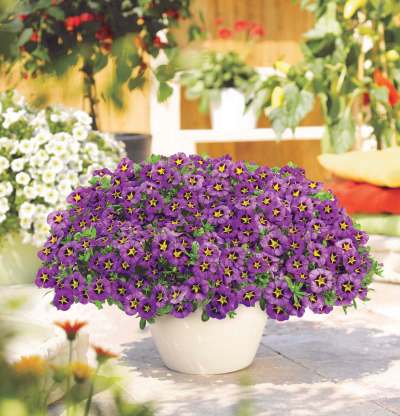
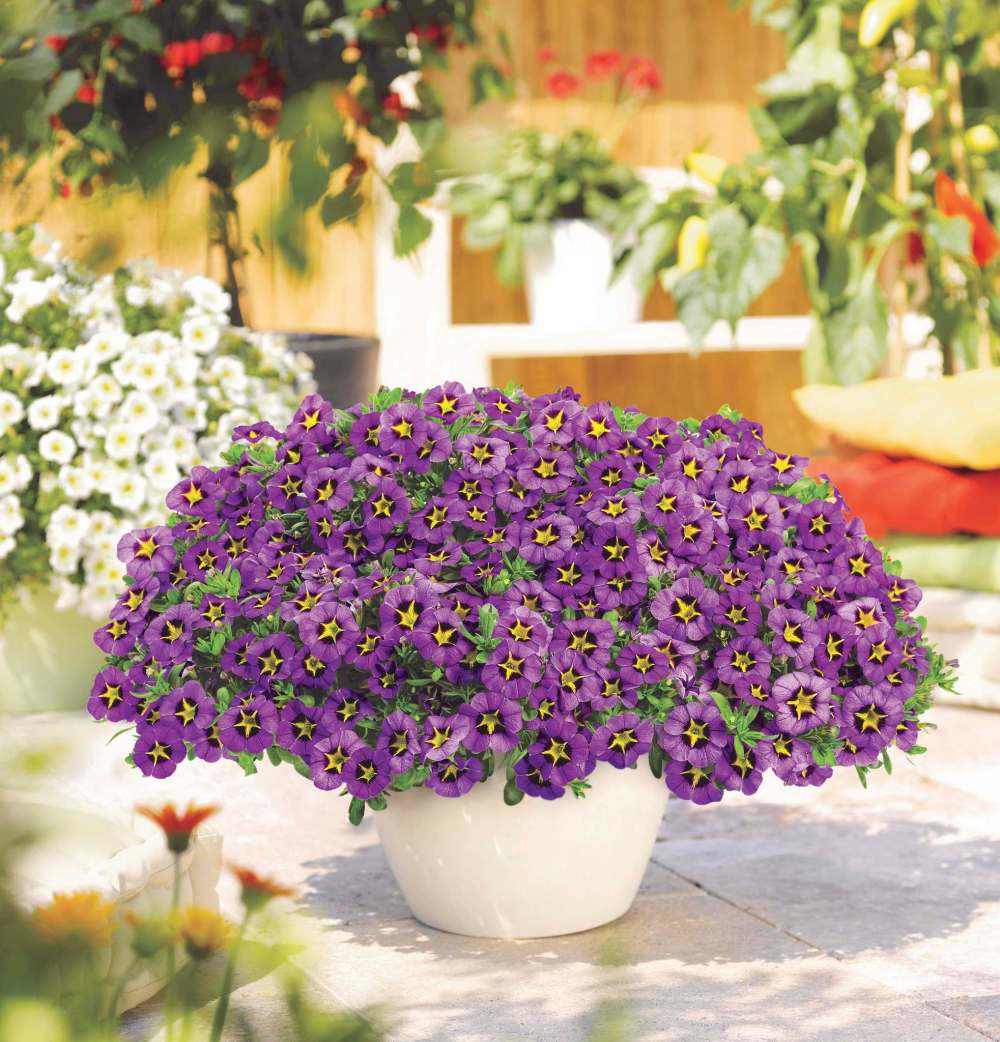
The Home Depot Canada’s 2021 Vegetable of the Year — its first-ever — is the Burpee Mocha Swirl Sweet Pepper, a green and white striped sweet pepper that ripens to a deep brown. The 2021 Plant of the Year is Sunny Daze Calibrachoa (aka Million Bells) with purple flowers that have a yellow star in the centre of each bloom.
It’s also an interesting story at Loblaw Companies Limited which owns Real Canadian Superstore, and one where Manitobans might want to get involved in advocating on behalf of our native plant nurseries. Last year, in partnership with World Wildlife Fund Canada, Loblaw worked with growers who specialize in growing native plants and became the first major retailer to sell Ontario native plants grown from source-identified and ethically collected seeds. Native perennials were made available in 35 of its stores across Southern Ontario. This May, the program will expand to 143 garden centres across Ontario and Quebec. The program includes 42 different native plant species, however, each store receives native plant varieties that are local to their specific area in order to support local ecosystems.
I contacted Loblaw’s to inquire as to whether the program would be expanding to Manitoba in the future. Manitoba, after all, is home to two flourishing native plant nurseries, Prairie Flora and Prairie Originals. A spokesperson at Loblaw’s Public Relations replied: “At this time, we don’t plan on extending the native plants program to Manitoba in 2022.” Perhaps that will change in the future as Loblaw’s also stated that, through its partner WWF-Canada, it is exploring additional markets for expansion. Loblaw’s Corporate Social Responsibility report for 2020 states that none of the live plants in its garden centres are treated with neonicotinoids.
In April, Walmart announced a new pollinator health policy for its stores in the U.S. to improve and expand pollinator habitats while minimizing the use of pesticides that can harm pollinators. Walmart is encouraging live-plant suppliers to label pollinator-friendly plants (plants grown without neonicotinoids and other insecticides that are toxic to bees) for sale in their retail stores in the U.S.

There are also plans to avoid selling invasive plant species which have the potential to disrupt the structure and function of ecosystems.
I contacted Walmart Canada to find out if the new pollinator commitments by Walmart U.S. will also extend to Walmart stores in Canada. “At Walmart Canada, we continue to take action to help protect our planet, including helping bees,” said Felicia Fefer, manager, corporate affairs, Walmart Canada. “This includes selling pollinator-friendly plants in our garden centres from coast-to-coast. These plants have plant tags that say ‘attracts bees’, making it very easy for customers to identify these plants.”
In late March, Health Canada decided against a complete ban on neonicotinoid pesticides. This announcement was met with disappointment by environmental groups. However, Pierre Petelle, president and CEO, CropLife Canada, said in a recent phone conversation that there are more than 350 scientists at Health Canada whose only job is to review pesticides, and that Canadians should feel confident in their determinations. In Canada, he says, there has been a 42 per cent increase in bee colonies from the early 2000’s to 2020. “In Manitoba, we went from 80,000 bee colonies in the early 2000s to over 114,000 in 2020,” said Petelle.
There are increasing pressures around the use of chemical pesticides in horticulture as pests develop resistance. Research at Vineland Research & Innovation Centre in Ontario promotes and supports the use of biological control strategies in high-value horticultural crops. Vineland’s program works in conjunction with integrated pest management (IPM) solutions. Rose Buitenhuis is a research scientist in biological control at Vineland. Buitenhuis says a survey in 2017 showed nearly 100 per cent of greenhouse vegetable growers and 94 per cent of greenhouse ornamental growers were using biological controls instead of spraying plants with chemicals. Another survey will take place in 2021. “There is still some intervention with chemical pesticides,” says Buitenhuis, “but the majority of growers are using beneficial biological controls as the first line of defence.”
colleenizacharias@gmail.com
Colleen Zacharias
Gardening columnist
Colleen Zacharias writes about many aspects of gardening including trends, plant recommendations, and how-to information that is uniquely relevant to Prairie gardeners. She has written a column for the Free Press since 2010 and pens the monthly newsletter Winnipeg Gardener. Read more about Colleen.
Every piece of reporting Colleen produces is reviewed by an editing team before it is posted online or published in print — part of the Free Press‘s tradition, since 1872, of producing reliable independent journalism. Read more about Free Press’s history and mandate, and learn how our newsroom operates.
Our newsroom depends on a growing audience of readers to power our journalism. If you are not a paid reader, please consider becoming a subscriber.
Our newsroom depends on its audience of readers to power our journalism. Thank you for your support.
Colleen Zacharias
Gardening columnist
Colleen Zacharias writes about many aspects of gardening including trends, plant recommendations, and how-to information that is uniquely relevant to Prairie gardeners. She has written a column for the Free Press since 2010 and pens the monthly newsletter Winnipeg Gardener. Read more about Colleen.
Every piece of reporting Colleen produces is reviewed by an editing team before it is posted online or published in print — part of the Free Press‘s tradition, since 1872, of producing reliable independent journalism. Read more about Free Press’s history and mandate, and learn how our newsroom operates.
Our newsroom depends on a growing audience of readers to power our journalism. If you are not a paid reader, please consider becoming a subscriber.
Our newsroom depends on its audience of readers to power our journalism. Thank you for your support.
Advertisement Advertise With Us
Advertisement Advertise With Us