Happy, smiling faces will get your goat
People with a positive demeanour get more attention from farm critter: study
Advertisement
Read this article for free:
or
Already have an account? Log in here »
To continue reading, please subscribe:

Digital Subscription
One year of digital access for only $205*
- Enjoy unlimited reading on winnipegfreepress.com
- Read the E-Edition, our digital replica newspaper
- Access News Break, our award-winning app
- Play interactive puzzles
*First annual payment billed as $205.00 + GST for one year. This annual subscription will automatically renew at $233.00 + GST every 52 weeks (10% off the regular annual price of $259.35). Offer available to new and qualified returning subscribers only. Cancel any time.
To continue reading, please subscribe:
Add Free Press access to your Brandon Sun subscription for only an additional
$1 for the first 4 weeks*
- Enjoy unlimited reading on winnipegfreepress.com
- Read the E-Edition, our digital replica newspaper
- Access News Break, our award-winning app
- Play interactive puzzles
*Your next Brandon Sun subscription payment will increase by $1.00 and you will be charged $17.95 plus GST for four weeks. After four weeks, your payment will increase to $24.95 plus GST every four weeks.
Read unlimited articles for free today:
or
Already have an account? Log in here »
Hey there, time traveller!
This article was published 01/09/2018 (2876 days ago), so information in it may no longer be current.
Before we get to today’s topic, which is the hidden power of the smile, we need to spend a few minutes discussing the growing threat seagulls pose to public safety.
If you do not believe seagulls constitute a legitimate safety hazard, I can only assume you did not read Wednesday’s column wherein I described a shocking incident during my recent vacation in Vancouver when a brazen seagull swooped out of the blue and ripped a large slice of pizza out of the hands of an innocent young woman standing beside me on the wharf at Granville Island.
I know what you are thinking. You are thinking: “Excuse me, Doug, but I do not think it is fair to tarnish the reputation of all law-abiding seagulls based on the actions of a few bad apples.”
Well, that is exactly what I thought — until I was flooded by emails (there were two, so it was more of a minor deluge) proving that the incident I witnessed was merely the tip of a huge iceberg, which, when flipped over, revealed a large number of aggressive seagulls helping themselves to greasy snacks.
I started to become concerned about this issue when I read an email from reader Barb Woodrow, who described how she and her husband had stopped at a picnic area near Pebble Beach in California to enjoy some tasty baked goods they had purchased earlier in the day.
“We were standing next to a picnic table enjoying some very delicious butter tarts,” Barb wrote. “I had eaten ¾ of mine and was about to take another bite when suddenly the remaining piece was gone out of my hand. I couldn’t believe it — I stared at my empty hand and then at the huge seagull that was departing with ¼ of my butter tart in its beak.
“I was angry and in shock, grieving for my lost butter tart, but also most amazed at how this large bird could steal it out of my hand without me feeling a thing. It still amazes me to this day!”
Just as I was working myself into a blind rage over the loss of Barb’s butter tart, I received an equally shocking email from reader Anita Peter, who recounted not one, but two terrifying encounters with galling gulls.
In incident No. 1, Anita and her fiancé were sitting on the pier at Fisherman’s Wharf in San Francisco with their backs to the water. “I held up the biggest, juiciest shrimp and asked if he wanted it,” Anita wrote.
“Out of the blue, a master thief swooped between us and grabbed the shrimp, leaving me holding nothing but the tail and breading. We were so startled I don’t know how I managed not to fall into the bay.”
In the second incident, the couple were attempting to enjoy a picnic lunch of smoked salmon on the beach in Tofino, B.C., but decided to take a stroll before feasting. When they returned, they discovered a winged invader had broken into their backpack.
“There was another big gull, wrestling my beautiful smoked salmon out of the package, and some of his friends gathered around at a bit of a distance squawking at him, wanting in on the action. So much for our picnic! Someone really needs to warn the tourists, so I’m glad you’re taking up the cause.”
Well, thank you, Anita. As a crusading newspaper columnist with naturally curly hair and steely blue eyes, I feel it is my public duty to warn innocent readers of the burgeoning threat posed to their snacks by badly behaved seabirds.
I am also calling on every government official within the sound of my voice to immediately implement plans to erect a Donald Trump-style wall — possibly a huge safety net — at the B.C. border to protect Prairie dwellers from having slices of pizza, butter tarts, shrimp and other tasty items ripped from their grasp by the claws of wayward gulls.
Which somehow brings us to today’s topic, which, if I recall correctly from the first paragraph, has something to do with the hidden power of the smile.
You most likely already know that science has shown people who smile have a higher level of emotional and physical well-being. In one study, researchers examined photographs of Major League Baseball players who were active in 1952, and sorted them based on whether the player was smiling or not smiling.
“Overall, players with genuine smiles in their photos tended to live longer than non-smilers,” according to the website socialpsychonline.com. “When you look year by year, the smiling players were about half as likely as non-smilers to die in any given year.”
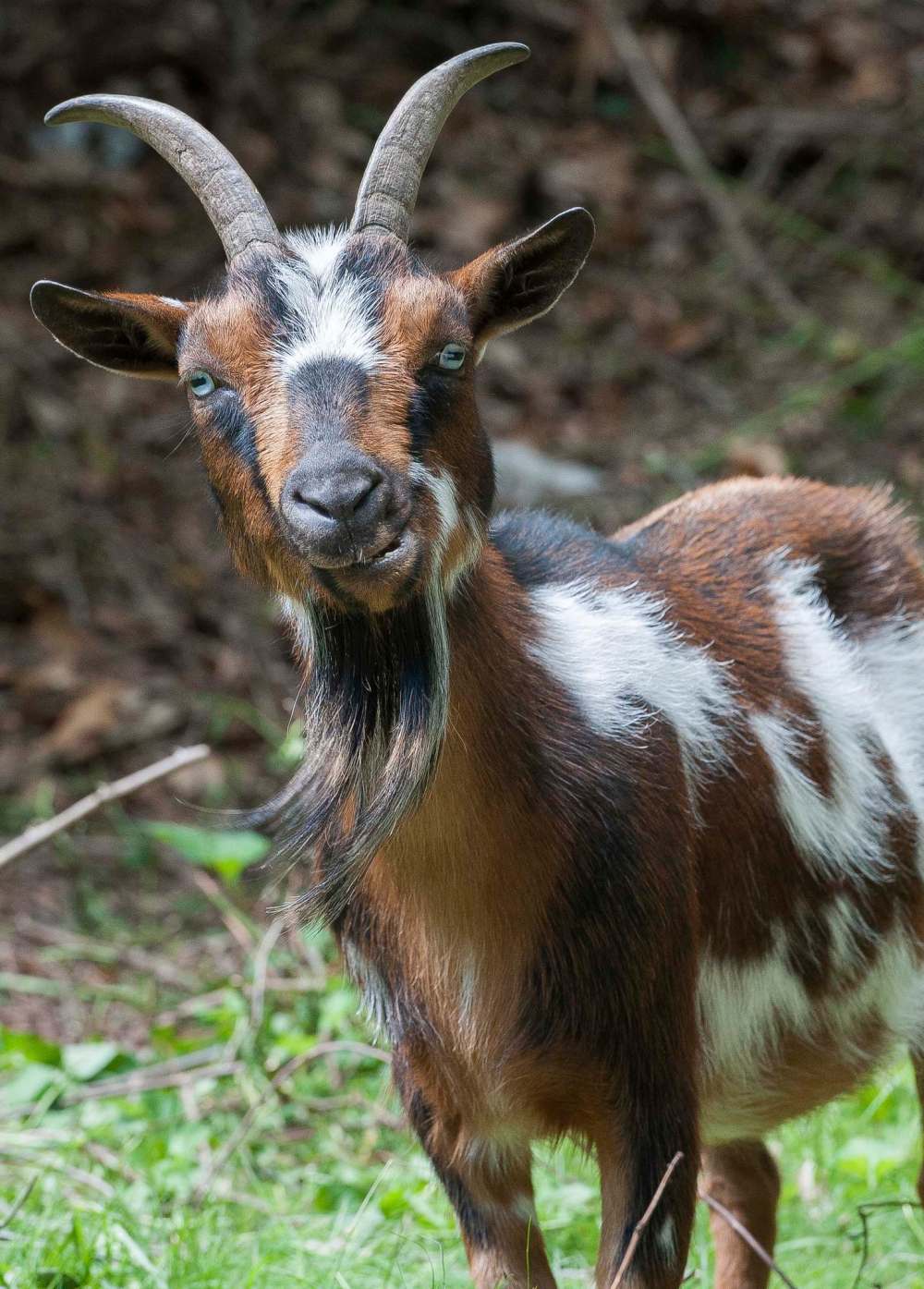
But the importance of smiling was driven home this week by a brand-new study, published in the journal Royal Society Open Science, that provides the first scientific evidence of goats reading human emotional expressions.
“Excuse me, did you say goats?” I can hear you asking.
Yes, in fact, I did.
According to a herd of news reports, the study, carried out at the Buttercups Sanctuary for Goats in Kent, England, revealed that goats are attracted to snapshots of happy human faces.
A BBC story stated the researchers showed goats pairs of photos of the same person, one of them featuring an angry expression, and the other a happy demeanour — and the goats made a beeline for the happy faces.
“Goats looked and interacted on average 1.4 seconds with the happy faces and 0.9 seconds with the angry faces,” study co-author Christian Nawroth of the Queen Mary University of London told the Sunday Times.

“That means that goats spend approximately 50 per cent more time to look and interact with happy images compared to angry ones.”
Whew! Is that a major scientific breakthrough, or what? Yes, it is. It goes to show that if you smile, you will not only live longer, but chances are you will be surrounded by goats.
As the old saying goes: “Smile and the world smiles with you, cry and you will never get your goat.”
Science aside, however, I have to say I don’t understand how anyone can sit around smiling when we have this (bad word) seagull issue hanging over our heads.
doug.speirs@freepress.mb.ca