WEATHER ALERT

Hawking was close to hitting his mark

Advertisement

Advertise with us

Stephen Hawking’s final paper was published last week. Like his last book, The Grand Design, it is about how the universe began.

Read this article for free:

or

Already have an account? Log in here »

To continue reading, please subscribe:

Subscribe and receive a limited-edition Free Press branded hat or tote.

Digital Subscription

One year of digital access for only $205*

  • Enjoy unlimited reading on winnipegfreepress.com
  • Read the E-Edition, our digital replica newspaper
  • Access News Break, our award-winning app
  • Play interactive puzzles

*First annual payment billed as $205.00 + GST for one year. This annual subscription will automatically renew at $233.00 + GST every 52 weeks (10% off the regular annual price of $259.35). Offer available to new and qualified returning subscribers only. Cancel any time.

To continue reading, please subscribe:

Add Free Press access to your Brandon Sun subscription for only an additional

$1 for the first 4 weeks*

  • Enjoy unlimited reading on winnipegfreepress.com
  • Read the E-Edition, our digital replica newspaper
  • Access News Break, our award-winning app
  • Play interactive puzzles
Start now

*Your next Brandon Sun subscription payment will increase by $1.00 and you will be charged $17.95 plus GST for four weeks. After four weeks, your payment will increase to $24.95 plus GST every four weeks.

Hey there, time traveller!
This article was published 12/05/2018 (2984 days ago), so information in it may no longer be current.

Stephen Hawking’s final paper was published last week. Like his last book, The Grand Design, it is about how the universe began.

In 1979, he became the 17th Lucasian professor of mathematics at Cambridge University. His modest aim was to understand the universe — the whole thing — from beginning to end. He missed his mark by a tiny fraction. But for a gap in his education, he might have made it.

More than 300 years before him, Isaac Newton was the second Lucasian professor. While more widely known for gravity, he devised calculus, which soon became the main math language of physics.
Francine Orr / Los Angeles Times Files
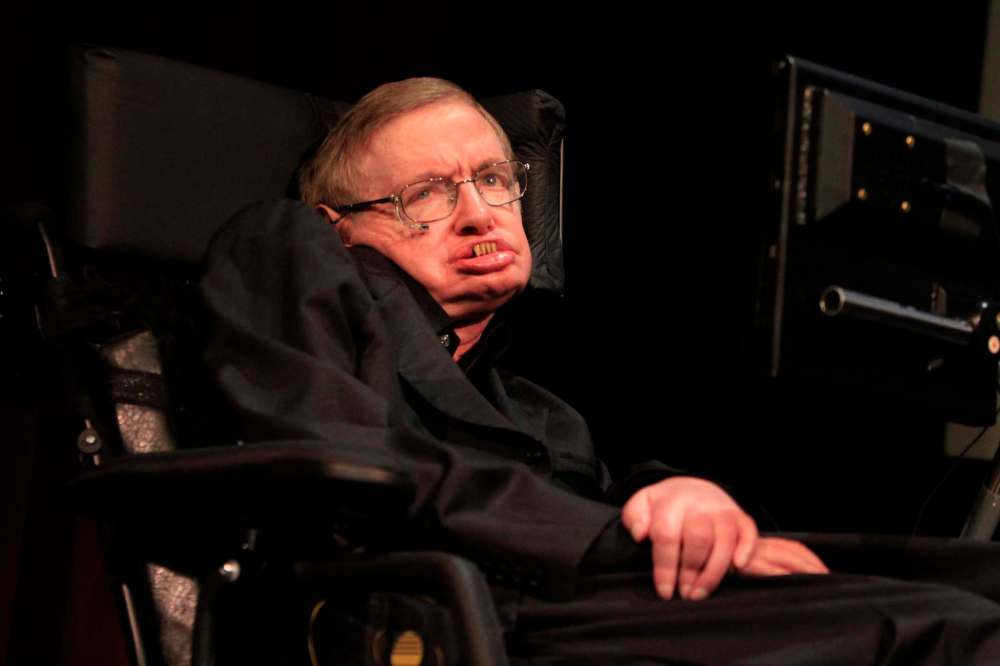
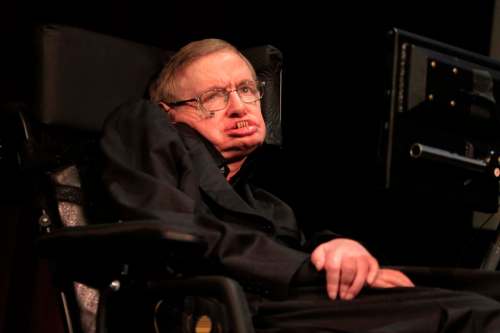
Renowned physicist Stephen Hawking asked why the universe even bothered to exist.
Francine Orr / Los Angeles Times Files Renowned physicist Stephen Hawking asked why the universe even bothered to exist.

With Newton’s math, Hawking showed the universe had a beginning. Yet, his best efforts fell short of understanding it. We will see it was Newton’s math — the wrong math for the job — that did him in.

Hawking might well have succeeded. Despite (or maybe in part because of) his disability, he brought unusual aptitudes in aid of his great task.

He set his sights on it openly. He asked, “Why does the universe go to all the bother of existing?”

Like Albert Einstein, he worked outside his silo. With physics deeply divided into relativity (the world of big) and quantum theory (the world of small), he worked both together. He also ventured boldly into thermodynamics (the world as many) and cosmology (the world as one).

Like both Newton and Einstein, he was at least as much philosopher as physicist. He sought not only theory, but understanding. “I would rather be right than rigorous,” he once said.

Rarest of all, as a physicist, he embraced that threshold philosophy calls the ultimate cause. In his inaugural Lucasian lecture, he said, “I think that the initial conditions of the universe are as suitable a subject for scientific study and theory as are the local laws.”

In each of these attributes, he was extraordinary. In combining them, he was unique.

His accomplishments were unique, too. With fellow physicist and mathematician Roger Penrose, Hawking revolutionized the study of black holes — until then, more science fiction than science — showing they are an inevitable consequence of general relativity.

Then, having established them as infinitely dense objects from which not even light can escape, Hawking showed black holes must emit radiation as an inevitable consequence of quantum theory.

He did more to educate us all about the wonder and value of physics than all his Lucasian predecessors. His first book, A Brief History of Time — long since the all-time sales record holder — is back on current bestseller lists.

How could we think he could have done much more? The fact is he could have, with potentially huge economic benefits. His greatest disability was imposed on him: his Cambridge physics education stole the secret sauce he would sorely need. Physics taught him to think — like Newton did — in terms of space that is continuous.

A hundred years before Hawking was taught to think this way, Bernhard Riemann showed it was not the only way; rather, it was a choice. Building on Newton’s work, he devised the rules Hawking would later use for doing geometry in space.

Riemann said there are two kinds of spaces. One is continuous; one can — as calculus does — divide a length into infinitesimally small pieces. The other he called “granular,” meaning it is made of tiny finite pieces. He gave fundamental reasons why the latter may be better. But, he said, physics should choose to use whichever kind of space experience reveals to be real.

In 1901, Max Planck showed — while doing work that earned a Nobel Prize — how atoms provide evidence that space is granular. For a century, physics lamely tried to come to grips with the idea that nothing real is shorter than what is now called the Planck length. (Lamely, because physics mostly gave up on reality to concentrate on what could be done with calculus.)

In the end, like Einstein before him, Hawking could not break with calculus and continuous space.

His last thoughts on the beginning of the universe depict it as the product of unlikely mathematical abstractions applied to something he cavalierly called “nothing” and did not understand: space. Measurements by the Planck satellite estimate this “nothing” has more than seven tenths of the entire mass of the universe. To misquote Winston Churchill: Some nothing!

One of many lessons we can learn from the amazing life and work of Stephen Hawking is: let’s start teaching physics teachers how to teach realities of space. With a better basic education, Hawking surely could have done even more.

Colin Gillespie is a physicist and author of Time One: Discover How the Universe Began. He writes a blog Science Seen.
Report Error Submit a Tip

More Stories

Havin’ a heat wave — forever

Judy Waytiuk 5 minute read 2:00 AM CDT

When I acquired my seaside home years ago on Mexico’s Yucatan Gulf Coast, I learned instantly that the Yucatan routinely broils for most of the year with temperatures in the mid-40s; by mid-afternoon, the house interior soared to 35 C or so, in 90 per cent humidity, and stepping outside was like entering a blast furnace. The heat is punctuated periodically by wild thunderstorms that flood sand streets and turn roads into lakes for days.

Similar, in fact, to the summer we’ve had here so far this year.

I needed my air conditioning. But electricity in Mexico is devilishly costly, generated by burning diesel fuel, so I installed solar panels. My energy bills plummeted from around 6,000 pesos to 50 pesos — the Comisión Federal de Electricidad’s minuscule administration fee. I was no longer contributing to the world’s soaring carbon emissions and because I generated more energy than I used, and returned that power to the grid, CFE was burning a few less gallons of diesel. While lowering electricity bills, I was also doing the ‘right thing’, planet-wise.

Too little. Too late.

Banned drunk driver in crash charged with getting behind wheel again

Erik Pindera 3 minute read Preview

Banned drunk driver in crash charged with getting behind wheel again

Erik Pindera 3 minute read Saturday, Jul. 11, 2026

A Winnipeg man who served time for drunkenly slamming a minivan into an off-duty police officer riding a motorcycle in 2023 is accused of getting behind the wheel, despite court orders.

Braedon Lee Gordon, 25, is charged with one count of driving while prohibited for an incident on March 2. His next court date is later this month.

Dan Léveillé, a veteran Winnipeg Police Service constable who was left with life-altering injuries in the June 14, 2023, collision, said he was not surprised to learn of the new charge.

“This is just another one of those stories, where a habitual, repeat offender is charged for the same offence. After having served time, his behaviour continues,” said Léveillé.

Read
Saturday, Jul. 11, 2026

Stephen Hawking was close to hitting his mark

Colin Gillespie 5 minute read Preview

Stephen Hawking was close to hitting his mark

Colin Gillespie 5 minute read Saturday, May. 12, 2018

Stephen Hawking’s final paper was published last week. Like his last book, The Grand Design, it is about how the universe began.

In 1979, he became the 17th Lucasian professor of mathematics at Cambridge University. His modest aim was to understand the universe — the whole thing — from beginning to end. He missed his mark by a tiny fraction. But for a gap in his education, he might have made it.

More than 300 years before him, Isaac Newton was the second Lucasian professor. While more widely known for gravity, he devised calculus, which soon became the main math language of physics.

With Newton’s math, Hawking showed the universe had a beginning. Yet, his best efforts fell short of understanding it. We will see it was Newton’s math — the wrong math for the job — that did him in.

Read
Saturday, May. 12, 2018

Five ATV deaths renew mandatory safety course debate

Morgan Modjeski 4 minute read Preview

Five ATV deaths renew mandatory safety course debate

Morgan Modjeski 4 minute read Updated: Yesterday at 11:27 AM CDT

A high number of ATV fatalities in Manitoba has longtime riders wondering what measures can be taken to prevent deaths, including the possibility of mandatory safety courses.

So far this year, five riders have been killed in the province. The latest tragedy took place Thursday when a 59-year-old woman died in South Indian Lake, located about 770 kilometres north of Winnipeg. RCMP arrived to find her lying on the road, while her ATV was in the ditch.

Dave Lee, the president of the All-Terrain Vehicle Association of Manitoba, said one death is too many.

“Someone has lost their loved one,” he said. “It’s devastating for a family. The first question I always ask is: ‘Why did this happen?

Read
Updated: Yesterday at 11:27 AM CDT

First-aid volunteers treat folk fest attendees suffering from heat

Eva Wasney and Jill Wilson 4 minute read Preview

First-aid volunteers treat folk fest attendees suffering from heat

Eva Wasney and Jill Wilson 4 minute read Yesterday at 11:16 PM CDT

Shade was at a premium at Birds Hill Provincial Park over the weekend as Winnipeg Folk Festival goers tried to keep cool during an extreme heat wave.

Heat warnings were issued across southern Manitoba and temperatures peaked at 35 C Sunday afternoon.

First-aid volunteers were seen administering cold compresses to several overheated attendees. STARS air ambulance responded to a medical call at the park on Saturday night, but did not transport the patient to hospital. By Sunday at noon, EMS had been called to the festival nine times.

“This is not an unusual number of calls for us or other events of our size,” festival executive director Valerie Shantz said.

Read
Yesterday at 11:16 PM CDT

Carney plays well on the road

Editorial, July 13 4 minute read Preview

Carney plays well on the road

Editorial, July 13 4 minute read 2:01 AM CDT

Bankers are detail-oriented, pragmatic types. They seek to maximize assets incrementally, without taking big swings or big risks.

Bankers who run central banks — controlling the monetary policy of nations and states — must also think strategically and geopolitically, taking care of the details of national monetary policy, protecting assets and minimizing risk while also positioning and protecting their nations in a global economy fraught with financial and political pitfalls.

Given that Canadian Prime Minister Mark Carney has been head of both the Bank of Canada and the Bank of England, it should be no surprise that, since he entered the political realm and became prime minister in 2025, he has governed like a careful national banker — the sort who raises or lowers interest rates a quarter-point at a time while carefully plotting a course through choppy geopolitical seas.

Domestically, Carney’s economic policies have focused on realizing the value of Canada’s assets in a post-COVID, inflationary global economy disrupted by the trade chaos of U.S. President Donald Trump, the U.S. and Israel’s war on Iran and Russia’s continuing war with Ukraine.

Read
2:01 AM CDT